
Try to find out who invented Nova Scotia fish cakes and you will come back with nothing. No date, no town, no first recorded recipe, no family that claims it. This is a region that will happily argue about which village invented Finnan haddie. The absence is strange.
It is also the answer. Nobody invented the fish cake because there was nothing to invent. Salt cod needed soaking. Soaking left you with flaked fish, potatoes were the cheapest thing in the house, and frying was the fastest way to make it dinner. Versions of it turn up all over the world, and the ones that look most like ours got here by a route worth tracing. What is regional about ours is not the fish and not the potato.
It is what sits beside it on the plate.
Two kinds of fish cake, and they are not related
Before the local story, it is worth knowing that “fish cake” covers two completely separate inventions that happen to share a name in English.
The paste tradition
The older one grinds the fish. Japanese kamaboko, chikuwa and satsuma-age, Chinese and Taiwanese fish balls, Korean eomuk, Thai tod mun pla. White fish is pulverized into a paste with salt, shaped and then steamed, grilled or fried. There is no potato because none is needed: the paste sets into something springy on its own, and the point of the dish is that bounce rather than thrift.
It is old. Japan’s Ministry of Agriculture, Forestry and Fisheries dates the oldest surviving written record to a document called the Ruiju-zoyosho, describing dishes served at a ceremony on 21 July 1115.
And the ministry says something about its own national dish that is worth quoting for what it implies about ours. Because making kamaboko involves no complicated special process, they write, it was likely developed in a decentralized way in each region rather than invented in one place and spreading out from it.
A government agriculture ministry, writing about a food nine hundred years old, reaching the same conclusion: simple enough that everyone got there separately. The same page notes the parallels abroad, including cod fish cakes in northern Europe.
The preservation tradition
The other one flakes the fish, and it exists because of salt.
Portuguese pastéis de bacalhau, Spanish buñuelos de bacalao, Brazilian bolinhos, Caribbean saltfish cakes, Irish and British fishcakes, and ours. Every one of them is salt cod, reconstituted, flaked and bound with a starch. Not one of them is trying to make something springy. All of them are trying to turn a preserved ingredient back into dinner.
That is the family we belong to, and unlike the paste tradition, this one did not develop independently everywhere. It travelled, and it travelled on a specific trade route.
Ours came down a trade route, and it is not a comfortable one
The salt cod that made Portuguese fritters and the salt cod that made Nova Scotian fish cakes came from the same water.
Portuguese, Spanish, Basque, French and English fleets all fished the Grand Banks off Newfoundland from the sixteenth century onward, salting the catch aboard or ashore and carrying it back to Iberian and Mediterranean markets where Catholic fasting days guaranteed demand. Bacalhau is a Portuguese institution built on North Atlantic cod.
The Caribbean connection runs the same way and is harder reading. Lower-grade salt cod, the portion not good enough for European tables, was shipped south to feed enslaved people on sugar plantations, with sugar and rum moving north in return. Jamaican saltfish fritters and Nova Scotian fish cakes are cousins, and the family relationship is that trade.
We set out the whole arrangement in salt cod trade history. It is not a story that flatters anybody, and a dish that came out of it is more interesting for being placed honestly than for being called heritage and left there.
Salt cod first, and the reason for the potato
So much for where it came from. Here is why it works.
Salt cod is not convenient. It has to be soaked overnight, with the water changed several times, then simmered before it is fit to eat. What you get at the end is flaked fish, and a lot of it, because salt cod was sold in slabs rather than portions.
The potato is not a filler in the way people assume. It is a corrector. Salt cod, even well soaked, carries more salt than you want to eat straight. Mashed potato dilutes it and turns a preserved ingredient back into food. Onion adds moisture, egg binds, and the pan does the rest.
That is the whole dish, and it has stayed the whole dish for as long as anyone has bothered to write it down.
The plate is the regional marker
Ask what makes a fish cake Nova Scotian and the honest answer is not in the cake.
They come with baked beans. Not as a garnish. As half the plate, and frequently at breakfast. It is on menus from Cape Breton to the South Shore, and visitors find it completely baffling. The Saturday night bean supper is its own tradition here, and the fish cake attached itself to it.
And they come with green tomato chow. Chowchow, chow, a chunky green tomato relish that is sweet and sharp at once. It is the standard Acadian accompaniment, and it is the more important of the two. A fish cake is soft, starchy and rich. Chow is acid. It cuts the whole plate.
If you have only ever eaten a fish cake on its own, you have eaten it incompletely.
A third marker, quieter than the others: summer savoury. It is the herb Maritime kitchens reach for where another region would use thyme. It turns up in fish cake recipes across Nova Scotia and Newfoundland with a consistency that is hard to explain except as regional habit.
Why every recipe is vague
Look up five versions and you will get five different sets of quantities, and several will tell you to use whatever fish you have.
That is not sloppiness. It is a leftovers dish, and leftovers do not come in measured amounts. The proportions were whatever the house had. More potato in a thin year, more fish in a good one. Carrot turns up in some Acadian versions. Salt pork or bacon fat instead of oil, in others. Cornmeal instead of breadcrumbs on the outside.
A dish that survives on adaptability does not produce a canonical recipe. Asking for one slightly misses what it is.
What changed, and what did not
Here is the part worth being straight about.
Almost nobody makes fish cakes from salt cod any more, including us. Our Fish Cakes are made with Canadian wild-caught haddock, not salted and not dried. The preservation problem the dish was built around no longer exists. Freezing solved it. Nothing needs rescuing from a salt slab.
So what survives is the form rather than the reason. That is worth saying plainly instead of selling a heritage story that is no longer true of the food.
And the form turns out to be the good part. Flaked white fish, potato, onion, a crisp exterior and a soft middle is a genuinely excellent thing to eat, whether or not the fish spent six months in salt. The Scottish version made with smoked haddock is the same idea from a different direction, and we go into it in smoked haddock. The chowder tradition on this coast comes from the same root, covered in how to make seafood chowder.
Making them better, whichever fish you start from
Four things separate a good fish cake from a heavy one.
Dry potato. Boil them whole and unpeeled if you can be bothered, or at least drain them properly and let the steam off before mashing. Wet potato makes a cake that falls apart and tastes of nothing.
Flake, do not mince. You want to find pieces of fish. A paste is a different and worse dish.
Chill before frying. Twenty minutes in the fridge firms the mix. It is the difference between a cake that holds and one that spreads.
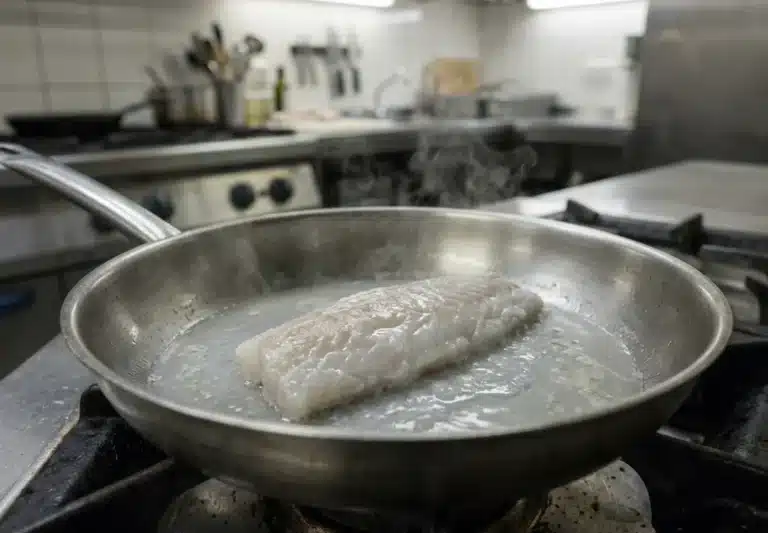
Do not crowd the pan, and leave them alone once they are down. They release when the crust forms. Same rule as every other piece of fish, covered properly in why fish sticks to the pan.
Nova Scotia fish cakes, in short
Nova Scotia fish cakes are what happened when a preserved ingredient met a cheap one and somebody had a pan. No inventor, no date, no canonical recipe. None of that is a gap in the record. It is what the dish is.
Serve them with beans and chow, and they stop being a patty of fish and potato and start being the thing people here actually mean.
Ours are Fish Cakes made with Canadian wild-caught haddock, ready for the pan, and the rest of the market is stocked on the same principle.