The dry vs wet scallops question has a four second answer, and almost nobody bothers with it.
Turn the bag over and read the ingredient list. If it says scallops, you are buying scallops. If it says anything else, you are buying scallops plus something added to make them heavier.
That is the whole of dry vs wet scallops as a shopping decision. The rest of this is why the test works, what the Canadian rules actually require, and what to do when there is no bag to turn over.
The short version of what a wet scallop is
Shucked scallops get soaked in a solution containing sodium tripolyphosphate, a phosphate salt that helps muscle tissue hold water. They swell. And they keep that water through freezing, storage and thawing, which is the point of doing it. The trade calls those wet, or soaked, or treated. Untreated ones are dry.
Neither term carries a legal definition anywhere. They are shop language that became consumer language.
We have written at length about what the practice does and why we refuse to sell the result, in why we only sell dry-packed scallops. This is the buying guide rather than the argument, so it assumes you already want the untreated ones and gets on with how to find them.
What Canadian rules actually require
Here is where the advice you will find first stops being reliable, because almost all of it is American.
Canada runs a permitted-list system for food additives. A manufacturer cannot use an additive in a food sold here until Health Canada approves that specific use. The default is no.
For phosphates used to hold water in seafood, Health Canada’s own notices enumerate which products the permission covers. A Health Canada notice describing these approvals lists frozen shrimp, frozen cooked shrimp, frozen clams, frozen crab, frozen fish fillets, frozen lobster, frozen minced fish and frozen squid.
Scallops are not on that list.
We are telling you what the list says rather than what it means. We have not confirmed with Health Canada or the CFIA whether that absence means phosphate-soaked scallops cannot legally be sold here, or whether some other provision covers them. A gap in an enumerated list is meaningful, and it is not the same thing as a ruling. If you want certainty, the CFIA is the place to ask, and we would rather say so than guess in either direction.
What it does mean practically is simple. Advice written for an American counter may not describe what sits in front of you at a Canadian one. Check anyway, because checking costs four seconds.
The label is the test
Canadian labelling rules are why the four second test works.
A prepackaged product must declare its food additives by an acceptable common name in the ingredient list. There is no exemption for seafood and no way to include an additive silently. A bag of dry scallops carries an ingredient list one word long.
Three things to know so you read it correctly.
The phosphate may not use its full name. The regulations let a producer declare a group of phosphates, sodium tripolyphosphate among them, collectively as sodium phosphate or sodium phosphates. Do not go hunting for the long chemical name. Any phosphate at all is your answer.
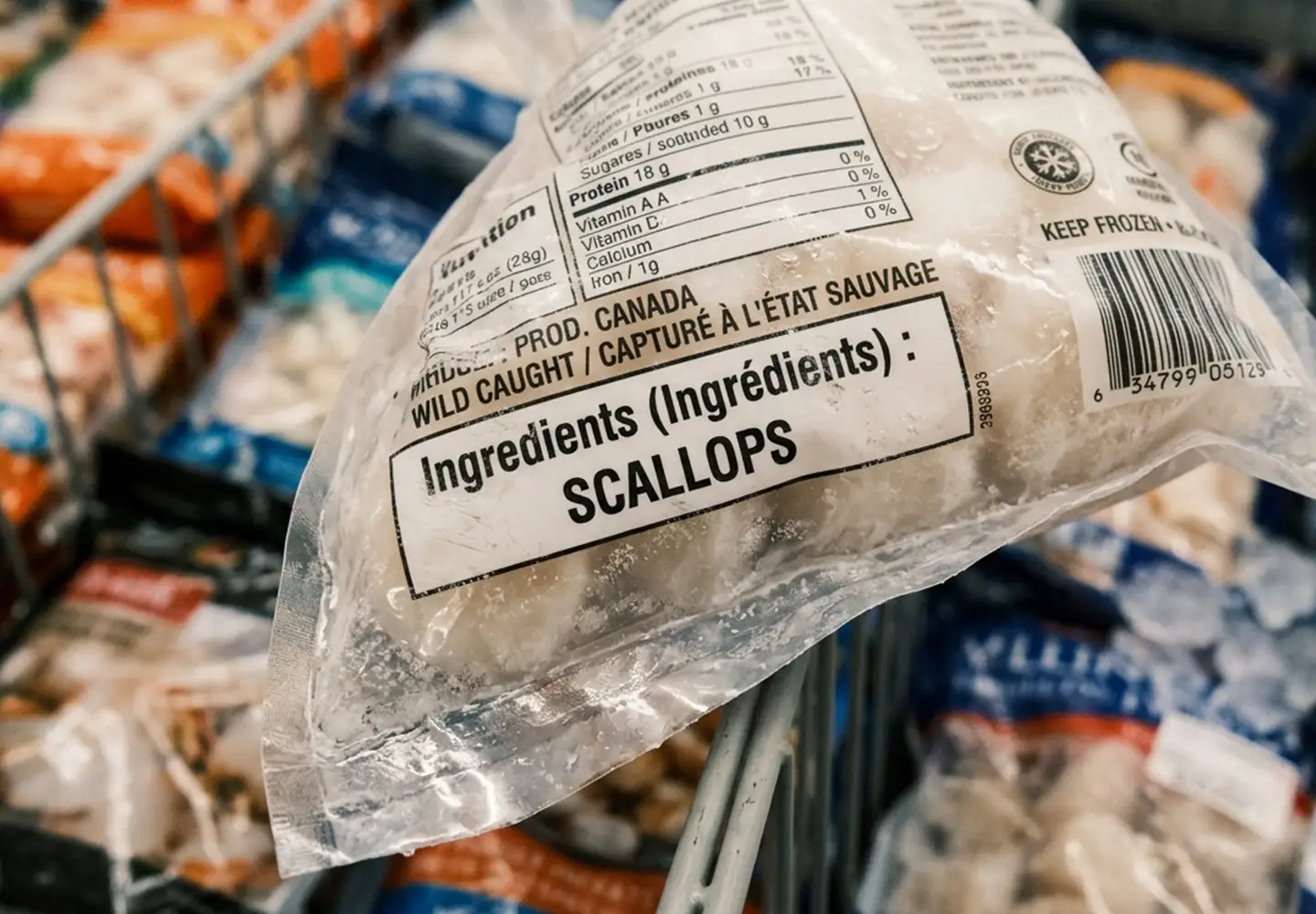
Water counts as an ingredient too. If water appears in the list of a product that should be nothing but shellfish, that tells you something on its own.
A helpful list is still a treated product. Some labels read “scallops, sodium tripolyphosphate (to retain moisture),” and the parenthetical is doing you a favour. Others just name the additive and leave you to it. Both are treated.
The habit transfers, which is the best argument for building it. Four seconds tells you whether a bag of shrimp has been treated, or a fillet, or a bag of frozen fish sticks. Prepackaged seafood is one of the easier categories to read once you know the list is where the answer lives.
When there is no label
At a counter, in a case, over ice, you have no ingredient list. Three checks, in order of how much to trust them.
Ask. The strongest test available without a package. Anyone selling dry scallops knows the answer immediately and enjoys the question, because stocking them costs more and almost nobody notices. Hesitation is information.
Worth knowing why the question lands so rarely. Neither term has a legal meaning, so nobody has to volunteer anything. And treated scallops carry real commercial advantages. They weigh more. They last longer. They look plumper and whiter in a case, which most shoppers read as fresher. The incentives all run one way, and the labelling requirement is the only thing running the other.
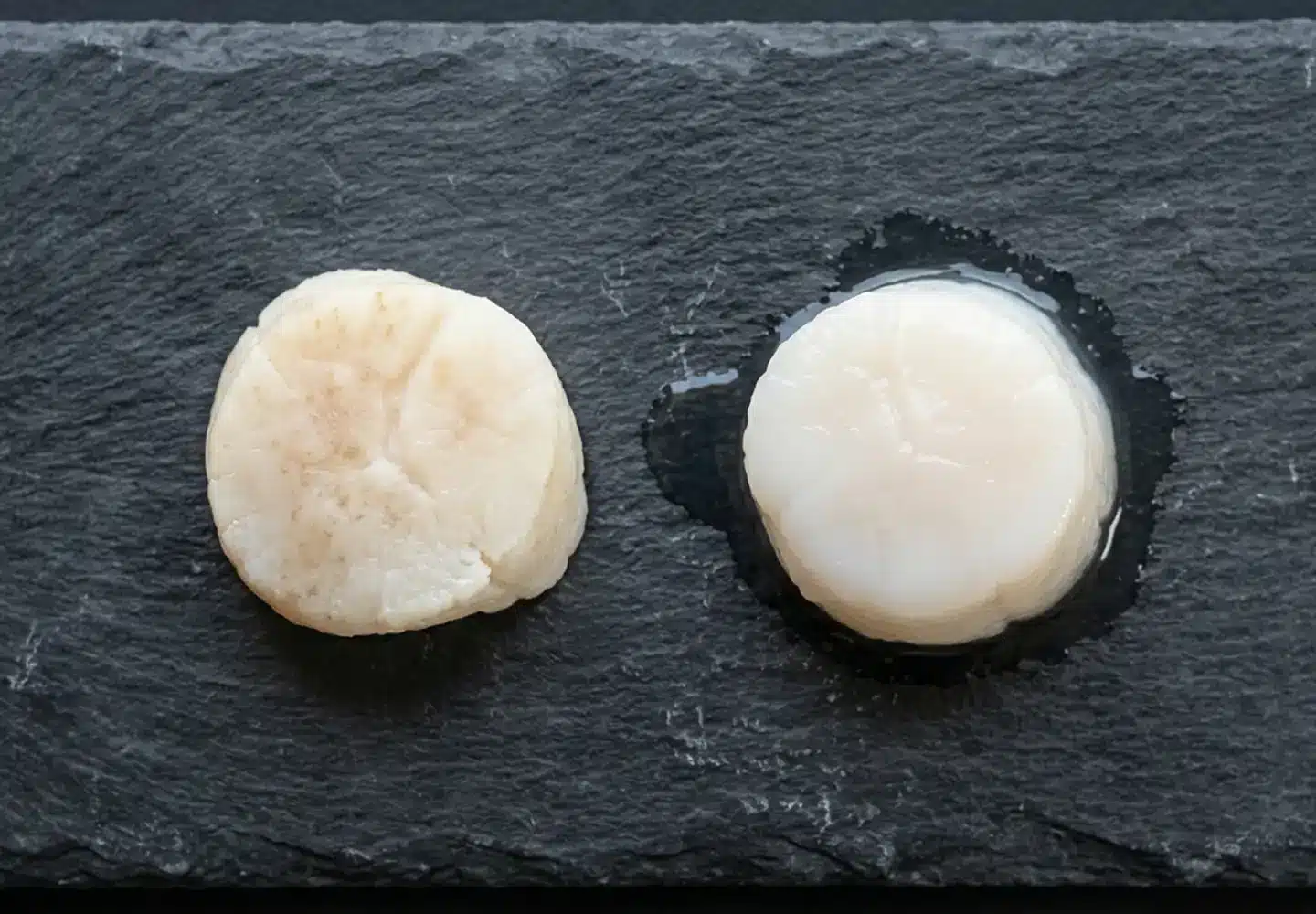
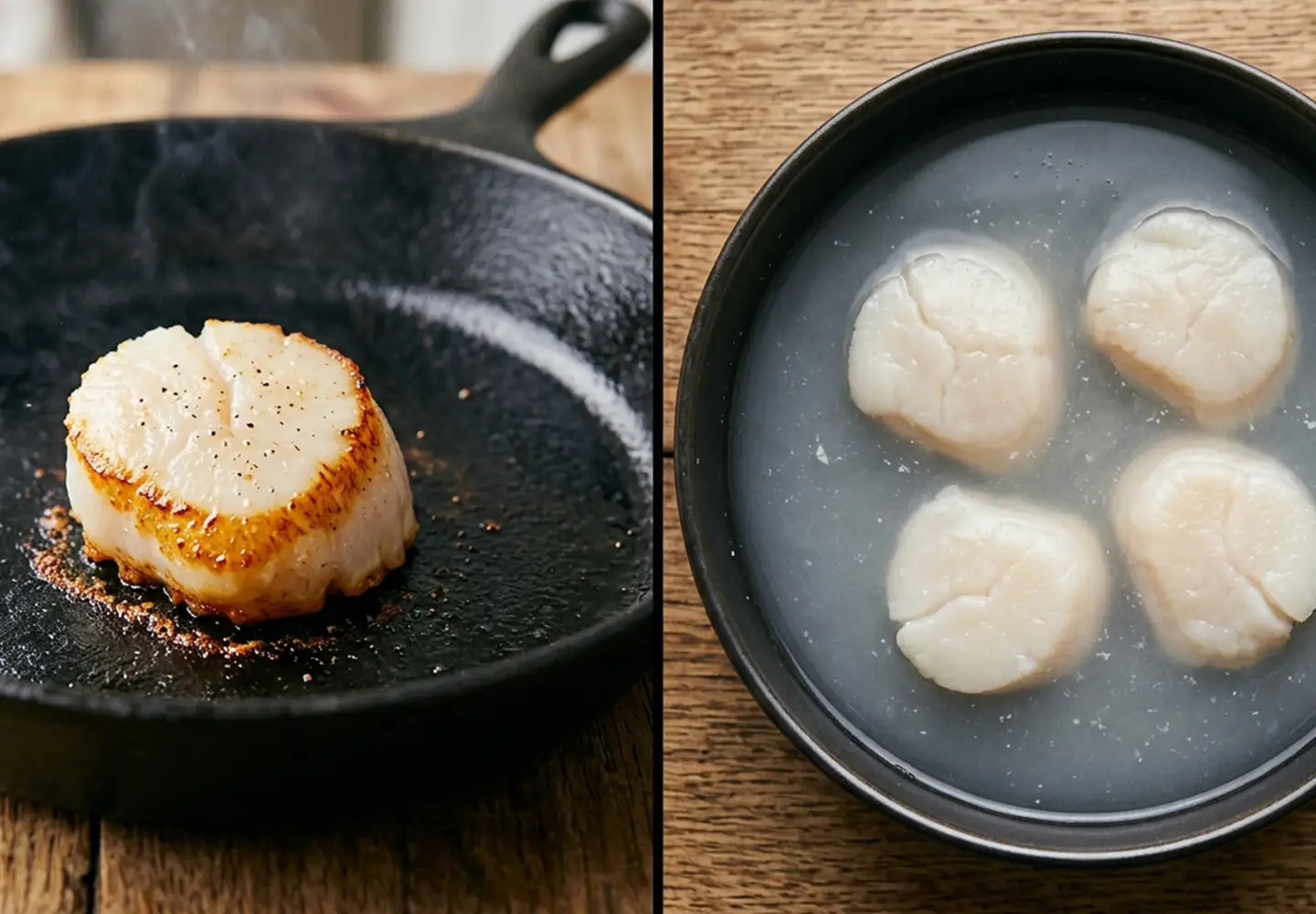
Look at the colour. Dry scallops are ivory, cream, faintly tan, sometimes slightly pink or orange. Treated ones tend toward a bright, uniform, opaque white, because the phosphate has a bleaching effect. Once you have seen both side by side this is obvious. Before you have, it is unreliable on its own, because a very fresh dry scallop can be quite pale.
Look at the liquid. Treated scallops often sit in a milky, slightly viscous fluid. A tray of dry scallops in their own liquid looks different, thinner and cloudier, and a bag of frozen dry scallops should be essentially dry inside.
What you are actually paying for
Two costs, and only one gets discussed.
The obvious one is weight. America’s Test Kitchen ran the controlled version of this rather than repeating the folklore, soaking scallops in phosphate solutions and weighing the result. They picked up an average of 14 percent moisture. Figures of 25 and 30 percent circulate widely without a source behind them, so treat 14 as the number somebody actually measured.
Fourteen percent of a nine pound case is over a pound of water sold at scallop prices, and it leaves in the pan.
Run that as arithmetic and the comparison gets uncomfortable. Say a treated bag costs $30 a pound and a dry bag costs $34. The treated pound is 14 percent water, so you are getting about 0.86 pounds of scallop, which works out to roughly $35 a pound for the actual food. The dry bag was the cheaper product and it looked like the expensive one.
That gap widens every time the treated product is discounted, because a sale on water is still water. It is worth doing the sum once, on whatever two products are actually in front of you, because the intuition it builds lasts longer than the calculation.
The second cost is the sear, and that one ruins dinner rather than the budget. You cannot pat out water bound chemically inside the muscle, so the outcome was settled before you got home. The mechanism is the same one that governs every protein, and we explain it in pat fish dry before cooking.
This is why professional kitchens buy dry almost without exception. A restaurant scallop that arrives with a dark crust and a sweet centre is not only the work of a better cook. It started as a different ingredient.
Frozen is not the same question as treated
The two get conflated constantly and they are unrelated.
Freezing is preservation. Soaking is a weight and shelf life intervention. A scallop can arrive frozen and untreated, which is the best combination most people can get, or unfrozen and treated, which is the worst.
Scallops frozen quickly after harvest hold their quality well, the same argument as for any species and the one we make in fresh vs frozen fish. Why speed matters is in what is IQF.
Be careful with the word fresh at a counter. It tells you nothing about treatment, and often nothing about freezing either, because shops routinely thaw previously frozen product for display.
Buying online versus at a counter
The two situations fail in opposite directions and it is worth knowing which one you are in.
Online you have more information and less recourse. A good seller publishes the ingredient list, the count grade, the species and the origin. You can read all of it without asking anyone. A seller who publishes none of that has told you something too. What you cannot do is look at the product before it arrives, so you are trusting the description.
At a counter you can see it and not much else. No ingredient list, no count grade half the time, and the colour cue is your main instrument. What you gain is the person behind the case, who can answer in ten seconds what a website might not say at all.
The practical rule is the same either way. Whichever channel you are in, use the tool it gives you. Online, read. In person, ask.
What the size grade tells you, and what it does not
Sellers grade scallops by count per pound, so 20/30 means 20 to 30 scallops make a pound. Lower numbers mean bigger scallops and higher prices, and that accounts for most of the price variation between untreated products.
Size helps more than people expect. A bigger scallop can absorb the heat needed to brown its surface before the centre overcooks. That buys you a wider margin for error, where a small scallop gives you seconds. Ours are Sea Scallops at 20/30, which is a large scallop.

Count grading tells you nothing about treatment. Treated scallops come in every size, and a low count number is not a quality guarantee. The two axes are independent, and shoppers routinely read one as evidence of the other.
Once you get them home
Buying dry does most of the job, not all of it.
If they came frozen, thaw them in the fridge rather than in water, for the same reason you would not thaw a fillet in the sink. Our guide to thawing frozen fish applies directly.
Then leave them uncovered on a rack or a paper towel for fifteen minutes in the fridge before they meet the pan. A dry scallop still carries surface moisture, and surface moisture is still the difference between browning and steaming. That step costs nothing. It is also the one most people skip, and the reason a good scallop can still disappoint.
Use them quickly. A scallop shucked at sea, frozen, shipped and thawed has spent most of its patience. How long fish lasts in the fridge covers the timelines.
Dry vs wet scallops, in one line
Read the ingredient list. If it says anything other than scallops, you are buying something other than scallops.
That is not a rule about scallops, in the end. It is a rule about knowing what a label is for.
Everything above is context for that one habit. The colour cue helps once your eye knows what to look for, the question at the counter is worth asking, and the Canadian regulatory picture looks genuinely different from the American advice you will find first. But the label settles it in four seconds, at any counter, in any country.
If you want the cooking side, our guide to searing scallops covers the method. And if you would rather skip the interrogation entirely, our scallops have an ingredient list one word long.