There is a number that explains almost every disappointing piece of fish you have ever cooked, and it is not the oven temperature or the minutes per side. It is 100 degrees Celsius. Water boils at 100. Until the water on the surface of your fillet has finished boiling away, that surface cannot get any hotter than 100, no matter how ferocious your pan is. That single piece of physics is the entire reason you pat fish dry before cooking.
Most guidance treats drying as a tidiness step, something you do because wet fish is unpleasant to handle. It is not housekeeping. It is the difference between searing a fillet and quietly poaching it in its own runoff while the pan screams and nothing happens.
The number that explains it
Put a damp fillet in a 220 degree pan and the pan does not start cooking the fish. It starts boiling the film of water sitting on it. All that ferocious heat goes into converting liquid water into steam, which is thermodynamically expensive, and while that is happening the fish surface sits pinned at 100 degrees.
That matters because browning does not begin at 100. The Maillard reaction, the cascade of reactions between amino acids and reducing sugars that produces crust and savoury depth, needs a surface hotter than roughly 140 degrees. A peer-reviewed review in Foods lays out how temperature and water activity together control the reaction. Push past 140 and the aromatic compounds multiply. Water activity is one of the parameters governing whether the reaction proceeds at all.
So there is a gap of 40 degrees between where a wet surface is stuck and where flavour begins. You cannot cross it while the water is still there.
Here is what that looks like in a real pan. The fillet goes in. It hisses, which you read as searing but is actually boiling. Steam rises and condenses on the cooler fish above the contact point, keeping that wet too. The pan temperature drops. By the time the surface finally dries enough to climb past 140 and begin browning, the inside has been cooking for three minutes and is already past done. You get pale, slightly rubbery fish with a grey band around the edge, and you conclude you do not have the touch.
You have the touch. You had a wet fillet.
Why patting fish dry before cooking matters more than it does for steak
Every protein browns better dry. Fish is the one where getting it wrong is least recoverable, and the usual explanation for why is not quite right.
The water-content story is only half true
You will read that fish holds more water than land animals and that this is why it is so sensitive. Check it and the picture gets more interesting.
Lean white fish really is very wet. Work published in Nature put the water content of normal cod muscle at around 80.5 percent, and as high as 88 percent in stressed fish. Compare that to land animals. The American Meat Science Association gives meat muscle as roughly 75 percent water and 20 percent protein. Beef eye of round sits near 73 percent raw, and whole chicken closer to 66. So for haddock or cod, yes, the claim holds.
Now try it on salmon. A survey of retail seafood published through the National Library of Medicine found salmon had the lowest moisture content of everything tested, below the white fish and below the shrimp. Its fat displaces the water. Salmon holds less water than beef does.
Which sinks the theory. If water content were the reason fish is unforgiving, salmon would be the most forgiving fish on the counter. Anyone who has turned a good side of salmon grey and weeping knows it is not.
The real answer is collagen and clock speed
The honest explanation is structural. Fish muscle is built in short segments separated by thin sheets of connective tissue, and it carries far less collagen than beef or chicken, with fewer cross-links holding it together. Research in Food Science and Technology comparing salmon and chicken found exactly that: raw salmon muscle has lower collagen content and fewer collagen cross-linkages than chicken.
Collagen is scaffolding. Less scaffolding means the flesh has less structural tolerance for sitting in hot water, which is what a wet surface creates. The fillet does not just fail to brown. It begins to fall apart at the surface, which is where the mushy texture comes from and why the fish then grabs the pan.
Then there is the clock. A thick steak gives you eight or nine minutes of cooking, so it can waste two of them evaporating surface water and still recover. A haddock fillet is done in four or five minutes total. Spend ninety seconds boiling instead of browning and you have burned a third of your window. There is no second half of the cook in which to fix it.
That is the real reason to pat fish dry before cooking rather than treating it as optional. The consequences arrive faster and they are permanent.
Where the water is actually coming from
Surface moisture is not a property of fish. It is the residue of everything that happened to the fillet before it reached your hand, and knowing the source tells you how much drying it will need.
Thaw drip loss is the big one. Freezing and thawing damages the proteins that hold water in place, and weakened proteins release it. That liquid has to go somewhere, and it goes to the surface. How much depends entirely on how the fish was frozen and how you thawed it. That is why how you thaw frozen fish has more effect on your sear than anything you do in the pan, and why frozen fish quality is not an abstract concern. Fish frozen fast and hard, the way IQF works, gives up much less. Fish that has been thawed and refrozen gives up a lot.
Sealed packaging traps whatever the fish releases against the fish. Open a vacuum pack and you often find the fillet sitting in a shallow pool of its own purge.
The fridge keeps adding to it. The longer a fillet sits, the more liquid works its way out of the muscle cells.
Rinsing is the self-inflicted one. Plenty of people rinse fish under the tap out of habit. You are adding water to the exact surface you need dry, and you are not making it any safer.
How to pat fish dry before cooking, properly
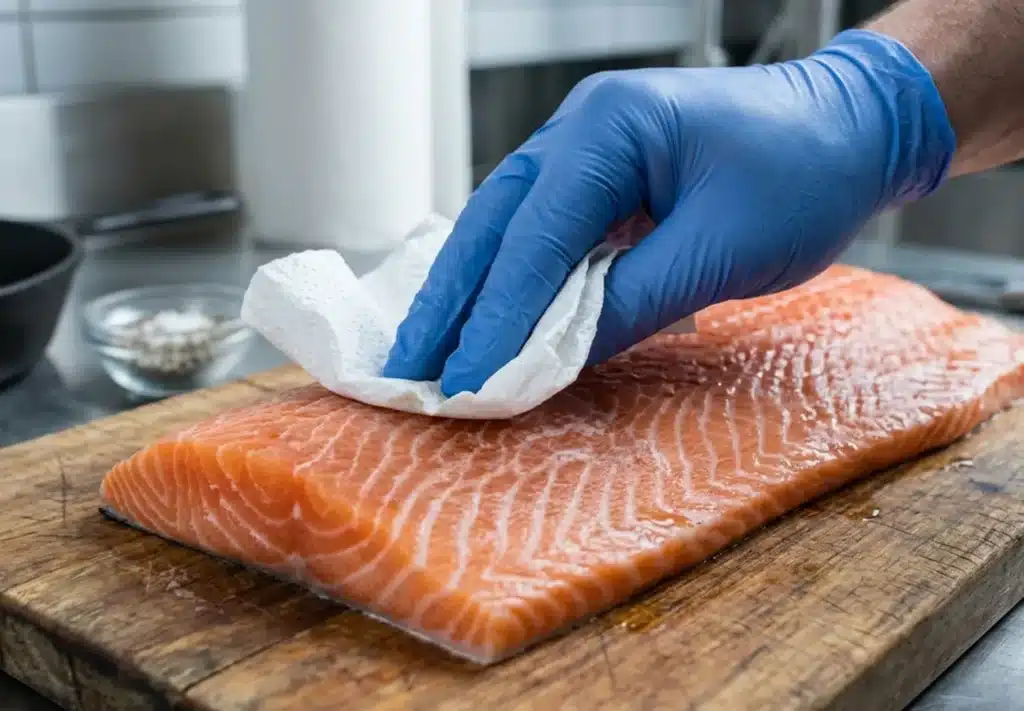
The basic move is unglamorous. Take paper towel, lay it on the fillet, and press. Do not rub or scrub, because fish flesh tears and you will drag the surface apart. Do both sides. Change the towel when it stops absorbing, which with thawed fish is usually sooner than you expect. Do it immediately before the fish goes in the pan, not twenty minutes earlier while you chop things, because the surface will re-wet while it waits.
That takes forty seconds. Two additions make it substantially more effective.
The rack does more than the towel
A towel takes off the free water sitting on top. It cannot touch the moisture that keeps migrating out of the flesh.
Set the fillet on a rack over a plate, uncovered, in the fridge for fifteen to thirty minutes. Cold dry air pulls moisture off the surface continuously, and the rack means the underside dries too instead of sitting in a puddle. The surface goes slightly tacky to the touch. That tackiness is what you want. It browns almost on contact.
This is also the single best thing you can do for skin. If you are chasing crispy fish skin, the rack matters more than the pan.
Salt first, then dry
Salt looks like it should be counterproductive here, since the first thing it does is pull water to the surface. Give it time and it reverses.
Salt the fillet, wait fifteen to forty minutes, then blot. The salt draws moisture out, dissolves into it, and the loosened proteins reabsorb most of that brine while binding water more tightly than they did before. What is left on the surface after blotting is drier than an unsalted fillet, and the flesh underneath is seasoned throughout rather than just on top. America’s Test Kitchen uses this exact sequence for flaky white fish: salt, rest, pat dry so it browns rather than steams, then sear in a very hot pan.
If you want to push further in that direction, that mechanism scaled up is a dry brine, and the salting decisions sit alongside the rest of seasoning fish.
Marinades, and the trap inside them
Marinades are mostly water, with some acid, salt, and oil. Everything above still applies, which puts you in an awkward spot: you spent four hours adding flavour in liquid form, and now you need the surface dry.
Blot, do not strip. Lift the fish out, let it drain for a moment, then press gently with towel. You are removing the loose surface liquid, not scraping off what soaked in. The flavour you care about is in the flesh, not in the film.
The exception is a marinade built to become a glaze, where sugar is doing the browning instead of the fish proteins. Then the film is the point, and you accept a softer surface underneath it. Whether the whole exercise is worth it is a separate argument, and we made it in marinating fish.
When a dry surface genuinely does not matter
This is a rule about dry heat, not a law of nature, and it is worth being straight about where it stops applying.
If water is the cooking medium, surface water is irrelevant. Poaching, steaming, cooking in parchment, dropping fish into a chowder or a coconut curry: none of these are trying to brown anything, so nothing is competing for the heat. Skip the towel and lose nothing.
Low-temperature baking sits in between. At 150 degrees you were never going to get meaningful crust anyway, so drying buys you a cleaner texture and less liquid pooling in the dish rather than a sear.
And a glaze, as above, changes the goal.
Everywhere else, meaning anything with a hot pan, a grill, a broiler, or a hot oven, the surface has to be dry or the heat goes to the wrong job. A broiled haddock needs it. Crispy dry brined salmon is built on it.
Drying is one variable in a system of four
Here is the part that trips up people who have already learned the drying trick and still get mediocre results. A dry surface is necessary and it is not sufficient. Four things have to be true at once:
- The surface is dry. Everything above.
- The pan is hot enough before the fish arrives. A dry fillet in a lukewarm pan still fails, just for a different reason. That is the argument in cooking fish temperature.
- There is enough fat to bridge the fish and the metal, so heat transfers instead of the proteins bonding directly to the pan. That mechanism is why fish sticks.
- The pan is not crowded. This one quietly destroys all your good work. Four cold fillets in one pan drop its temperature and release steam that has nowhere to escape, so the fish sits in a humid cloud. You dried it perfectly and it steams anyway. Cook in batches, or use a bigger pan, or move to the oven.
Then leave it alone. Once the surface is dry and hot, a crust forms and the fish releases itself. Poking at it resets the process every time.
For how all four come together on specific species, how to cook salmon and how to cook haddock walk through it.
Pat fish dry before cooking, then let good fish be good
Forty seconds with a paper towel, or twenty minutes on a rack if you have them. That moves the surface of your fillet from a place where browning is physically impossible to a place where it starts on contact. Nothing else in the process gives you that much for that little.
It will not rescue fish that was mishandled before it got to you. A fillet that has already surrendered its structure to a bad freeze and a worse thaw will weep no matter how carefully you blot it. That is the honest limit of the technique, and the reason we are particular about how ours is frozen.
Start with fish that arrives in good condition and this one step is the whole difference. If you would like some to test it on, the market is open.