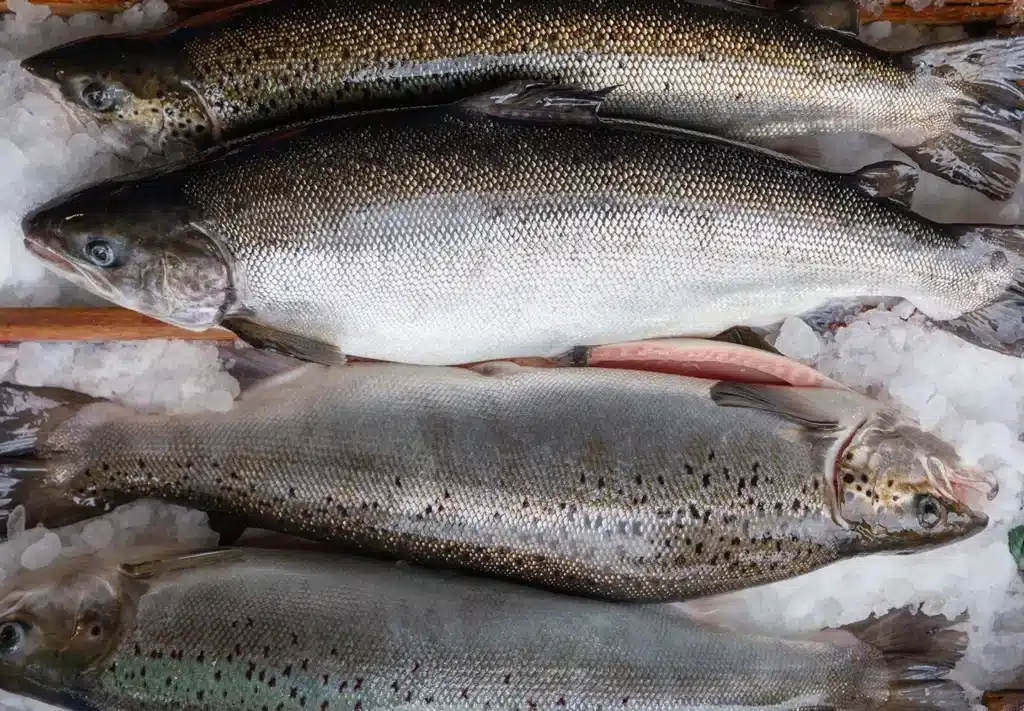
Salmon are the most-studied fish in the world for good reason. They migrate thousands of kilometres, jump waterfalls, change colour, navigate by smell, and feed entire ecosystems before they die. They’ve shaped human civilizations, supported coastal economies for millennia, and survived through climate shifts that wiped out other species.
The fish on your plate is a quiet evolutionary marvel. These 10 fun facts about salmon cover what they do, how they do it, and why it matters for the seafood you eat.
1. They swim against the current to come home
Salmon are anadromous. They’re born in freshwater rivers, migrate to the ocean to feed and grow, then return to the exact river of their birth to spawn. Fisheries and Oceans Canada confirms that wild Atlantic salmon migrations can span hundreds of kilometres, with the journey including leaps over rapids, waterfalls, and human-built obstacles.
This isn’t a casual swim home. It’s one of the most demanding migrations in nature.
2. Their bodies physically transform to switch between freshwater and saltwater
Anadromy gets the headlines, but the physical transformation that makes it possible is even more remarkable. The process is called smoltification, and it happens before young salmon leave their birth rivers for the ocean.
During smoltification, a salmon’s body undergoes dramatic physiological changes. The kidneys reverse function. The gills develop new salt-secreting cells. The skin darkens then silvers. Body chemistry adjusts to handle saltwater after a lifetime in fresh. The fish that leaves the river is biologically different from the one that hatched there.
The reverse process happens when adult salmon return to spawn. They readjust their body chemistry to handle freshwater again. Most fish can’t survive switching between fresh and salt water. Salmon evolved an entire biological system to do exactly that.
This is also why land-based aquaculture, like the closed-loop system used by Sustainable Blue, has to carefully manage water salinity through the salmon’s life cycle. The fish need freshwater hatcheries and saltwater grow-out tanks to mirror their natural development.
3. They change colour before spawning
A salmon’s silvery ocean body transforms as it nears spawning grounds. The US Geological Survey explains that hormonal shifts trigger dramatic changes: Pacific salmon turn bright red and green, develop hooked jaws, and grow humped backs. The colour signals readiness to mate. For most Pacific species, this transformation is also a one-way ticket. They die soon after spawning.
4. Atlantic and Pacific salmon are completely different fish
People talk about “salmon” as if it’s one species. It isn’t.
Atlantic salmon (Salmo salar) live in the North Atlantic and represent a single species. Pacific salmon (Oncorhynchus species) include sockeye, coho, chinook, pink, and chum, each genetically distinct.
The most surprising difference is what happens after spawning. According to the North Pacific Anadromous Fish Commission, Atlantic salmon are generally iteroparous, meaning some individuals survive spawning and return to spawn again. Most Pacific salmon are semelparous, dying after a single spawning event. The fish are biologically built for different life strategies.
For the full breakdown of the difference, see our piece on wild vs farmed salmon in Canada.
5. They can jump 12 feet straight up
Salmon are powerful jumpers. NOAA Fisheries documents that they can clear approximately 3.6 metres (12 feet) vertical, bypassing waterfalls and obstacles in their migration path. That’s roughly the height of a basketball hoop plus a foot. They do this repeatedly, against gravity, after swimming hundreds of kilometres against a current.
6. They feed entire ecosystems with their bodies
This is one of the most underappreciated facts about salmon: they’re a keystone species.
When salmon spawn and die in upriver streams, their decomposing bodies fertilize the surrounding landscape. Bears, eagles, and other predators carry salmon carcasses into surrounding forests, where the nitrogen and minerals from those bodies fuel tree growth, plant life, and the entire upstream food web. Researchers have traced salmon-derived nitrogen in trees growing kilometres from the rivers where the fish died. A salmon doesn’t just feed itself and its predators. It feeds the forest.
This is why salmon population health matters beyond fisheries. When wild salmon decline, the ecosystems that depend on them decline too.
7. Some salmon travel over 3,200 kilometres to spawn
The longest salmon migrations are extraordinary. NOAA Fisheries data shows that Yukon River chinook salmon travel over 3,200 kilometres upriver from the Bering Sea to their spawning grounds. Pacific salmon migrations can span thousands of kilometres in total when you count their ocean travel before the upstream run.
For context: 3,200 kilometres is roughly the distance from Halifax to Calgary. The salmon make this trip without GPS, supply lines, or rest stops, while fighting current the entire way.
8. They navigate by smell
Salmon don’t get lost. NOAA Fisheries research on fish olfaction documents that juvenile salmon imprint on the unique chemical signature of their home river before they migrate to sea. Years later, they use that olfactory memory to navigate back to their exact natal stream, often within metres of where they hatched.
Their sense of smell is so precise that researchers can identify which river system a salmon came from by analyzing its olfactory imprinting. It’s biological GPS, but more accurate than the digital version.
9. Most salmon eaten today is farmed
Wild salmon are vital to ecosystems, but they’re not what most people eat. Industry data shows that approximately 70% of salmon consumed globally is farmed. In 2021, global farmed salmon production exceeded 2.8 million tonnes against approximately 705,000 tonnes of wild-caught salmon.
That ratio is only growing. Wild populations are under pressure from climate change, habitat loss, and historic overfishing. Demand keeps climbing. Farmed salmon now anchors the global salmon supply.
The question isn’t whether you eat farmed salmon. For most people, you do. The question is what kind of farmed salmon, and how it was raised. Our piece on the case for land-based aquaculture covers what to look for.
10. Diet shapes salmon colour and flavour
Wild salmon eat shrimp, krill, and small fish rich in carotenoids, especially astaxanthin. This natural pigment is what gives wild salmon flesh its deep red-orange colour and is also a powerful antioxidant.
Farmed salmon receive astaxanthin through their feed. The pigment is approved for use in salmon feed by regulatory bodies, and the amount and source determines the final colour of the fish. Salmon raised with high-quality feed develop the rich colour and clean flavour you expect from premium salmon. Salmon raised with cheaper feed look paler and taste different.
The colour of your salmon is a story about what it ate.
Why these fun facts about salmon actually matter
The point of these fun facts about salmon isn’t just trivia. It’s that salmon are remarkable, and that the way they live affects how they should be eaten.
Wild salmon are under serious pressure. Climate change is shifting their migration patterns, warming the rivers they spawn in, and altering ocean food chains. Habitat loss continues to compound historic overfishing. Wild Atlantic salmon in Canada have been commercially banned for over thirty years because populations collapsed.
Farmed salmon now anchors the global supply, but how it’s farmed matters enormously. Open-net pen aquaculture (the dominant global method) carries documented environmental costs to wild salmon populations and coastal ecosystems. Land-based closed-loop aquaculture (the model used by our partner Sustainable Blue) eliminates those impacts while delivering consistent, high-quality salmon.
For the comprehensive view, see our ultimate guide to salmon for everything from species comparison to cooking technique. For the case for our specific sourcing choice, see why we only carry one type of Atlantic salmon.
Choose salmon that lives up to the story
The salmon on your plate is the result of millions of years of evolutionary adaptation and (depending on the source) a lot of human decisions about how it should be raised. The salmon we sell is Sustainable Blue Atlantic salmon, raised on land in Nova Scotia in a closed-loop system that doesn’t compromise wild populations or coastal ecosystems.
Two ways to get it:
Sustainable Blue salmon, 12 portion box — twelve 6oz portions, frozen in 2-packs. Right-sized for weeknight cooking, meal prep, and households that want quality salmon ready to go.
Sustainable Blue salmon, 24 portion box — twenty-four 6oz portions. Better value for families, regular cooks, or anyone building a freezer worth opening.
Both come in 2-portion packs, vacuum-sealed, and shipped frozen directly to your door. For everything else we sell, browse our shop. For cooking inspiration, explore our salmon recipes.