The history of fishing communities begins with the pull of water itself. Long before cities or agriculture, people followed rivers, lakes, and coasts that offered both food and direction. Where fish were steady, people stayed. Over time, those temporary camps grew into the first lasting settlements built around the rhythm of the tide.
These early communities did more than survive. They learned to read the seasons, to dry and smoke their catch, and to share knowledge that tied them to place. Archaeologists now trace that pattern from African lakes to the submerged coasts of the Mediterranean, where entire villages once stood on what are now ocean floors.
Every discovery tells the same story: life gathered where fish were reliable, and from those waters, human culture began to take root.
Where water gathered, people stayed
Archaeology shows that people settled where fish were abundant. Rivers offered transport and fresh water. Coasts offered predictable food and safety. When water was reliable, people stopped wandering and began to stay.
At Atlit Yam, a Neolithic village now submerged off Israel’s coast, a 9,000-year-old village now underwater preserves houses, wells, and rich fish remains, a snapshot of early coastal lifeways.
Thousands of kilometres east, on the island of Timor, the Jerimalai cave people were bringing in open-ocean fish like tuna about 42,000 years ago. The earliest shell fish hooks from the site are younger, roughly 23,000 to 16,000 years old. The skill and planning this required show that fishing was already a foundation of human life.
These sites reveal the same pattern: wherever water met land, communities grew.
Rivers and lakes as anchors of early communities
Inland waters tell a similar story.
Along Ontario’s Saugeen River, the Donaldson Site shows a large Middle Woodland camp where people gathered seasonally to harvest fish, with hearths, tools, and abundant fish remains dating to roughly the last two millennia.
In Africa, Lake Turkana served as a long-term food source even before farming began. Stone tools and fish bones dating back nearly two million years show that aquatic resources supported early human expansion.
Meanwhile, along the South Atlantic coast, circular shell-ring sites 3,000–5,000 years old point to communities organized around estuarine resources. Some rings show year-round occupation, others look more ceremonial. Either way, seafood was central.
In every region, stable fishing grounds led to stable homes.
Preserving the catch: Technology that sustained fishing communities
Fresh fish spoil fast. To live by the water year-round, early people learned to slow decay with sun, smoke, and salt.
- Drying was likely the first method. A steady wind and a few days of sun could preserve fish for months.
- Smoking on the Nile, Late Paleolithic sites show evidence of smoking fish about 13,000–12,000 BCE, one of the oldest examples of fish preservation.
- Salting followed in regions rich in natural salt. Romans packed fish in brine to make garum, a fermented sauce traded across the empire, while medieval Europeans turned salting and drying into an organized industry.
These techniques turned a fragile food into portable wealth. Preservation allowed trade, and trade allowed communities to grow.
From villages to trade routes
Once fish could travel, so did people. In the Viking era, an intriguing insight comes from Haithabu (in what is now northern Germany). Archaeologists used ancient DNA from cod bones dated between 800 and 1066 CE to show that they came from Arctic Norwegian stocks, indicating that dried cod (stockfish) was transported over long distances in Europe during that period.
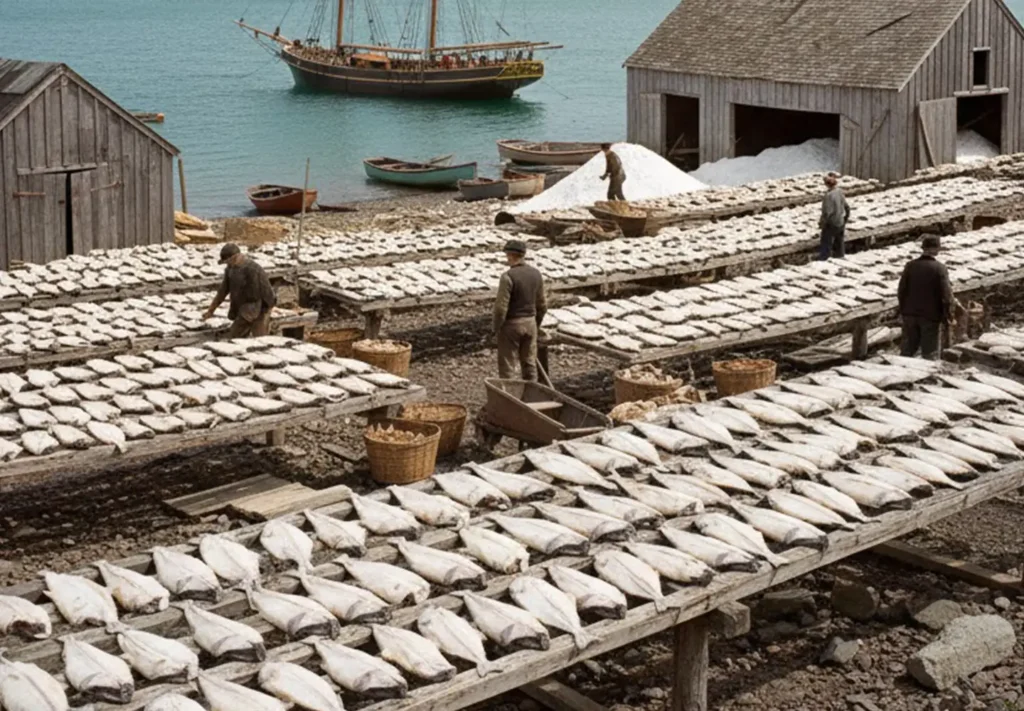
Centuries later, the same principle powered the salt-cod trade that built Atlantic Canada. Beginning in the 1500s, European fleets cured cod onshore before sailing home with holds full of salted fish. It filled markets from Lisbon to Naples and became both food and currency.
These exchanges turned fishing camps into ports and connected continents long before modern globalization.
The architecture of early fishing communities
The history of fishing communities is also written in how they were built.
At Walraversijde in Belgium, a medieval fishing village now excavated by archaeologists, researchers uncovered smokehouses, drying sheds, salt stores, and docks arranged within a tight cluster of homes. Wooden weirs extended into tidal flats to guide fish into traps.
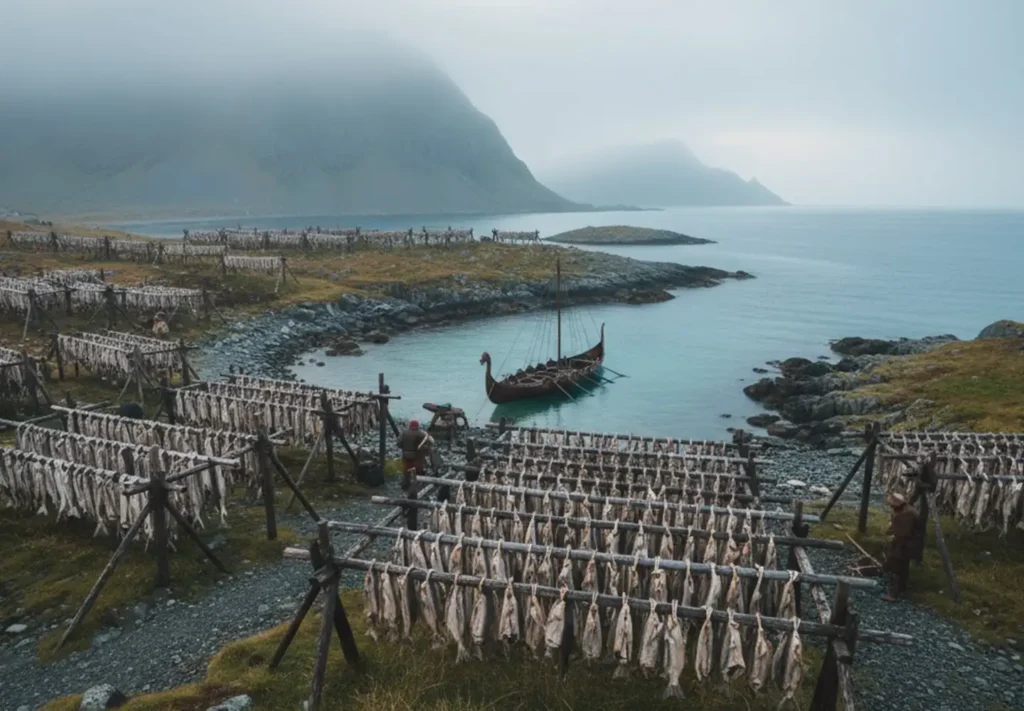
Similar designs appear in coastal Japan, Scandinavia, and West Africa. Each community adapted to its environment, but the pattern stayed constant: homes faced the water, smokehouses stood near shore, and daily life moved with the tide.
These settlements were early supply chains. They balanced ecology, technology, and social life in ways still visible today.
How fishing shaped economies and identity
Living beside water meant reading its currents and seasons. Many coastal societies developed rituals to honour the first catch or to thank the sea. These customs reflected respect for the resource that sustained them.
As preservation spread, fish linked distant worlds. Dried and salted fish crossed deserts, mountains, and oceans, connecting inland farmers to coastal fishers. The geography of fish became the geography of trade.
From Bronze Age deltas to Viking harbours and Newfoundland outports, the history of fishing communities shows how food became culture and commerce.
Continuity and modern meaning
The same knowledge still guides coastal life. For example, in Newfoundland, salt cod dries on wooden flakes each summer. Over in West Africa, fish smoke slowly in clay ovens. And in northern Japan, herring hang from eaves in the cold wind.
These practices are not museum pieces. They are proof that sustainability has always been part of survival.
At Afishionado, we continue that lineage through traceable, responsibly caught seafood. When you prepare salt cod or smoked mackerel, you take part in a story that began when the first families settled beside the tide.
Why the history of fishing communities still matters
Every shoreline tells the same story.
Water gathered life. Fish gathered people. Together they built the first communities.
From the submerged ruins of Atlit Yam to the drying racks of modern Newfoundland, the history of fishing communities connects us to the same partnership that shaped civilization. When we care for the waters that feed us, we carry that history forward.