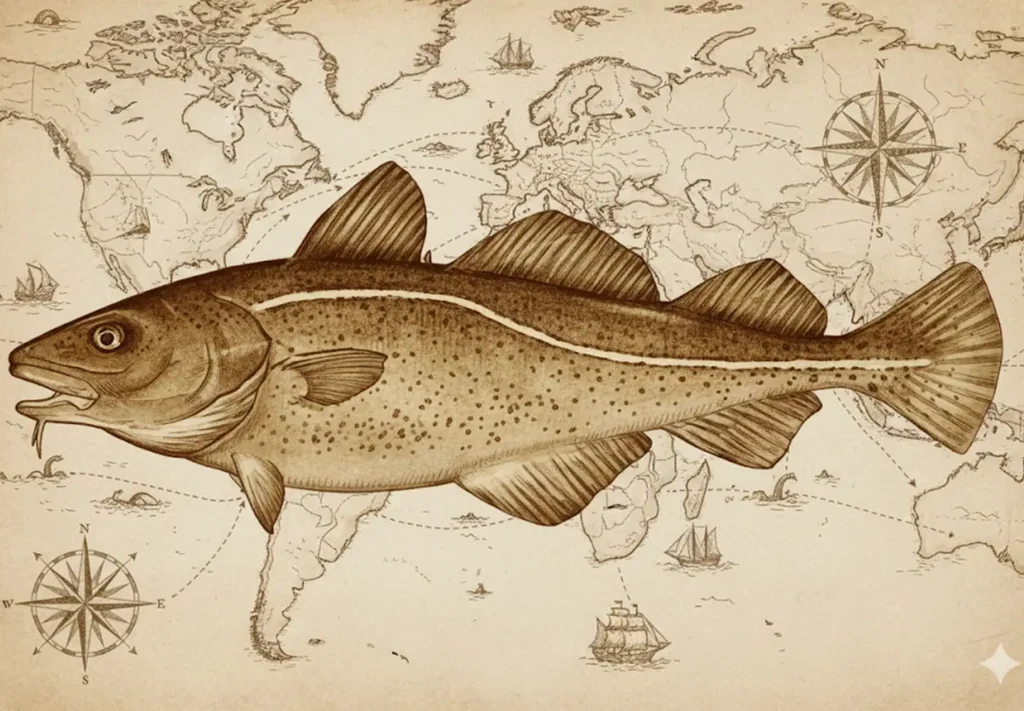
If gold fuelled the Spanish empire and spices drove the Dutch East India Company, then cod was the quiet coin of the North Atlantic. The Salt Cod Trade History is a reminder that sometimes the most valuable currency is not mined or minted but caught from the sea. For centuries, cod was more than food. It was wealth, power, and survival, salted down and shipped across oceans.
The Viking discovery that sparked salt cod trade history
The saga begins with the Vikings. Around 800 AD, Norse sailors pushed into the cold waters of the North Atlantic and discovered seas thick with cod. They learned to split and air-dry the fish into stockfish, a light and durable ration that kept for months.
Genetic evidence even places Arctic-Norwegian cod on Viking-age tables in northern Germany, showing that people were moving this fish across long distances a thousand years ago. Stockfish provisioned Viking voyages to Iceland, Greenland, and Vinland. It was not the cause of their expansion, but it made long-range travel possible.
In this way, the Vikings did more than discover cod. They transformed it into a portable form of wealth, one that laid the foundation for the salt cod trade history that would dominate centuries of European commerce.
The Fish Revolution of the 1500s
The true explosion in the salt cod trade history came after 1500, when European fleets tapped into the extraordinary Grand Banks off Newfoundland. John Cabot’s 1497 voyage is often credited with opening English access to these fisheries, and early explorers described waters so full of fish they could be scooped up in baskets.
Historians call what followed a North Atlantic Fish Revolution. More boats, more cod, and more protein surged into European markets. Catholic fasting rules created steady demand: more than a hundred days each year when meat was off-limits, salted or dried cod filled the gap from Lisbon to Naples.
Cod as currency
By the 1600s and 1700s, a fisherman’s wealth was tallied in quintals of salt cod. In Newfoundland outports, merchants advanced nets, salt, and staples on credit, with the expectation that barrels of cod would settle the account at season’s end.
This barter-credit system linked directly into Atlantic trade. Barrels of lower-grade cod sailed south to feed enslaved workers on Caribbean sugar plantations. In return, sugar and rum moved north. Cod was not coin, but it functioned as one of the quiet currencies of empire.
Governments knew its importance. Tudor England even mandated “fish days” not only for piety but to train seamen. Officials explicitly described fisheries as nurseries for the navy, a policy that linked cod to imperial expansion.
Salt cod and the making of trade routes
From the 16th century onward, European powers such as France, Portugal, Spain, and England made seasonal voyages across the Atlantic to fish the rich cod grounds off Newfoundland and Labrador. These were not only food expeditions. Ships carried salted cod back to Iberian and Italian ports, filling demand in regions where meat was scarce or costly. France and Spain, lacking local supply at scale, relied heavily on these imports. The pattern connected Europe to North America long before permanent colonies took hold, turning Newfoundland into a strategic hub for transatlantic trade.
The cod trade also shaped exploration and colonial rivalry. John Cabot’s 1497 voyage gave England its opening presence in Newfoundland, while French, Spanish, Portuguese, and Basque fishing crews built seasonal camps along the coast. These camps drew Europeans to North America every year, mapping coastlines and learning local waters while curing fish for transport. Over time, these outposts laid groundwork for permanent settlements, fueling boundary claims and colonial competition that eventually influenced the borders dividing British North America and the United States.
Trade routes forged by cod were varied and extensive. Fleets from southern Europe, France, and England sailed each spring to Newfoundland, returning in autumn with holds full of salted cod. The exports flowed into Spain, Portugal, Italy, and France, while in return Europe supplied goods such as tools, textiles, wine, and salt to North American fishing camps. This two-way traffic sustained colonial economies, tied distant markets together, and reinforced the geopolitical value of Atlantic Canada. That value was later reflected in treaty negotiations, imperial rivalries, and the shaping of borders between Canada and the United States.
Centuries of abundance, centuries of strain
For centuries, cod seemed inexhaustible. Explorers spoke of Newfoundland cod so plentiful they slowed ships and filled barrels with ease. This apparent abundance encouraged more fleets, bigger nets, and expanding markets.
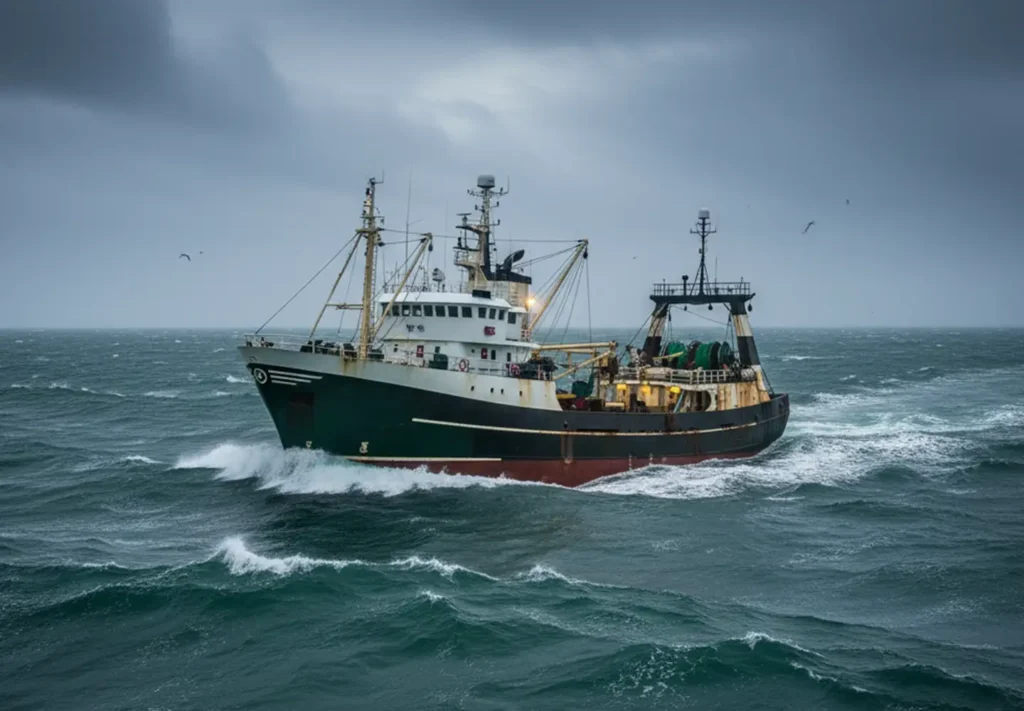
But abundance is fragile. Pressure grew over centuries, then industrialized trawlers of the 20th century accelerated the decline. By 1992, Northern cod stocks were reduced to a fraction of historic levels. Canada’s moratorium closed the fishery and cost more than 30,000 jobs. It was the dramatic end of a long overfishing story.
Rebuilding cod stocks
The 1992 moratorium froze a way of life. More than thirty years later, cautious openings show the story is not finished. In 2024, Canada reopened a limited Northern cod fishery with a total allowable catch of 18,000 tonnes. In 2025, that number was raised to 38,000 tonnes. It is still only a fraction of the roughly 250,000 tonnes landed each year during the 1980s.
Scientists warn recovery is fragile. Cod reproduce slowly, and ecosystems have shifted in their absence. Still, the cautious approach reflects lessons learned from the salt cod trade history: it is easier to exhaust abundance than to rebuild it.
What the cod trade left behind
The salt cod trade history is a story of how one fish provisioned explorers, fueled global trade, and helped shape borders. It is also a cautionary tale of what happens when abundance is treated as infinite. Centuries of overfishing led to collapse. Recovery is now possible only because of careful management and restraint.
At Afishionado, we carry that lesson forward. Just as cod once connected continents, our work connects households to the ocean, but through sustainable seafood and transparency. Our seafood boxes are a way to enjoy the bounty of Atlantic Canada while ensuring that history does not repeat itself. Where salt cod was once currency, sustainability is the true value we need to invest in today.