
Almost every seafood disaster at Christmas is a timing problem, and most were decided two days earlier. So build a holiday seafood menu backward, starting at the moment you want food on the table.
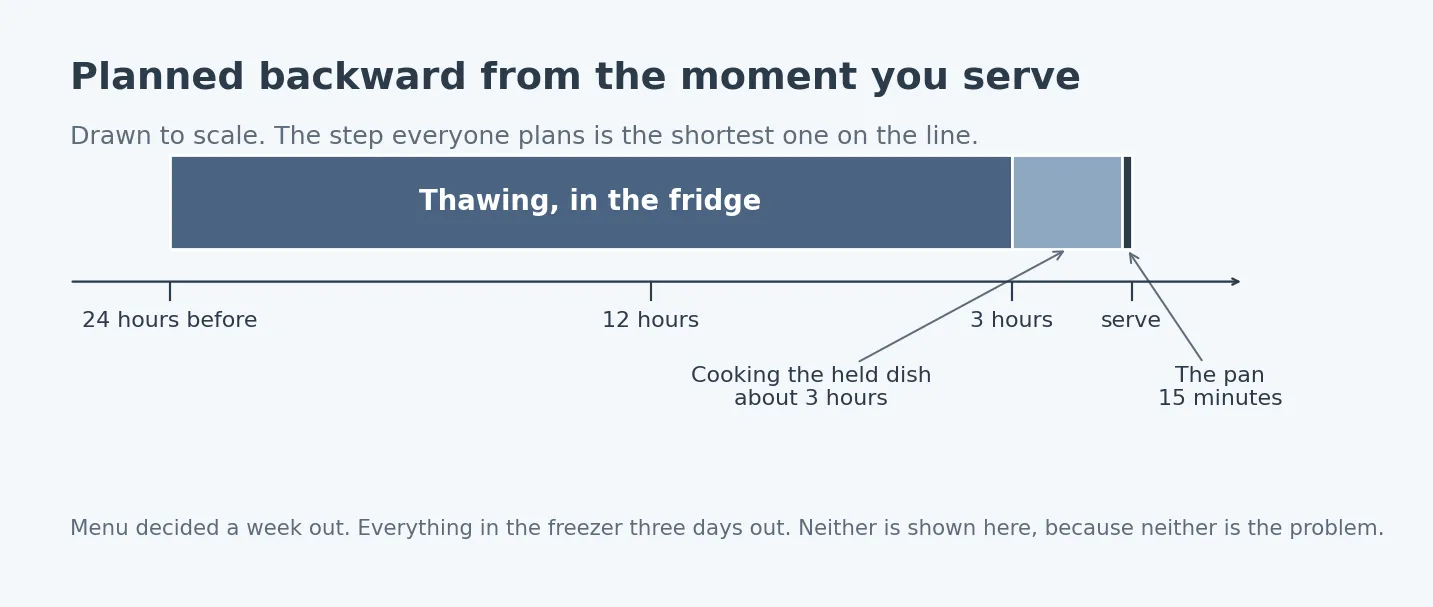
The steps that go wrong are the ones nobody scheduled. Cooking is fifteen minutes. Thawing is a day. Guess which one gets planned.
Start at the end
Write down the time you want to serve. Then work back through four questions, in this order.
What is on the plate, and does any of it need a pan at the last minute? If the answer is yes for more than one dish, change the menu. That is the subject of seafood for a crowd. It is the decision that makes everything after it either easy or impossible.
When does each thing go in? Held dishes start early. Anything seared starts last and goes straight out.
When does it come out of the fridge? Not the freezer. The fridge.
And when does it go into the fridge? This is the one. Everything above is an afternoon. This one is a day or two, and it is where holiday seafood actually fails.
Thawing is the step that ruins it
Health Canada is clear about the methods. There are three safe ways to defrost: in the refrigerator, in the microwave, and in cold water inside a sealed package. And one instruction stated plainly. Do not let food defrost on the counter.
The refrigerator is the safest of the three. Put it on the bottom shelf so nothing drips onto anything else. For most meat, Health Canada says 24 hours in the fridge is usually enough.
Fish is thinner than a roast, so most fillets will be well under that. But a bag of shrimp frozen into a solid block is not a fillet, and neither is a thick portion still in its vacuum pack. Give it the full day and plan for it on the twenty-third, not the morning of.
There is a second constraint people miss. Thawed fish does not wait well. Once defrosted it has a day or two in the fridge, not a week. Thawing on the twentieth for a dinner on the twenty-fifth solves one problem by creating another. The method detail is in how to thaw frozen fish.
Two rescues, and both are legitimate
You will forget. Here is what to do about it.
Cold water, sealed, changed every half hour. The package goes in cold water, not warm, and the water gets changed so it stays cold. It is much faster than the fridge. The catch is that food thawed this way has to be cooked straight away, which makes it a rescue rather than a plan.
Or cook it from frozen. This is the option most people do not know they have and it works better than it sounds. Allow roughly half as long again as you would for thawed fish. Keep it to thicker cuts and gentler methods, baking and poaching rather than searing. A fillet that goes into a hot oven frozen will not sear, but it will cook perfectly pleasantly.
What you do not do is leave it on the counter. That is the instruction Health Canada gives most directly, and the one most commonly ignored.
The backward timeline
| When | What |
|---|---|
| A week out | Decide the menu. One cold dish, one hot held dish, nothing needing a pan at the end |
| Three days out | Have everything in the freezer. Count portions now, not on the day |
| The day before | Move it to the bottom shelf of the fridge. The whole day, not the evening |
| Three hours out | Start the held dish |
| One hour out | Everything cold comes out of the fridge last, not first |
| Fifteen minutes out | Anything that needs a pan |
The only row most people have is the last one.
What to decide a week out
Three things, and deciding them early is most of the work.
How many people, and therefore how much. Count portions against the packs you actually have rather than estimating. A twelve-portion pack is twelve portions, which is a different problem from a loose bag.
What is held and what is not. One of each, maximum.
What comes out of the freezer on which day. Write it down. The most common failure here is a bag still frozen at four o’clock, and a note on the fridge door prevents it.
If you are stocking the freezer from scratch for this, the best frozen seafood to keep in it is where to start.
A holiday seafood menu, in short
Work backward from the serving time and treat thawing as a scheduled step, not something you do when you remember. It takes a day, it happens in the fridge, and thawed fish will not wait five days for you.
The rest of a holiday seafood menu is an afternoon’s work, and if the dishes are chosen properly most of it is done before anyone arrives.
Our Sustainable Blue salmon comes in twelve individually frozen portions, which exists precisely so you can thaw six and leave six. The rest of the market is stocked on the same principle.