Mercury in fish is not one problem. It is two very different situations wearing the same name.
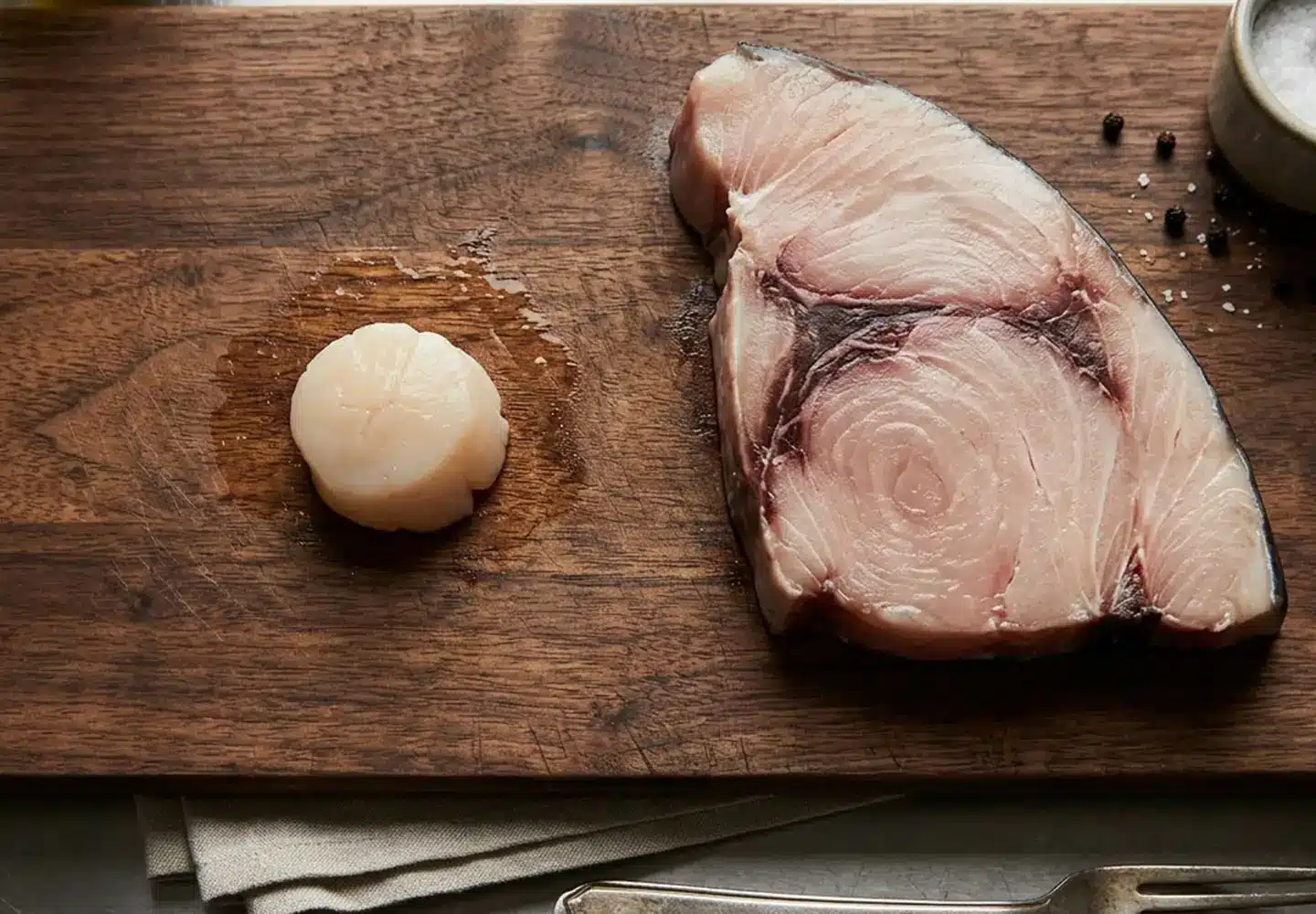
A scallop contains about 0.003 parts per million of mercury. A swordfish contains about 0.995.
That is a difference of more than three hundred times, between two things sold at the same counter. It is also the single most useful fact about mercury in fish. The risk is not spread evenly across seafood. It sits in a short list of species, and most people worry about the wrong ones.
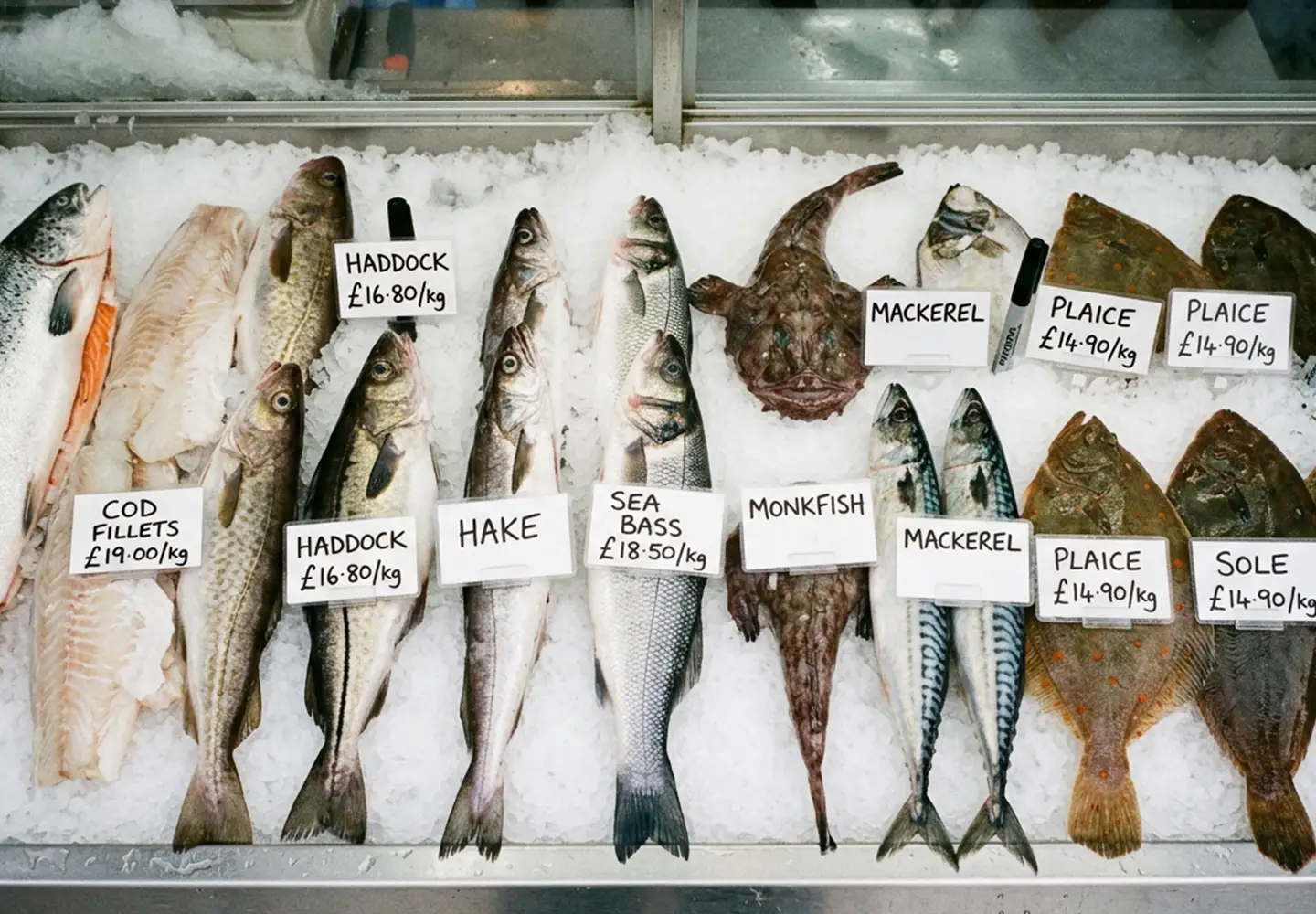
Haddock, for the record, is 0.055.
Where mercury in fish comes from
Mercury occurs naturally in rock and soil. It also enters the environment through human activity: burning coal, mining, industrial processing. It settles into water, where bacteria convert some of it into methylmercury. That is the form that accumulates in animal tissue.
Two things follow, and they explain the entire pattern.
It builds up. A fish absorbs methylmercury faster than it clears it, so concentration rises over a lifetime. An old fish carries more than a young one of the same species.
It concentrates upward. A predator eating contaminated prey inherits the accumulated load of everything it ate. So the highest levels turn up in large, long-lived predators near the top of the food web.
That is why the answer is so lopsided. A scallop filters plankton and lives a few years. A swordfish eats other predators and can live fifteen. The gap between them is not luck. It is arithmetic.
The same logic works inside a species as well as between them. A large old haddock carries more than a small young one, which is part of why the published figures are averages rather than guarantees. It is not something worth managing at the fish counter, but it explains why numbers move between studies.
Total mercury and methylmercury
You will see both terms and they are not quite the same thing.
Mercury in its inorganic form is poorly absorbed. Methylmercury, the form bacteria produce in water, is absorbed efficiently and accumulates in tissue, and it is the one health guidance is about. In fish, the overwhelming majority of what is measured is methylmercury, so the total-mercury figures published by regulators are a good proxy.
That is why you can read a table of total mercury values and treat it as a risk ranking without adjusting anything.
The numbers, by species
The figures below come from the FDA’s mercury monitoring programme, which has tested commercial seafood over three decades. Values are mean parts per million of total mercury in edible tissue.
| Species | Mercury (ppm) |
|---|---|
| Scallop | 0.003 |
| Shrimp | 0.009 |
| Salmon, fresh or frozen | 0.022 |
| Pollock | 0.031 |
| Atlantic mackerel | 0.050 |
| Haddock | 0.055 |
| Flounder, sole, plaice | 0.056 |
| Crab | 0.065 |
| Herring | 0.084 |
| Lobster | 0.107 |
| Cod | 0.111 |
| Canned light tuna | 0.118 |
| Halibut | 0.241 |
| Swordfish | 0.995 |
| Shark | 0.979 |
| Tilefish, Gulf of Mexico | 1.123 |
Read the top and the bottom together. Everything in the first half of that table belongs to a different category from the last three entries. It is not a slightly better version of them.
Notice what is not on the high end, too. Lobster, crab, cod, halibut and canned light tuna all sit in the lower reaches, and those cover most of what a Canadian eats in a year. The species that carry a real load are ones many people go a decade without buying.
For scale, the FDA’s action level, the point at which it will take enforcement action against a product, is 1.0 ppm. Haddock sits at roughly one eighteenth of that. A scallop is at three thousandths of it.
Does cooking get rid of it?
No. This is the most common follow-up and the answer is unhelpfully simple.
Mercury binds to protein in the muscle tissue. It does not cook off, it does not drain away, and it does not concentrate in a part you can trim, the way some fat-soluble contaminants do. Grilling, poaching and frying all leave it where it was.
Cooking does remove water, so a cooked portion can test slightly higher per gram than a raw one purely because it weighs less. That is a measurement artefact rather than a change in what you are eating.
The only lever is species selection. There is no preparation that turns a swordfish into a haddock.
Is haddock high in mercury?
No. It is one of the lower-mercury fish on the market, and both regulators say so explicitly.
At 0.055 ppm, haddock sits comfortably in the bottom third of the table above.
The FDA’s advice about eating fish puts haddock on its Best Choices list, the lowest-mercury category. It shares that list with scallops, shrimp, salmon, cod, pollock, sole and flounder. And Best Choices is the list the FDA says is suitable for the groups it advises most cautiously: people who are pregnant or breastfeeding, and children aged one to eleven.
In other words, haddock is not merely acceptable. It is on the short list regulators recommend to the people they worry about most.
If you have arrived here because someone told you to worry about haddock, they were thinking of a different fish. The species that carry real mercury load are shark, swordfish, marlin, orange roughy, king mackerel, bigeye tuna and Gulf tilefish. Haddock is not adjacent to that group.
What Health Canada actually advises
Canadian guidance is more specific than most people realise, and it is worth reading properly rather than absorbing as a general anxiety.
Canadian and American advice agree on the substance and differ in presentation. The FDA sorts species into three tiers. Health Canada names the species to limit and sets amounts, which is shorter and more useful.
The species to limit are fresh and frozen tuna, shark, swordfish, escolar, marlin and orange roughy. Health Canada sets maximum amounts for those species combined:
| Group | Limit, those species combined |
|---|---|
| General population | 150g per week |
| Pregnant, may become pregnant, or breastfeeding | 150g per month |
| Children 5 to 11 | 125g per month |
| Children 1 to 4 | 75g per month |
Canned albacore tuna has its own separate advice, because it sits higher than canned light tuna. The amounts are in the next section, along with everything else you would actually need to act on.
Everything else is unrestricted. There is no weekly cap on haddock, salmon, shrimp, scallops, cod or pollock, because there is no need for one.
For context on portion size, a Health Canada Food Guide Serving of fish is 75g, which is smaller than most people picture. A typical restaurant fillet is two servings.
Who genuinely needs to be careful
Mercury matters most for the developing brain, which is why the guidance singles out three groups: people who are pregnant or may become pregnant, people who are breastfeeding, and young children.
If that is you, here are both lists in one place so you do not have to hold anything in your head.
The short avoid list
Six species. That is the whole of it.
- Shark
- Swordfish
- Marlin
- Escolar
- Orange roughy
- Fresh and frozen tuna
The FDA adds king mackerel, bigeye tuna and Gulf of Mexico tilefish, none of which turn up often on a Canadian counter.
If you are not buying anything on that list, you are done. There is no second step.
The eat-freely list
Everything here is on the FDA’s Best Choices list, the lowest-mercury category, and it is the list regulators recommend specifically to pregnant people and children.
- Shellfish: scallops, shrimp, clams, oysters, crab, crawfish, squid
- White fish: haddock, cod, pollock, sole, flounder, plaice, tilapia, catfish, whiting
- Oily fish: salmon, sardines, anchovies, Atlantic mackerel, herring, trout
No weekly cap applies to any of these. Health Canada does not set one because there is no need for one.
The one thing in between
Canned tuna, and only because the two types differ.
Canned light tuna is fine. It uses smaller species like skipjack and Health Canada sets no limit on it.
Canned albacore, sold as white tuna, has its own advice: up to 300g a week if you are pregnant or breastfeeding, 150g a week for children 5 to 11, and 75g a week for children 1 to 4.
Check which one is in your cupboard. Canned tuna is the single most common place a Canadian actually meets mercury, and the difference between the two tins is one word on the label.
And then
Talk to your own healthcare provider rather than a fishmonger. They know your circumstances and we do not. Nothing on this page is medical advice and it is not written to substitute for any you have been given.
If you are not in one of those groups
Health Canada’s position is that occasional consumption above the recommended amount will not put the average consumer at risk.
That is worth sitting with, because it reframes the whole question. Methylmercury leaves the body slowly, over weeks to months rather than days, which is exactly why guidance is written as weekly and monthly amounts. Exposure is a running average, not an event.
So a single swordfish steak on holiday is not a problem to solve. Swordfish every week for a year is a different question. Almost all the anxiety about mercury attaches to the first, and almost all the actual risk attaches to the second.
The mistake worth avoiding
The common response to reading about mercury is to eat less fish. Both Health Canada and the FDA spend a good deal of their guidance arguing against exactly that.
Canada’s Food Guide recommends at least two servings of fish a week. The FDA and EPA advise two to three servings of low-mercury fish weekly, including for pregnant people. Both agencies are trying to move consumption up, not down, because the nutritional case for fish is strong and the mercury risk is confined to species most people rarely eat.
Cutting fish out to avoid mercury means giving up the benefit to avoid a risk you were probably not exposed to. Switching species costs you nothing and solves the problem completely.
The same question exists for every protein
Worth saying, because the usual next thought is to eat more chicken or beef instead.
Every protein category has a version-level distinction that matters more than the category itself. With fish it is species, and mercury is the reason. With red meat it is processing. In 2015 the World Health Organization’s cancer agency classified processed meat as carcinogenic to humans and unprocessed red meat as probably carcinogenic, on the basis of more than 800 studies.
We are not in the business of telling anyone what to think about bacon, and the WHO is careful to note that its classifications describe how strong the evidence is, not how large the risk is. Those are different things and the distinction gets lost constantly.
The point is structural rather than competitive. Nobody responds to that classification by giving up protein. They ask which kind, how often, and in what form. Mercury deserves exactly the same treatment, and the reason it rarely gets it is that fish is unusually well monitored. The FDA has published species-level mercury data for thirty years. There is no comparable public table for beef, which makes the fish numbers more visible without making them worse.
Where our own fish sits
We do not sell any of the species on the limit list, which is not a virtue on our part. We sell Atlantic Canadian seafood, and the high-mercury species are mostly large ocean predators from elsewhere.
For what it is worth in numbers:
- Scallops, 0.003 ppm. The lowest reading in the FDA’s entire table.
- Shrimp, 0.009 ppm.
- Salmon, 0.022 ppm. Farmed and wild both test low; this is not a wild-versus-farmed question.
- Haddock, 0.055 ppm.
All four appear on the FDA’s Best Choices list. If you want the wider nutrition picture on any of them, is haddock good for you, is shrimp healthy and salmon health benefits cover the individual species, and best fish for heart health covers the category.
What to do with this
Three things, and none of them requires a chart on the fridge.
Know the short list. Shark, swordfish, marlin, escolar, orange roughy, fresh and frozen tuna, king mackerel, bigeye tuna, Gulf tilefish. That is essentially the whole of the problem. If you are not buying those, mercury is not your issue.
Vary what you eat. Rotating species is the single best protection against any contaminant. It stops any one source dominating your intake, and it works for things nobody has thought to test for yet. It also happens to make dinner more interesting.
Ask what you are buying. Species names matter, and “white fish” on a menu is not a species. That is the same argument we make about seafood traceability in Canada, and mercury is one more reason a real name on a label is worth something.
And keep the comparison inside the category. The gap between a scallop and a swordfish is larger than the gap between fish and almost anything else you might eat instead. This is a question about which fish, not about whether fish.
The scale is worth holding onto. More than three hundredfold, top to bottom. Very few food-safety questions resolve that cleanly. Most involve trade-offs and disputed evidence; this one has published numbers, a short list, and broad agreement between two regulators.
Mercury in fish is a real issue that has been generalised into a vague unease about seafood, and the generalisation does more harm than the mercury does. It moves people away from a food both Health Canada and the FDA are actively trying to get them to eat more of, in order to avoid an exposure most of them never had.
The numbers are public. The list is short. Almost everything on a Canadian counter sits on the safe side of it, and the few things that do not are easy to name.