Most people who search is shrimp healthy have already been told the answer is yes. They are asking anyway, and usually because of one number.
Shrimp carries more cholesterol than steak. About 189mg per 100g, against roughly 90mg for a similar weight of beef.
That single fact has done more to keep shrimp off dinner tables than anything else about it. So start there, rather than with the reassuring summary.
The number, in context
Cooked shrimp contains roughly 189mg of cholesterol per 100g, according to USDA FoodData Central. Depending on species and preparation that figure ranges from about 122mg to 251mg.
That is genuinely high. A 100g serving carries more dietary cholesterol than most things you would put on a plate, and there is no point pretending otherwise or burying it under a paragraph about protein.
What matters is the second number nobody quotes alongside it. That same 100g of shrimp carries almost no saturated fat, under half a gram.
Those two figures together are the whole argument, and they point in opposite directions from what people assume.
Why the cholesterol number stopped carrying the weight it used to
For decades, dietary advice treated the cholesterol you eat as a fairly direct input to the cholesterol in your blood. It was an intuitive model and it shaped a generation of eating. Eggs went through it. So did shellfish, and shrimp took the worst of it because its number is the highest in the category.
Then the research moved. The Harvard T.H. Chan School of Public Health notes that for most people, dietary cholesterol is not the main driver of blood cholesterol levels. What moves blood cholesterol more reliably is saturated fat.
Which puts shrimp in an unusual position. It looks alarming on a cholesterol chart and it lacks the thing that does the damage. A ribeye carries less dietary cholesterol and considerably more saturated fat. Judged on the measure that matters, the two are not close, and the one that looks worse on the chart is the better choice.
This is why the shrimp conversation feels stuck. The number that made shrimp suspicious is still true, still printed, and still the first thing anyone finds. What changed is how much weight that number carries, and reputations move slower than research.
Two honest caveats, because the general answer is not everyone’s answer.
A minority of people are what researchers call hyper-responders, whose blood cholesterol does move measurably with what they eat. If that is you, the general finding does not describe you, and you probably already know it from bloodwork rather than from an article.
And if a doctor has given you specific advice about cholesterol, that advice is about your body and this page is not. Anyone in either category should be talking to them rather than to a fishmonger.
For most people, though, shrimp can sit in a regular rotation without concern, and it has been able to for longer than its reputation suggests.
What shrimp actually gives you
With the cholesterol question out of the way, the rest is straightforward and quite good.
| Per 100g, cooked | Shrimp |
|---|---|
| Calories | ~99 |
| Protein | ~24g |
| Total fat | Under 1g |
| Saturated fat | Under 0.5g |
Values from USDA FoodData Central and the Canadian Nutrient File. Actual figures vary by species and preparation.
Read that ratio rather than the individual numbers. Roughly 24 grams of protein for under 100 calories means about four fifths of what you are eating is protein. Very few foods do that, and the ones that do tend to be other lean seafood.
The practical version: it is difficult to eat enough shrimp to derail a day of eating, and easy to eat enough to change the protein total. That combination is rarer than it sounds. Most high-protein foods bring calories with them, and most low-calorie foods bring very little protein.
How that compares
Numbers mean more next to other numbers. Per 100g, cooked:
| Protein | Calories | Cholesterol | Saturated fat | |
|---|---|---|---|---|
| Shrimp | ~24g | ~99 | ~189mg | under 0.5g |
| Chicken breast | ~31g | ~165 | ~85mg | ~1g |
| Salmon | ~25g | ~208 | ~63mg | ~3.5g |
| Whole egg | ~13g | ~155 | ~373mg | ~3.3g |
Approximate values, USDA FoodData Central. They move with cut, species and preparation.
Two things fall out of that grid. Shrimp is the lowest-calorie option on it by a distance, and it has the least saturated fat by a wider distance still. It also has more cholesterol than everything except the egg, which is the food that went through this exact argument thirty years ago and came out the other side.
It is a complete protein, which is worth a sentence
Shrimp contains all nine essential amino acids, which makes it a complete protein. The Food and Agriculture Organization recognises seafood as a high-quality protein source on exactly that basis.
This matters more if you are eating less meat than you used to. Plenty of plant proteins are incomplete on their own and need pairing to cover the full set, which is manageable but requires thinking about. Shrimp does not ask you to think about it.
It is also worth not overstating. Most people eating a varied diet are not short of essential amino acids, and complete protein is a useful property rather than a rare one among animal foods. It just means shrimp is doing the whole job rather than part of it.
The nutrients that do not make the headline
Protein gets the attention. Two others are worth knowing about, because they are the sort of thing that goes missing from a normal diet without anyone noticing.
Vitamin B12. The National Institutes of Health identifies seafood as a significant dietary source. B12 occurs almost exclusively in animal foods, which is why it is one of the first things to go short in a diet that has cut back on meat without replacing it with anything.
Selenium. Shrimp is a strong source. Selenium is a trace mineral, meaning the amounts involved are tiny and the margin between too little and plenty is narrow, so foods that supply it reliably are worth knowing about.
Iodine. The one most likely to be quietly missing. Iodine largely reaches people through iodised salt and seafood, and anyone cooking with sea salt or kosher salt instead of table salt has removed one of those two without necessarily noticing. Seafood is the other.
Phosphorus and zinc, in useful amounts, without anything to say about them beyond that.
None of these is a reason to eat shrimp on its own. Together they are the reason it does more work in a diet than a 99 calorie food has any business doing.
The thing nobody mentions: sodium
Shrimp is naturally moderate in sodium, around 111mg per 100g cooked. That is unremarkable.
What is not unremarkable is what happens to shrimp before you buy it. Much of the shrimp on the market has been treated with a phosphate and salt solution to hold water, and shrimp that has sat in salted brine carries considerably more sodium than the USDA figure for plain shrimp suggests.
So the honest version is that the sodium content of your shrimp depends less on the animal than on the processor. If sodium matters to you, the ingredient list is where the answer is, and a bag whose list reads only “shrimp” has not been through that. The same logic applies across shellfish, and we set it out properly in cooked vs raw shrimp.
This is also why precooked shrimp, which is usually cooked in salted water, sits higher than raw.
What 100 grams actually looks like
Nutrition tables run on 100g and nobody cooks in 100g.
At a 21/25 count, which is a large shrimp, 100g is roughly five or six of them. A normal portion for one person runs 140g to 170g, so seven to ten shrimp, which puts you around 140 to 170 calories and 34 to 41 grams of protein before anything else goes in the pan.
That is a useful thing to hold, because it means a generous serving of shrimp costs about the same in calories as a small chicken breast and delivers more protein per calorie. It also means the numbers above are conservative for a real plate rather than optimistic.
One thing to say plainly
Shellfish is among the most common food allergies, and shrimp is one of the most frequent triggers within it. Reactions can be severe.
Nothing in this article applies to anyone with a shellfish allergy, and there is no version of “healthy” that survives an allergic reaction. Everything below assumes you are not in that group.
Shrimp against chicken and against fish
The useful comparison is not which is best. It is which problem each one solves.
Chicken breast is the default lean protein: cheap, versatile, and actually higher in protein per 100g than shrimp. What it does not bring is iodine, meaningful selenium, or any of the rest of the seafood profile, and it carries more calories to deliver its protein.
Oily fish like salmon brings omega-3s and more calories with them. It is a different tool, and if you want the fuller comparison we have written it up in is fish healthier than chicken and oily fish vs lean fish.
Shrimp sits between them. Protein density close to chicken, calorie load closer to lean fish, plus the seafood micronutrients. It also cooks in three minutes, which is not a nutritional argument but is the reason people actually eat it on a Tuesday.
Rotating between all three beats optimising for one. That is less satisfying than a ranking and it is what the evidence supports.
For weight loss and for building muscle
These get asked separately and the answer is the same shape.
For weight loss, the thing that makes a food useful is a high protein-to-calorie ratio, because protein is satiating and calories are the constraint. Shrimp has close to the best ratio available. If you are working through that question more broadly, best fish for weight loss covers the wider category and how much protein in fish has the comparison table.
For muscle, what matters is hitting a daily protein target consistently, day after day, which is a logistics problem more than a nutrition one. Shrimp helps because a modest portion delivers a lot and it cooks faster than almost anything else. The protein you actually eat beats the protein in the food you did not have time to cook.
Neither of those is a special property of shrimp. It is ordinary protein logic, and shrimp happens to be unusually convenient at executing it. That convenience is doing more work than the nutrition label in both cases.
Wild or farmed, does it change the nutrition
Barely, and less than people expect.
The nutritional difference between wild and farmed shrimp is small compared with the difference cooking method makes. Protein and calorie figures land in the same range either way. Where sourcing genuinely matters is in what the shrimp was raised on, what it was treated with afterwards, and whether the operation was audited, which are questions about the producer rather than the nutrition label.
If that is the part you care about, it is a different article and we wrote it: where does shrimp come from covers the sourcing question properly, including how certification works and why country of origin tells you almost nothing on its own.
The short version for this page: pick shrimp on sourcing and on treatment. The nutrition will look after itself.
Cooking it without undoing the point
Shrimp is only as lean as what you cook it in. The nutrition above describes shrimp, not shrimp in butter.
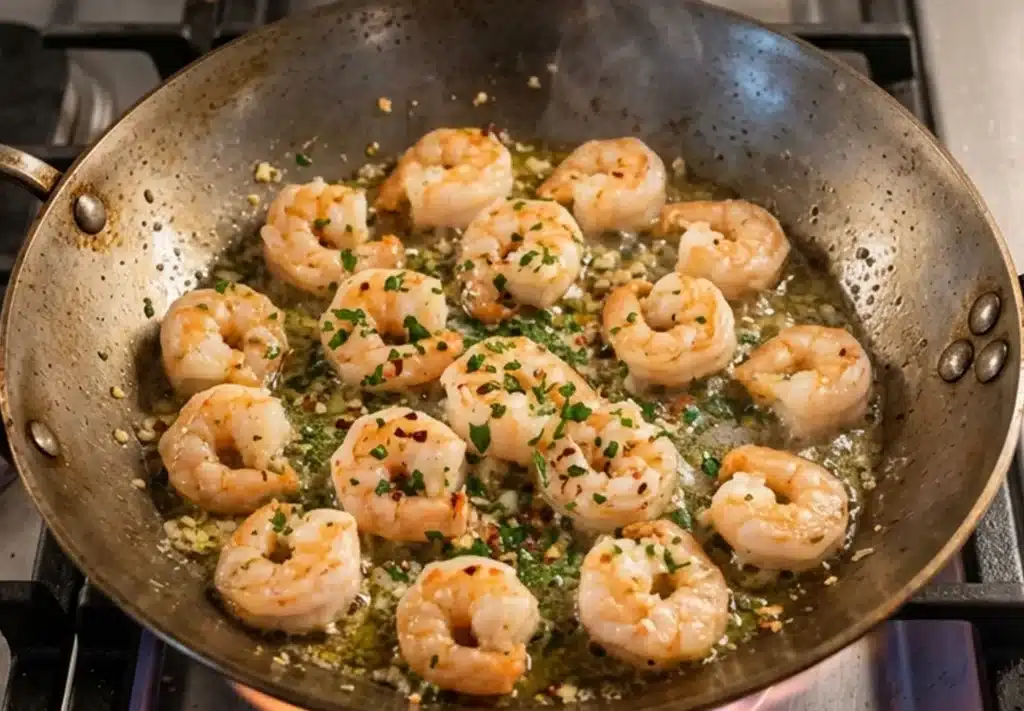
It needs very little. Three minutes in a hot pan, a grill, or an air fryer.
The main risk is not fat, it is time. Overcooked shrimp turns rubbery fast and the window is genuinely about ninety seconds a side. A dry surface helps more than people expect, for the reason set out in pat fish dry before cooking.
Worth naming the things that quietly undo the numbers above, since none of them is the shrimp’s fault. Breading and deep frying, which roughly doubles the calories. Butter or cream sauces, which is where the saturated fat you avoided walks back in. And salt on top of shrimp that was already brined, which is the sodium point again.
None of that is an argument against any of those dishes. It is an argument for knowing which set of numbers you are actually eating.
If you want the technique properly, that is in the ultimate guide to shrimp, and grilled shrimp skewers is the easiest way to make a lot of it at once.
So, is shrimp healthy?
Yes, and the reason is more interesting than the answer.
Shrimp looks worse on paper than it performs, because the number people judge it by turned out to be the wrong number. It carries a lot of dietary cholesterol and almost no saturated fat, and current understanding says the second of those matters far more.
What is left, once you set that aside, is one of the most protein-dense foods available for the calories, a complete amino acid profile, and a handful of micronutrients that are easy to miss elsewhere. In a package that cooks in three minutes.
The caveats are real and they are short. If you have a shellfish allergy, none of this is for you. If you are a hyper-responder or under medical advice about cholesterol, follow that advice. And if sodium matters, read the ingredient list rather than the nutrition panel, because the processor has more influence over that number than the animal did.
If you want some, ours is Ocean Wise recommended and frozen at source, and it is in the market.