Order scallops at a middling restaurant and you already know how it goes. They arrive pale and a little shrunken, sitting in a shallow puddle, soft where they should be crisp. That is not entirely the cook’s fault. Those were almost certainly not dry-packed scallops, and no cook alive can make a waterlogged scallop sear no matter how hot the pan runs.
Most scallops sold in North America are what the trade calls wet. We only sell dry-packed scallops, and the difference is not a marketing word. It is a chemical soak, a load of added water, and whether the scallop in your pan browns or steams. Here is what is actually going on, and how to make sure you never pay for water again.
What a wet scallop actually is
A wet scallop has been soaked in a solution of water and sodium tripolyphosphate, STPP for short. America’s Test Kitchen, which treated and tested scallops itself to measure the effect, found the soak makes them pull in and hold water, adding around 14 percent to their weight before they ever reach your kitchen. In the industry those are called wet scallops. The ones left alone are dry.
It helps to know why the practice exists, because it is not simple villainy. Scallops are shucked at sea, often days from port, and then frozen for a supply chain that can stretch across a continent. The phosphate soak keeps them from drying out and shedding weight over that long haul, and it turns a delicate, fast-spoiling shellfish into something that ships and stores like a commodity. That is a real problem it solves. The catch is who it solves it for. Every benefit lands on the side of the people moving scallops in volume, and every cost lands on the one person the whole chain supposedly exists to feed.
STPP is a real preservative, and it does something genuinely useful for the person selling the scallop. It stretches shelf life and it pads the weight. A scallop that drank 14 percent water weighs 14 percent more, and scallops are sold by the pound. So you carry home water at the price of shellfish. The same compound turns up in synthetic detergents, which is a decent clue about what it can do to flavour. The soak works beautifully for the producer. It works against the cook.
Why dry-packed scallops sear and wet ones steam
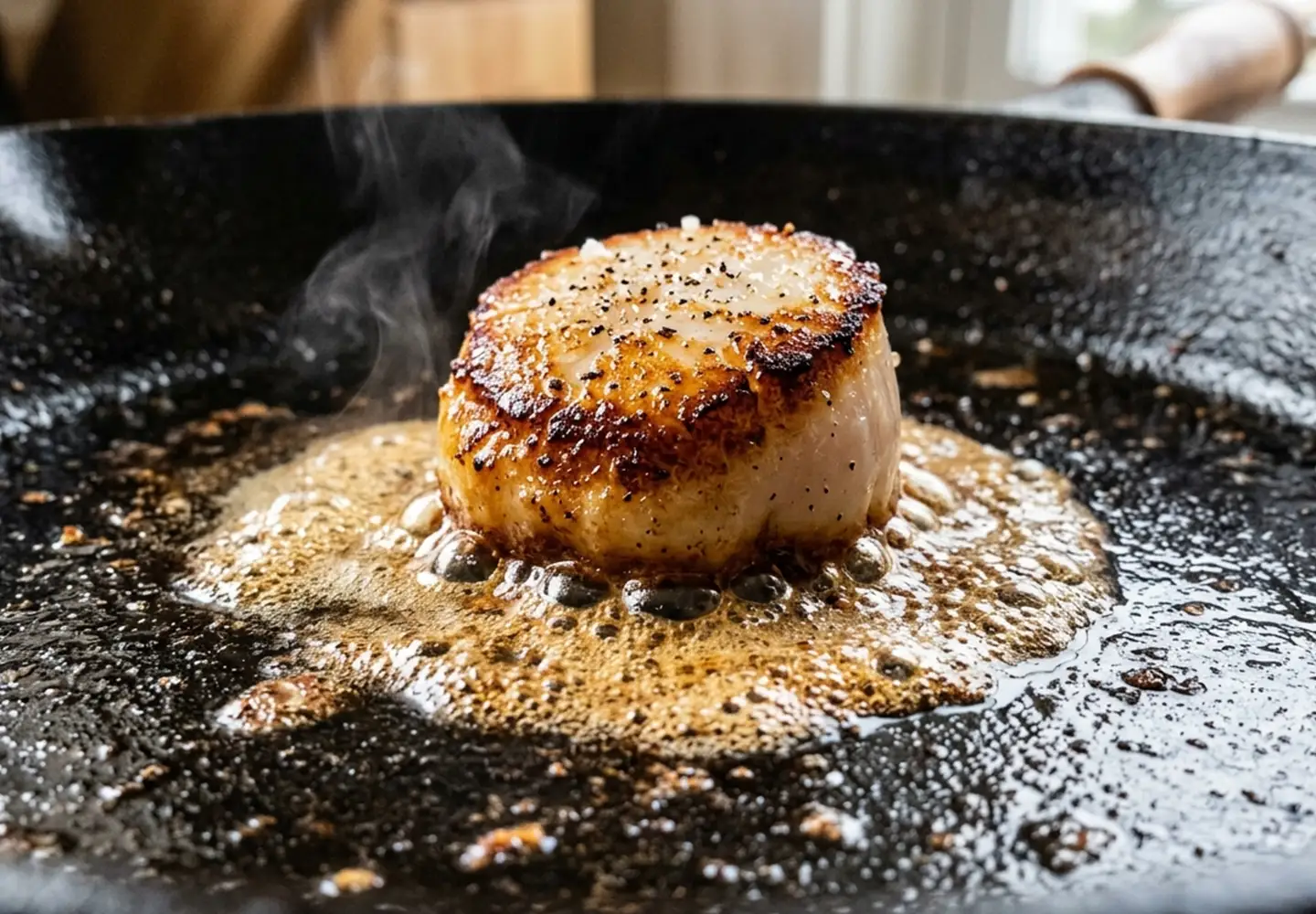
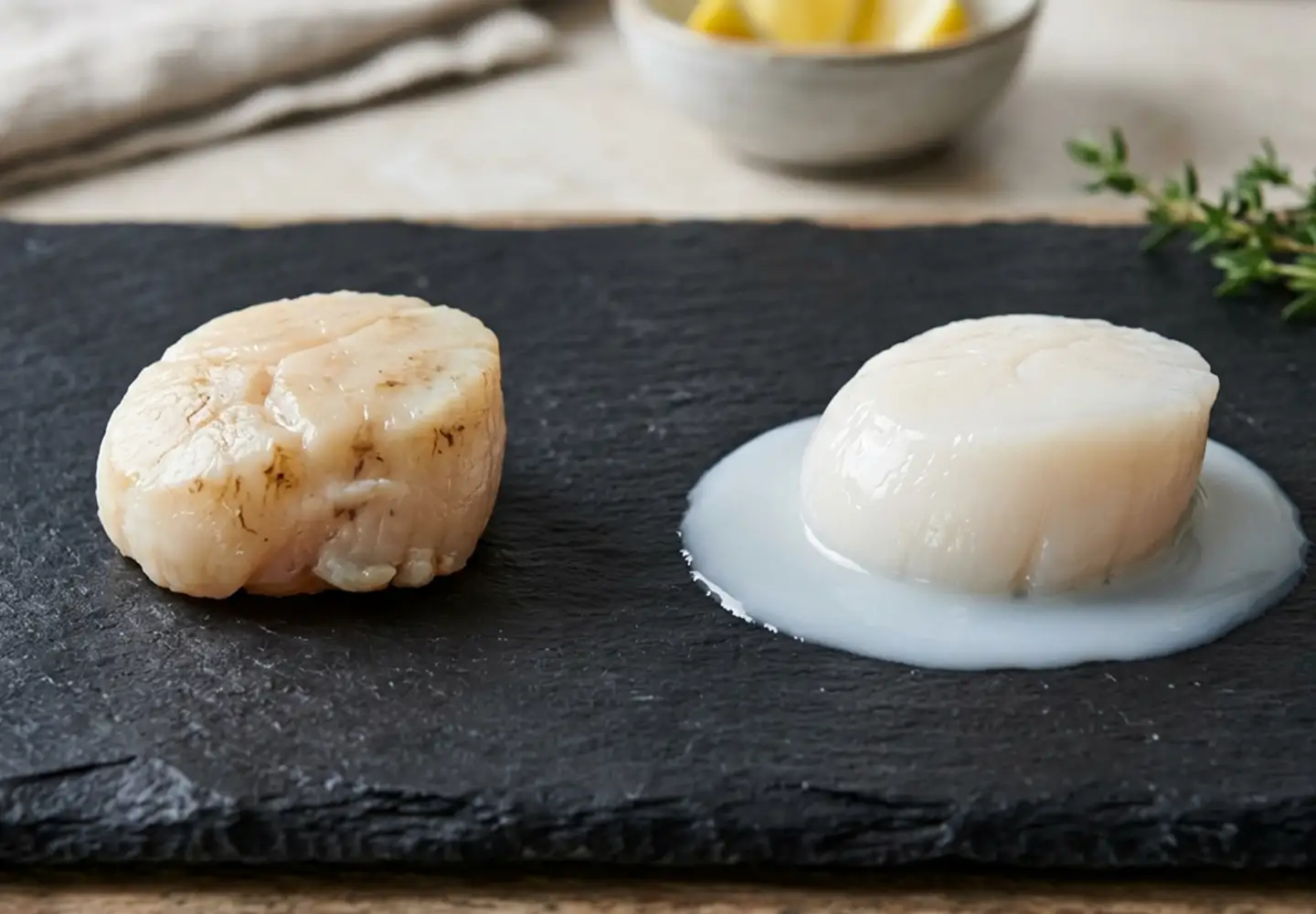
Here is the mechanism, because it is the whole argument in one image.
A good sear is the Maillard reaction, the browning that builds flavour and crust. It needs a hot, dry surface. Drop a scallop into a screaming pan and the surface has to hit high heat fast and stay there. A wet scallop cannot. It is carrying a reservoir of brine, and the moment it hits the pan that water floods out, the temperature crashes, and the scallop sits there simmering in a puddle instead of browning. America’s Test Kitchen measured this too: treated scallops shed about 25 percent more moisture in the pan than dry ones. What you get is a pale, rubbery, faintly soapy disc with a bouncy texture and no crust.
A dry-packed scallop has nothing to boil off. Its surface dries and browns, the sugars caramelize, and you get the deep amber crust and the sweet, briny centre that made you want scallops in the first place. We break down the full method in how to cook scallops, but every step in it assumes one thing: that the scallop was dry to begin with. Technique cannot rescue a wet scallop. It can only stop making things worse.
The flavour follows the same logic. A dry scallop tastes of itself, clean and faintly sweet, with the firm-tender bite of muscle that has not been waterlogged. A wet one tastes of not much, its sweetness thinned by the water it soaked up and shadowed by that faint soapy note from the phosphate. You did not overcook it. It arrived that way.
How to spot a dry-packed scallop
You do not need a lab. You need your eyes, a question, and about fifteen seconds.
- Look at the colour. Dry scallops look like food. They range from ivory to pale tan, sometimes with a faint pink or orange cast. Wet scallops look processed: bright, uniform, almost bleached white.
- Look at the liquid. Wet scallops usually sit in a milky, cloudy pool. Dry scallops are comparatively, well, dry.
- Ask. Ask whoever is selling them whether they are wet or dry. Anyone worth buying from will know the answer without hesitating.
The fifteen-second test
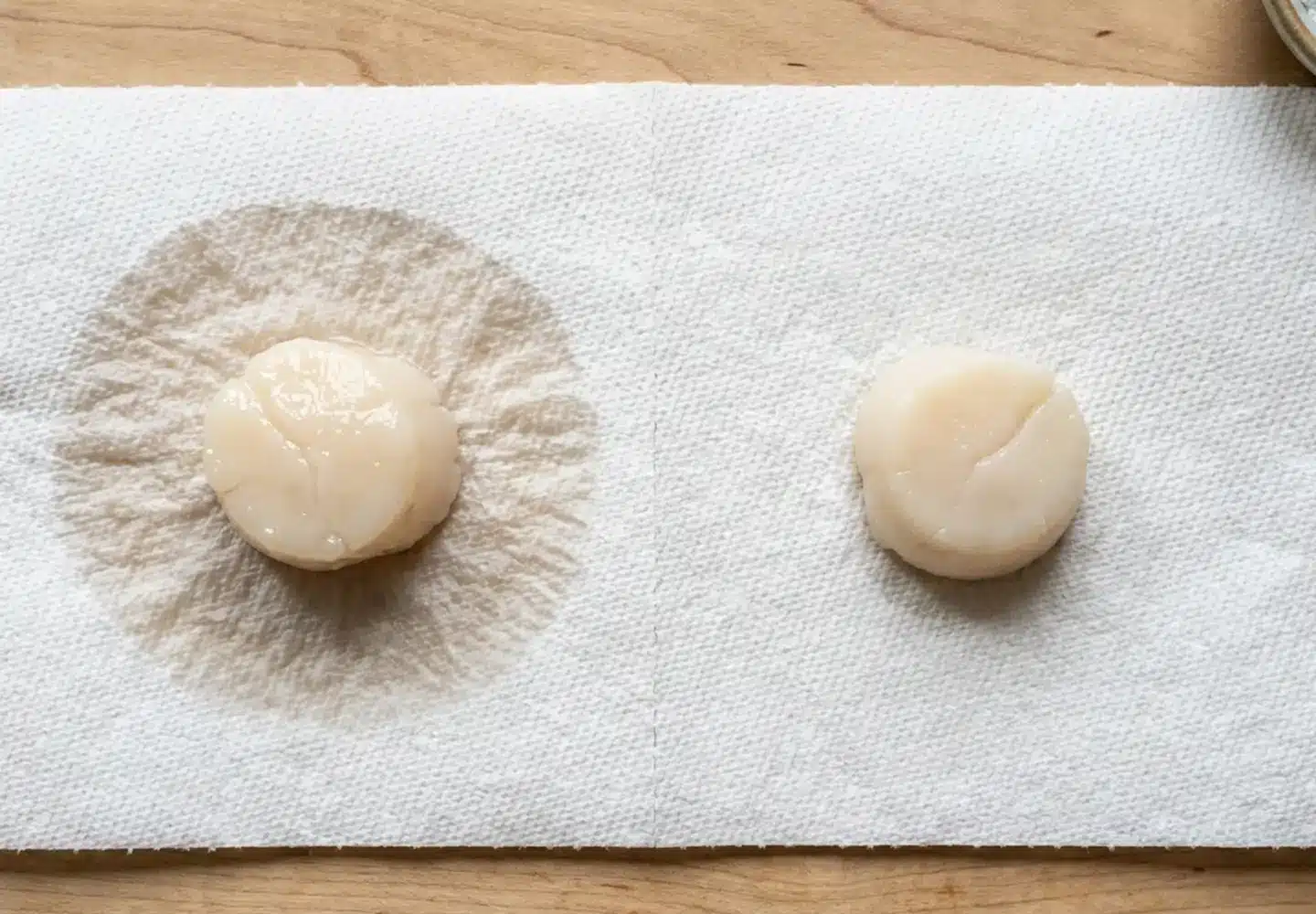
If you already have scallops at home and you are not sure what you bought, run the test America’s Test Kitchen recommends. Put one scallop on a paper-towel-lined plate and microwave it for fifteen seconds. A dry scallop leaves almost nothing behind. A wet one leaves a clear ring of water on the towel. Either way you can still cook the scallop, so nothing is wasted except your remaining doubt.
Why we refuse the soak
This is where we come down on one side of it, plainly. We only carry dry Sea Scallops. No STPP, no phosphate bath, no added water.
The reasoning is simple, and it is the same reasoning behind everything we sell. We would rather hand you a smaller weight that is all scallop than a bigger weight that is part brine. When you buy our Sea Scallops, you are paying for the adductor muscle, the sweet round of meat that the animal actually grew, and nothing else. Not a preservative. Not a few ounces of tap water dressed up as seafood. A dry-packed scallop reads as more expensive per pound and works out cheaper per pound of actual scallop, and it does the one job you bought it for. That trade is not close, so we do not offer the other side of it.
What a dry-packed scallop asks of you
Buy the right scallop and the cooking gets easy, because you are no longer fighting the ingredient.
Pat the scallops dry with paper towel, even the good ones, right before they go in. Get the pan properly hot, oil shimmering and just beginning to smoke. Lay the scallops down without crowding them, because a crowded pan cools and steams just like a wet scallop does. Then leave them alone. Do not poke, do not slide, do not check. Give them a couple of minutes to build a crust, flip once, and finish. That is the entire skill. If you want it done for you on a weeknight, our Bacon-Wrapped Scallops take the same dry-packed scallop and make it close to foolproof.
The bottom line
Wet scallops are a good deal for almost everyone in the chain except the person standing at the stove. They store longer, weigh more, and cost the seller less. They also refuse to sear, taste washed out, and charge you for water.
Dry-packed scallops ask you to pay a little more per pound and give you back a lot more scallop, plus the crust and the clean, sweet flavour that make the whole thing worth cooking. That is not a hard call, which is why we only sell dry-packed scallops. When you want a batch that behaves in the pan, they are waiting in the shop.