

The salmon health benefits conversation usually starts and ends with omega-3s. That’s understandable. Omega-3s are the headline. But the full picture is more interesting than the headline suggests. A single serving of salmon delivers complete protein, vitamin D in a form your body actually absorbs, B12, selenium, and meaningful amounts of EPA and DHA, the two omega-3 fats most Canadians don’t get enough of.
This article walks through what the science actually says about salmon health benefits, how salmon compares to other proteins, and how to add more of it to your week without overthinking it.
Why salmon is a serious protein, not just a healthy choice
Three things make salmon stand out among proteins:
Complete protein. Salmon supplies all nine essential amino acids your body cannot make on its own. About 22 grams of protein per 100 grams cooked. Enough to support muscle maintenance, recovery, and the structural protein needs that build everything from skin to enzymes.
Omega-3s in the form that matters. EPA and DHA, the two omega-3 fatty acids with the strongest evidence for heart and brain health. Most Canadians underconsume them. According to Statistics Canada research, Canadian adults have a mean Omega-3 Index of 4.5 percent, while the low-risk threshold is 8 percent. Fewer than 3 percent of Canadians meet that threshold.
Micronutrients that are hard to get elsewhere. Vitamin D, vitamin B12, and selenium. Vitamin D in particular is difficult to get from food, and salmon is one of the few significant natural sources.
Heart and Stroke Foundation explains that EPA and DHA from fish may help lower triglycerides and blood pressure and support cardiovascular health. Canadian health guidance encourages at least two servings (about 175 g of cooked fish) per week to support omega-3 intake.
Salmon vs beef: a head-to-head nutrition comparison
Beef is the usual red-meat benchmark for protein. Here’s how 100 grams of cooked Atlantic salmon stacks up against 100 grams of cooked lean ground beef.
| Nutrient | Atlantic salmon (farmed, cooked) | Lean ground beef (85%, cooked) |
|---|---|---|
| Calories | 206 kcal | 256 kcal |
| Protein | 22.1 g | 27.7 g |
| Total fat | 12.4 g | 15.3 g |
| Saturated fat | 2.4 g | 5.8 g |
| Omega-3 (EPA+DHA) | ~2,300 mg | ~50 mg |
| Cholesterol | 63 mg | 89 mg |
| Vitamin D | 13.1 mcg (~526 IU) | ~0 mcg |
| Selenium | 41.4 mcg (~75% DV) | 21.6 mcg (~39% DV) |
| Vitamin B12 | 2.8 mcg (~117% DV) | 2.8 mcg (~117% DV) |
Sources: USDA FoodData Central for both proteins. Omega-3 in beef estimated from NIH ODS data scaled to 100 g cooked.
The takeaway is straightforward. Salmon delivers comparable protein at fewer calories, less than half the saturated fat, dramatically more omega-3, and nearly half the cholesterol of beef. It also brings vitamin D and selenium that beef does not.
This doesn’t mean beef has no place on the plate. It means that swapping one red-meat meal a week for salmon is one of the simplest nutritional upgrades available to most Canadian eaters.
Seven science-backed salmon health benefits
The case for eating salmon regularly rests on a body of clinical and observational research. Here are the most evidence-backed salmon health benefits.
1. Heart health
Omega-3 fatty acids EPA and DHA in salmon help lower triglycerides, support healthy blood pressure, and maintain flexible blood vessels. Studies indicate that two servings of fish per week may reduce the risk of heart disease. Salmon is one of the most omega-3-dense ways to hit that target. For a deeper look at fish and cardiovascular health, see our companion piece on the best fish for heart health.
2. Brain function and cognition
DHA is one of the primary structural fats in the brain. Research published in peer-reviewed journals links higher omega-3 intake with better memory, learning, and focus, especially in older adults. Regular salmon consumption may help slow cognitive decline and support brain function across the lifespan.
3. Joint and inflammation support
Clinical research in the Journal of Orthopaedic Surgery and Research shows that omega-3 supplementation provides relief in people with osteoarthritis through reduced pain and improved joint function. Studies in the Journal of Clinical Rheumatology document similar effects on rheumatoid arthritis. The anti-inflammatory action comes from down-regulating pro-inflammatory cytokines and protecting cartilage.
4. High-quality protein for muscle maintenance
Salmon is a complete protein, supplying all the essential amino acids your body needs to build, repair, and maintain muscle, bone, and organs. Seafood generally contains 20-30% protein by weight, making salmon one of the most protein-dense whole foods available. For more on how much protein you actually need from fish, see our piece on how much protein in fish.
5. Natural vitamin D source
Health Canada notes that vitamin D plays a critical role in bone health, immune function, and muscle function. Few foods naturally contain vitamin D, but salmon is one of them. A single serving can provide up to half your daily needs. Canadians, especially in northern regions, often need extra vitamin D during winter months when sunlight exposure is limited.
6. Eye health support
The Canadian Ophthalmological Society confirms that omega-3s and antioxidants like astaxanthin (the natural pigment that gives salmon its colour) help protect eyes from age-related macular degeneration and dryness. Regular fish intake supports retinal health and reduces oxidative stress.
7. Mood and mental health
Research links higher omega-3 intake with lower risk of depression and anxiety. EPA in particular plays a role in neurotransmitter signalling and inflammation control in the brain. Some clinical studies show modest improvement in mood among those who eat fish regularly or supplement with omega-3s.
Why sourcing matters for salmon health benefits
Not all salmon delivers the same nutritional profile. Feed, environment, handling, and freshness all matter.
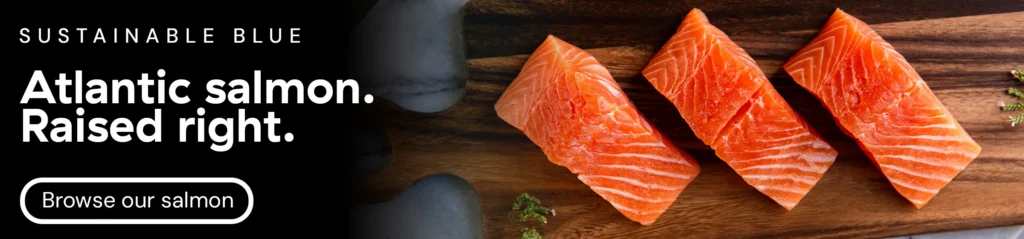
Farmed Atlantic salmon, the most common type sold in Canada, often delivers higher total omega-3s per 100 grams than wild Pacific species because of richer feed. The trade-off is that farming methods vary enormously. Open-net pen aquaculture comes with documented environmental impacts and disease pressures that can affect both fish quality and ecosystem health. Land-based closed-loop aquaculture, the model used by our partner Sustainable Blue, avoids those impacts while maintaining the nutritional profile that makes Atlantic salmon worth eating.
Beyond environmental sourcing, freshness matters for nutrient retention. Salmon frozen at peak quality holds its omega-3 profile, vitamin D, and protein content remarkably well. Salmon that’s been mishandled or sitting on ice for days starts losing both nutritional and culinary quality. For the full breakdown, see our piece on wild vs farmed salmon in Canada and our ultimate guide to salmon.
We carry Sustainable Blue salmon because it meets the standard we apply to every product: traceable, responsibly raised, frozen at peak quality, and consistently excellent. Available in a 12 portion pack or 24 portion pack for easy weeknight cooking.

How to actually eat more salmon
The salmon health benefits only matter if you eat the fish. Here’s the practical version.
Make swaps, not additions. Replace one red-meat dinner this week with salmon. Same time commitment, dramatically different nutritional outcome.
Match the cooking method to the fillet. Thicker cuts handle high heat better. Pan-sear, oven-bake, grill, or air-fry depending on what’s easiest. For specific techniques, see our pillar on how to cook salmon.
Build it into your meal prep rotation. Salmon holds up beautifully for two to three days after cooking, which makes it one of the better proteins for batch cooking. For specifics, see our piece on the best fish for meal prep.
Try a few different preparations. Variety prevents boredom. Our recipe collection has tested salmon recipes including crispy dry-brined salmon, air fryer salmon bowls, and maple mustard glazed salmon.
Keep some on hand. Frozen salmon thaws overnight in the fridge and cooks in minutes. Having it in the freezer turns “what’s for dinner” from a question into an answer.
Final thoughts on salmon health benefits
The case for eating more salmon is one of the more straightforward arguments in nutrition. Complete protein with a fraction of the saturated fat of red meat. Significant omega-3 content in an era when most Canadians don’t get enough. Naturally occurring vitamin D when most foods provide none. Trace minerals like selenium that support immune function. And it tastes good.
The salmon health benefits aren’t a single nutrient story. They’re a combination that makes salmon one of the few foods most people would benefit from eating more often. Two servings a week is a reasonable target. One swap from your current rotation is a reasonable place to start.
If you want salmon that delivers on all of this without the trade-offs that come with conventional aquaculture, browse our shop for our full Sustainable Blue product line. Or learn more about why we only carry one type of Atlantic salmon and the standards behind that decision.