When it comes to sustainable salmon in Canada, most seafood markets carry three or four Atlantic salmon options on the shelf. Norwegian. Scottish. Canadian East Coast. Sometimes Faroese. Different price points, different labels, different farms. The customer is expected to choose.
We carry one. The reason isn’t that we couldn’t get the others. The reason is that we decided we shouldn’t. This article explains how we got to that decision, and what it says about how we approach salmon sourcing more broadly.
What “sustainable” actually means to us
Sustainable is a word that’s been used badly for so long that it’s lost most of its meaning. Every supplier claims to be sustainable. Every label promises responsibility. Every brand has a story about commitment to the ocean. None of it tells you what’s actually happening at the source.
We use a working definition: a product is sustainable to us if its production doesn’t damage the system it depends on. For seafood, that means fishing and farming practices that don’t degrade wild populations, don’t harm marine habitats, and don’t compromise the ability of fisheries and ecosystems to keep functioning into the future.
That’s a higher bar than most certifications set. Ocean Wise recommended is the minimum standard we require, but Ocean Wise is the floor for us, not the ceiling. We vet producers ourselves on top of that. We look at how they handle waste, how they treat fish, how they manage their workforce, and what their long-term plan looks like. We reject more than we accept.
If we can’t trace it back to a producer we trust, we don’t sell it.
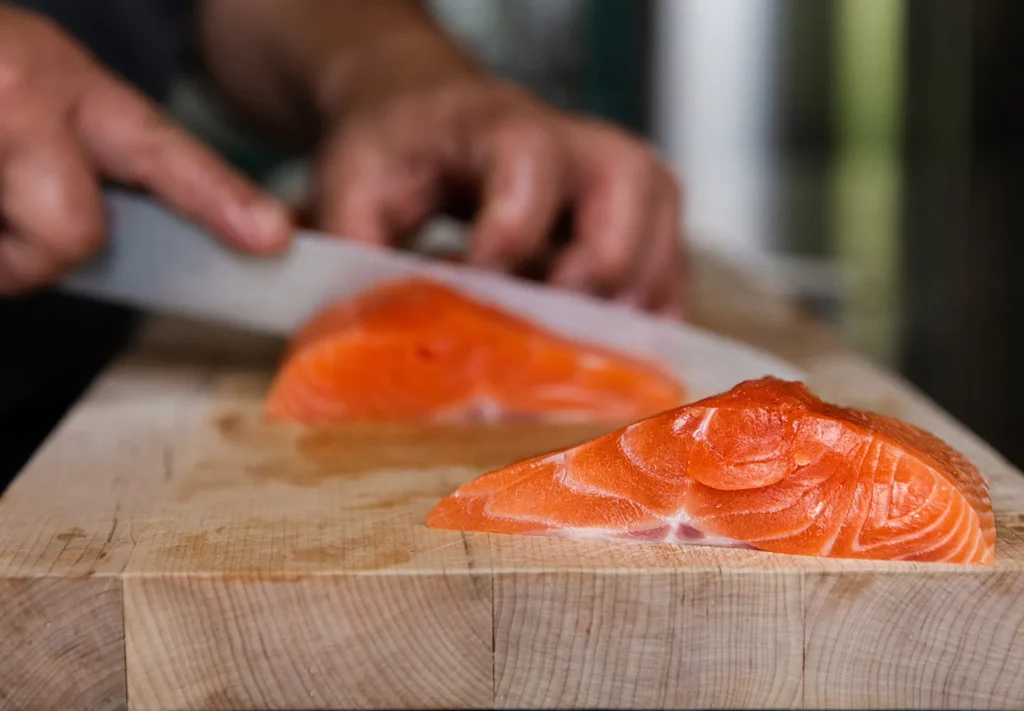
The Atlantic salmon options on the table
For Atlantic salmon specifically, that standard ruled out almost everything available to us. Here’s the walk-through.
Wild Atlantic salmon
Not commercially available in Canada. Wild Atlantic salmon populations on the east coast have collapsed so dramatically over the past 50 years that commercial fishing has been banned since the 1990s. What remains is recreational and Indigenous food fishery with strict catch limits to protect the few populations still hanging on.
When you see “Atlantic salmon” anywhere in a Canadian market, it’s farmed. Always. Wild salmon in the Canadian market is almost exclusively Pacific species: sockeye, coho, chinook, pink, chum. Different species, different flavour, different fat profile, and a separate conversation entirely.
For the long version of how this plays out for Canadian consumers, our pillar on wild vs farmed salmon covers what’s actually available.
Conventional open-net pen Atlantic salmon
Norwegian, Scottish, Canadian East Coast, Faroese. All raised in mesh enclosures suspended in coastal waters. Efficient at scale, much cheaper than alternatives, and responsible for the vast majority of Atlantic salmon sold globally. Also responsible for the well-documented environmental impacts of intensive ocean farming: sea lice transfer to wild populations, antibiotic and pesticide use, fish escapes, effluent discharge, dead zones beneath cages, and recurring mass die-offs from disease and rising water temperatures.
This category fails our standard. The damage is real, the externalities are paid by ocean ecosystems, and the industry’s incremental fixes haven’t addressed the underlying model. We won’t carry it.
Organic farmed Atlantic salmon
A small category, mostly Scottish and Norwegian. Better feed standards, no synthetic chemicals, sometimes lower stocking densities. Still raised in open-net pens. The “organic” label addresses some inputs but doesn’t solve the environmental impact of the farming model itself.
Better than conventional, but not enough to clear our standard. We don’t carry it.
Land-based closed-loop Atlantic salmon
Raised entirely on land, in tanks, with no ocean contact. No fish escapes, no disease transmission to wild fish, no effluent discharge, no antibiotics required. The trade-off is energy use, but the environmental impacts are internal to the facility rather than externalized to the ocean. Done well, this is the only model that genuinely meets our standard.
For a deeper look at the technology and the trade-offs, our piece on the case for land-based aquaculture covers the category in detail.
This category passes the bar. The question is which producer.
How we got to Sustainable Blue
Once we narrowed Atlantic salmon to land-based producers, we evaluated the available options. Most land-based salmon operations recirculate some water but still discharge a portion. Some use closed-loop systems but rely heavily on antibiotics or growth hormones. Some have strong technical credentials but limited transparency. The category is real, but the producers within it vary considerably.
Sustainable Blue was the producer that met every part of our standard: closed-loop with zero discharge, no antibiotics, no growth hormones, no fish escapes, full traceability, located close to home in Centre Burlington, Nova Scotia. Our full case for why Sustainable Blue is the only Atlantic salmon we carry lays out the specific reasoning.
The point of this article isn’t to make the case for Sustainable Blue. The point is to show how we got there. We didn’t start with a partner and rationalize backward. We started with a standard, applied it to every category, and ended up with one option that cleared the bar.
This is how we approach everything
The salmon decision isn’t a one-off. It’s the same process we use for every category we carry.
For shrimp, we evaluated wild and farmed options globally. Most farmed shrimp comes from regions with documented mangrove destruction, antibiotic abuse, and labor concerns. We carry Ocean Wise recommended Pacific White Shrimp from vetted Indian farms and wild Atlantic Coldwater Shrimp from Canadian waters. Two products, two distinct sourcing stories, both meeting the standard.
For haddock, we looked at Atlantic Canadian, Icelandic, and various imports. We use Icelandic haddock in products like our breaded haddock because Iceland’s fishery management ranks among the best in the world and the cold North Atlantic produces consistently high-quality fish. For haddock fillets and seafood medleys, we focus on Atlantic Canadian haddock whenever possible, though supply remains more limited as stocks continue to recover.
For sustainable salmon in Canada, we came to the same conclusion we always do: the producer matters more than the category itself. Actually, for every product we carry, the question stays the same: does this producer’s practice meet our standard? If yes, we consider it. If no, we don’t, regardless of price pressure or customer demand. We’ve turned down opportunities to carry cheaper salmon, more salmon varieties, and salmon from suppliers with persuasive marketing because they didn’t pass the test.
This is how a seafood market built around shortening the supply chain has to work. If we sold whatever we could get and let customers sort the ethics out themselves, we’d be just another fish counter. We’re trying to be something different.
Sustainable salmon in Canada: What this means for you
The practical implication is that when you shop with us, you don’t need to sort through options trying to figure out which one meets your values. We’ve already done that work. Everything in our shop has cleared a standard we’ll defend publicly.
This doesn’t mean we’re the only honest seafood seller in Canada. Plenty of operators do this work well. It means that if you trust us, you don’t need to research every product before you buy.
For Atlantic salmon specifically, the option is Sustainable Blue salmon, available in 12 portion packs for weeknight cooking or 24 portion packs for households that cook salmon regularly. For the rest of what we sell, our shop is where you’ll find it.
The choice we made on salmon is the choice we make on everything. Carry one good option and explain why, instead of stacking up alternatives and hoping you’ll pick well. We think that’s the more honest way to sell seafood.