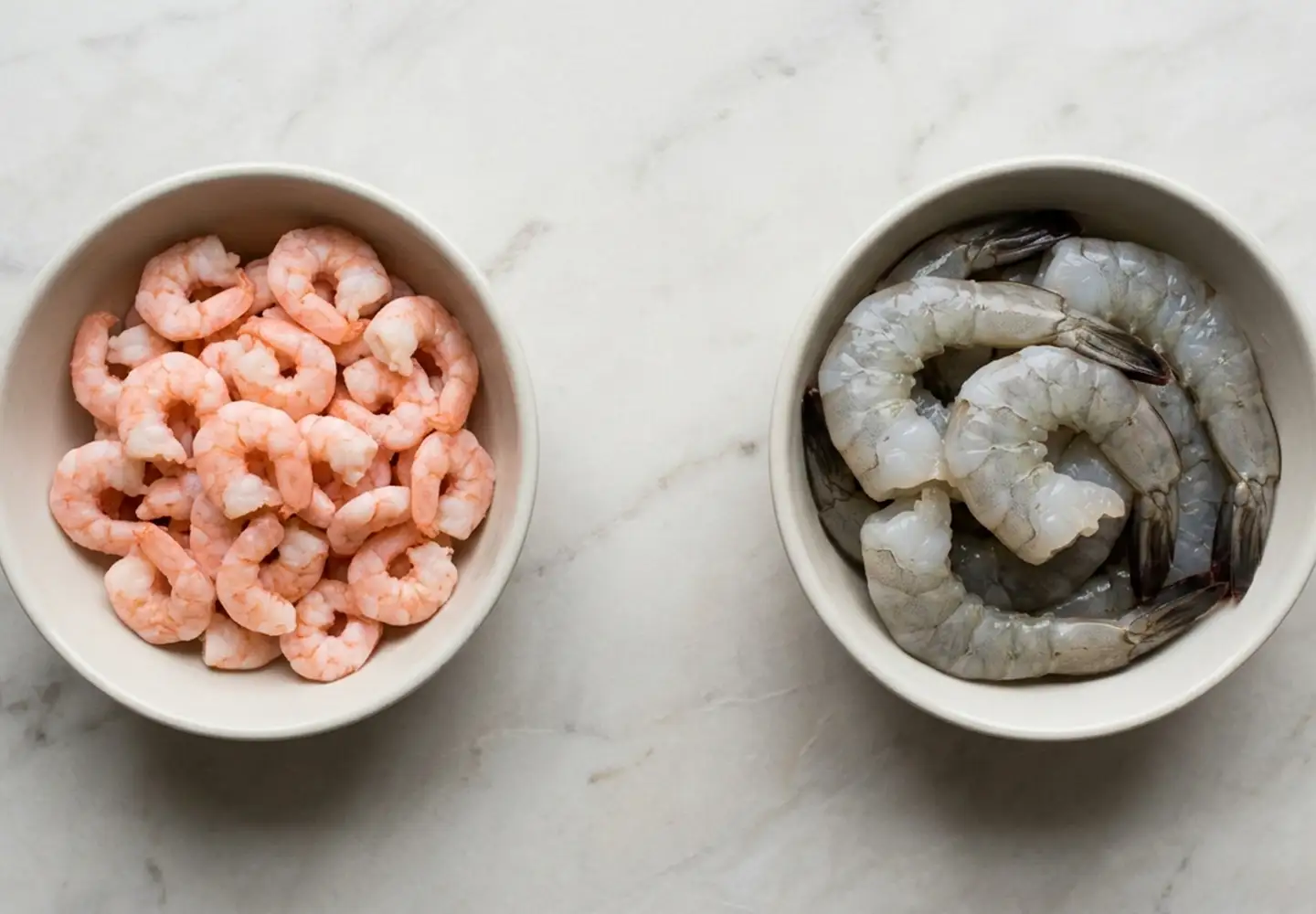
Most seafood counters sell shrimp the way hardware stores sell screws. They sort by size, as though the only question is how big. Almost nobody asks the question that actually decides the dish, which is cooked vs raw shrimp. So people see our two shrimp side by side and assume one is the small option and one is the large. Then they choose on budget, or on ambition.
That is not what is going on. One of ours arrives already cooked and one arrives raw. They are different species. A fishery catches one and a farm raises the other. They reach your freezer in completely different states, and mixing them up is how good shrimp ends up disappointing people.
Coldwater shrimp are a different species, not a smaller grade
Our coldwater shrimp are Pandalus borealis, the northern shrimp. They are a deep, cold-water animal. The University of Michigan’s Animal Diversity Web puts their usual range between 2 and 6 degrees Celsius. They tolerate water as cold as minus one, and they live between 100 and 600 metres down.
They also have one of the stranger life histories in the North Atlantic. Every northern shrimp hatches male. Each one lives a year or more as a male, then transitions into a female and grows substantially larger. It stays that way for the rest of its life. Which means a bag of coldwater shrimp is, biologically speaking, mostly middle-aged females.
Atlantic cod also eat them, a relationship that has shaped the fishery in ways worth their own article. The sourcing story covers where these come from and how the fishery got here.
For cooking purposes, two facts matter more than any of that.
They arrive already cooked
Not cooked in a plant. Cooked on the boat, in salt water, within minutes of coming out of the ocean. That is what the word seasoned means on the bag: sea water, not a spice rub.
These shrimp are too small and too delicate to hold their quality on a long raw trip to shore. The fishery solved that problem a long time ago: cook them on the water.
Jumbo does not mean large
They are also small, and no grade changes that. We sell ours as Jumbo, at 90 to 150 count. That number is shrimp per pound, not a size promise. Coldwater shrimp are naturally small, so Jumbo is simply the biggest grade the species offers.
It is not a large shrimp. Anyone expecting one will feel that the word misled them, though it never lied.
Pacific White shrimp are built to take heat
Our Pacific White Shrimp are Litopenaeus vannamei, farmed, and they show up raw. They run 21 to 25 count, which is to say large, and they come peeled with the tail on. We freeze them individually, so you can shake out eight and put the bag back.
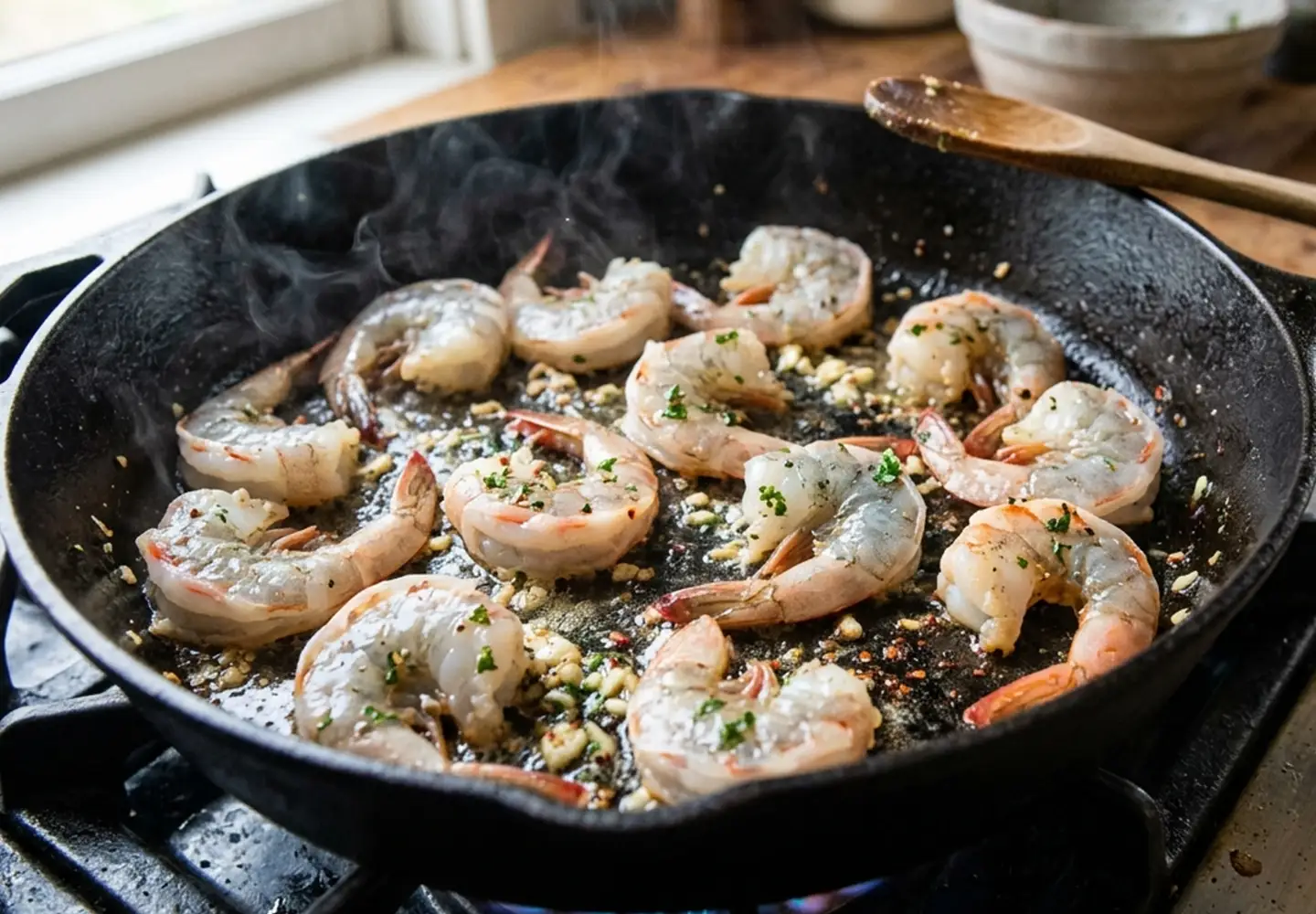
The flavour is mild and clean. That sounds like faint praise. We do not mean it that way. A mild shrimp takes on whatever you season it with and does not argue back. That is what you want in a taco, a curry, a garlic pasta, or anything where a sauce does the work.
The texture is firm and slightly snappy, and it holds that structure under a hot pan or a grill grate. They need about 20 to 30 minutes to thaw, and then roughly three minutes of actual cooking. That short window is the whole game. Plenty of people think they dislike shrimp. What they dislike is shrimp cooked for six minutes.
Cooked vs raw shrimp is the only distinction that matters
One thing reframes the entire comparison. It is not size, species, wild versus farmed, or price.
It is whether the cooking has already happened.
With coldwater shrimp, it has. Your job is not to cook them. Your job is to avoid cooking them. Every minute of heat you apply subtracts from something already finished. It turns tender into rubbery and sweet into flat. Warm them through at the very end of a chowder or a noodle bowl, off the boil. That is the outer limit.
With Pacific White shrimp, the cooking is the entire task. It runs on a three-minute window with no margin.
Once you see it that way, every other difference falls into place. The small sweet ones go into dishes you have already finished and want to add protein to. The large firm ones go into dishes where you are cooking the shrimp itself.
How to choose between the two
Sorted by what you are actually making:
Reach for coldwater shrimp when:
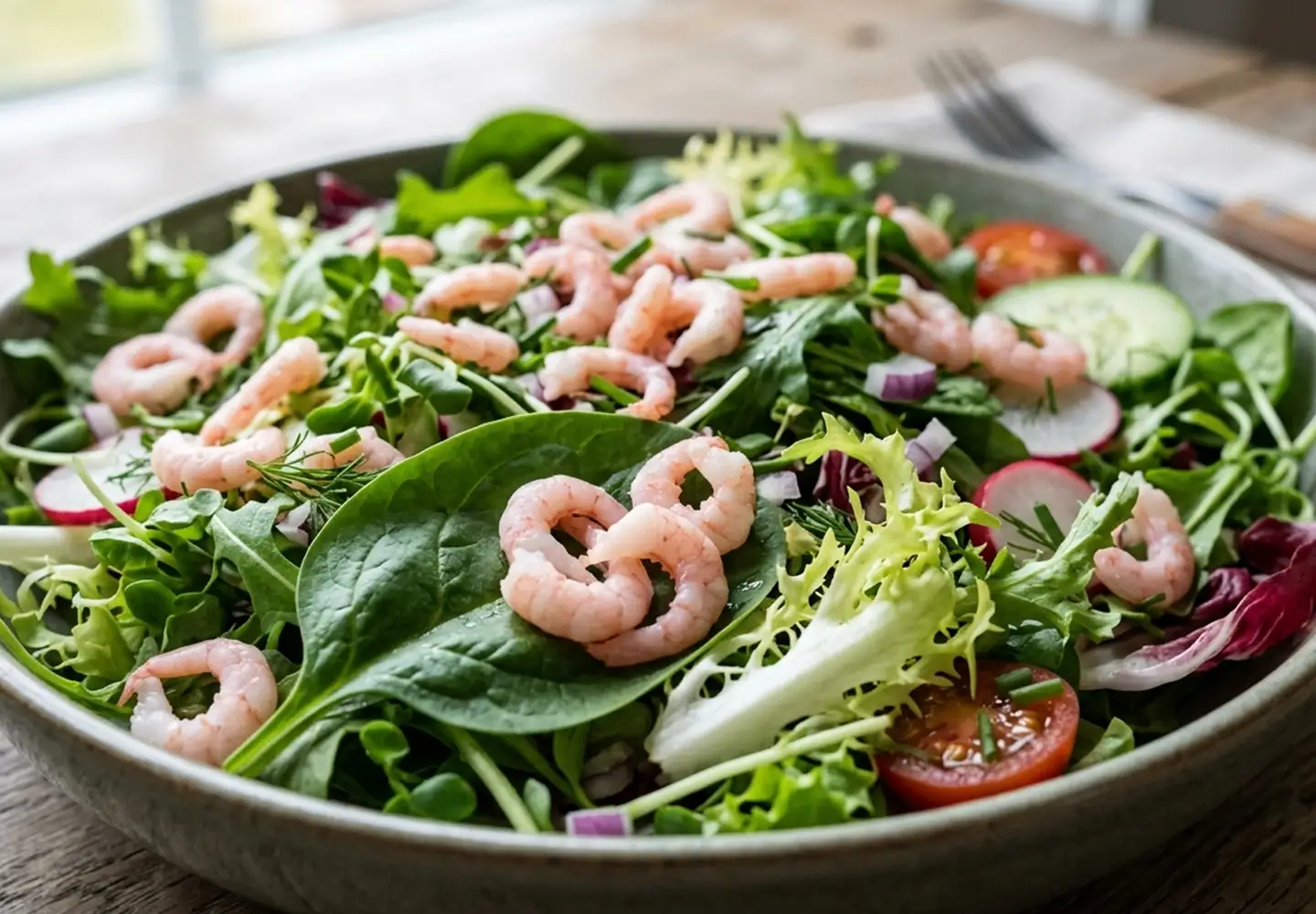
- The dish needs no cooking, or you have already done it. Salads, sandwiches, cold plates, rice bowls, chowder at the end.
- You want seafood in the meal without the meal being about seafood.
- You have no time and no patience. No thawing plan, no timer, no window to miss.
- You want that specific cold-water sweetness, a real and distinct flavour rather than a marketing adjective.
Reach for Pacific White when:
- Heat is the main event. Grilling, searing, roasting, stir-frying, tacos, honey garlic, smoky paprika.
- The shrimp is the centre of the plate and needs to look like it.
- You are watching protein per dollar. A 5 ounce serving gives you 18 grams of protein for under 100 calories, and the broader nutrition case holds up well.
- You want one shrimp that covers most situations.
On price the two run further apart than people expect. Pacific White comes to $3.28 a serving, coldwater to $5.66. That gap is not a quality ranking. It costs more to land and process small wild shrimp cooked at sea than to farm shrimp at scale. We price both honestly for what they are.
Why we carry both instead of picking one
Most direct-to-consumer seafood businesses carry one shrimp. Freezer space is expensive, and a second product only earns its slot if it does something the first cannot.
Ours does. No version of Pacific White shrimp solves the no-cooking problem. No version of coldwater shrimp survives a grill. Curation is not narrowing down to one good thing. It is carrying the specific things that do specific jobs, and being straight about which is which.
So here is the straight version, even though it costs us on the larger order. If you are only buying one, buy the Pacific White. It costs less per serving, handles more situations, and introduces you to how we freeze and pack things. Coldwater shrimp are the second purchase. You make it after you hit the problem they solve and find nothing else that solves it.
The ultimate guide to shrimp covers the wider picture on sizes, counts, and technique across the whole category. For what a properly cooked one tastes like, try the chilli crisp broccoli with shrimp or the Greek lemon herb shrimp.
So, cooked vs raw shrimp: The verdict
Cooked vs raw shrimp really does settle it. If you have already made the dish, take the cooked ones. If the pan is about to get hot, take the raw ones. That single question sorts almost every case. It beats asking which shrimp is better, because neither of them is.
Both sit on the market whenever you want to test the theory. If you get stuck between them, we are happy to talk it through.