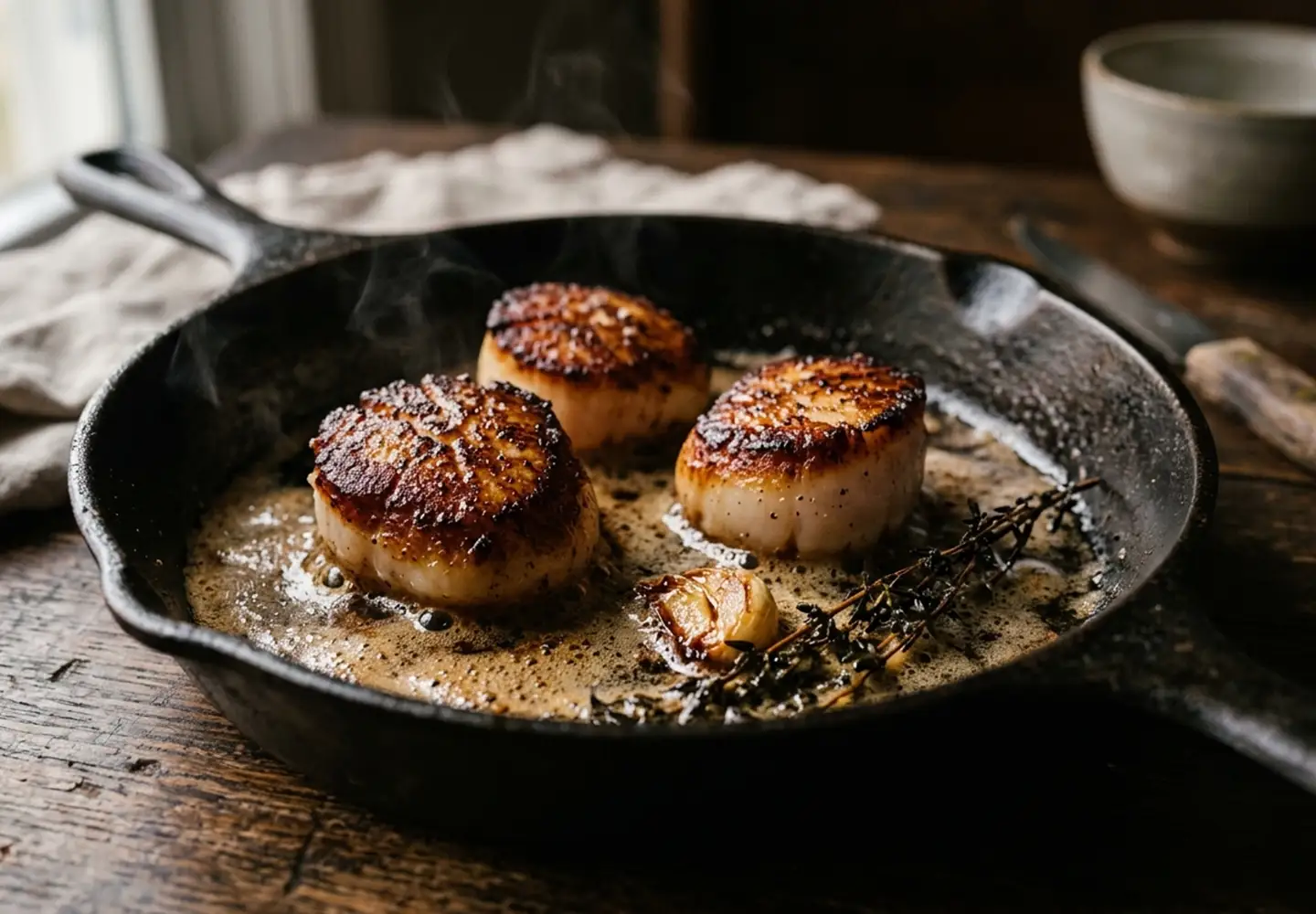
AA good scallop looks like a restaurant trick. Deep brown crust on top, soft and just-translucent in the middle, sitting on the plate instead of in a puddle. Then you cook them at home and get something pale, squeaky, and stewing in its own water. If you have ever wondered how to cook scallops so they actually sear, the honest answer is that most of the work happens before the pan ever gets hot.
Two things decide the outcome: the scallop you bought, and whether you leave it alone once it lands. Talent barely enters into it. Almost every scallop failure traces back to moisture, either water a processor added or water you failed to remove. Solve the moisture problem and the sear mostly takes care of itself.
Start with a dry scallop, not a wet one
Before you touch a pan, you need to know what you bought, because a large share of the scallops sold in North America will not sear no matter how good your technique is.
Scallops come two ways: dry and wet. Dry scallops are shucked, cleaned, and frozen with nothing added. Wet scallops are soaked in a phosphate solution, usually sodium tripolyphosphate, which makes them absorb and hold water. Processors do it because water weighs something and scallops sell by weight. You end up paying scallop prices for added water.
That water is also why wet scallops will not brown. In controlled tests, America’s Test Kitchen found that treated scallops soaked up about 14 percent of their weight in water, then shed roughly 25 percent more moisture in the pan than untreated ones. All that liquid floods the skillet, drops the temperature, and steams the scallop instead of searing it. You are boiling dinner in a hot pan and wondering why it will not brown.
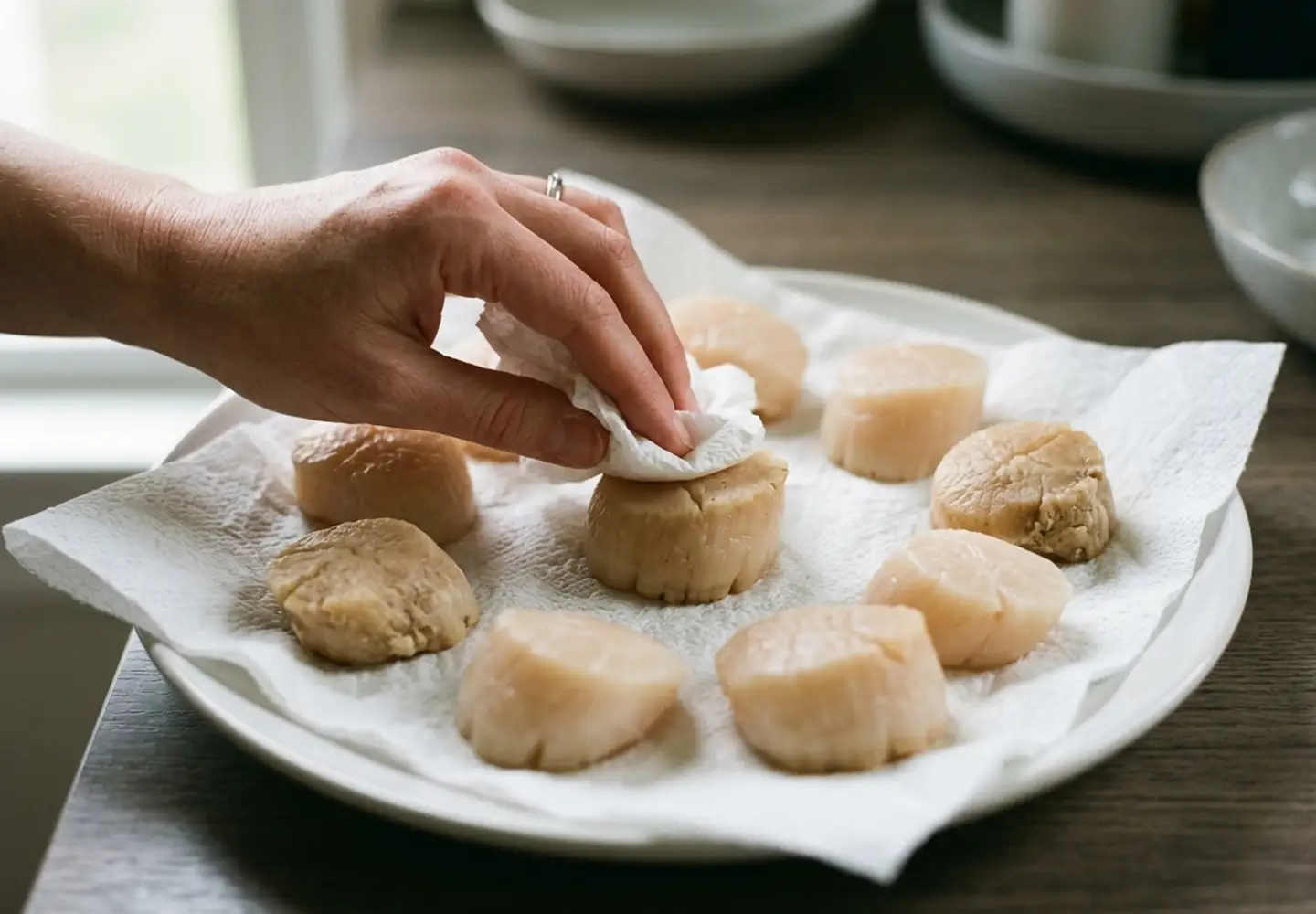
You can usually spot the difference. Wet scallops are bright, opaque white, and often sit in a milky liquid. Dry scallops look slightly off-white or ivory, sometimes faintly tan, and they smell clean and sweet. If you are buying frozen, the label matters more than the look: “dry” or “no phosphates added” is what you want.
This is the whole reason we only carry dry Sea Scallops, packed with nothing added. It reads as more expensive per pound and works out cheaper per pound of actual scallop, and it is the difference between a sear and a simmer. We refuse the phosphate soak for the reasons laid out in why our scallops are dry-packed.
How to cook scallops: the four rules of a good sear
Once you have a dry scallop, the cooking is fast and unforgiving. Scallops go from raw to overcooked in about a minute, so there is no room to fidget. Learning how to cook scallops is mostly learning four rules and then trusting them enough to stop touching the pan.
Rule one: dry them completely
Pat every scallop dry on both faces with paper towel, then do it again. Surface water is the enemy of browning, and even a dry-packed scallop carries some. For the best result, lay them on a paper-towel-lined plate, uncovered, in the fridge for 30 minutes to an hour before cooking. This is the single most important step, and it is the one people skip. The same logic applies to any fish you want a crust on, which is why we wrote a whole piece on why you pat fish dry before cooking.
Rule two: get the pan genuinely hot
Browning is the Maillard reaction, the chemistry that turns the surface of a protein brown and builds savoury flavour, and it needs real heat, well above the boiling point of water. If the pan is not hot enough, the scallop releases moisture faster than that moisture can evaporate, and you are steaming again. Use a heavy skillet, stainless or cast iron, over medium-high to high heat. Add a neutral, high-smoke-point oil, not butter yet, and wait until it shimmers and just begins to smoke. A lukewarm pan is the second most common reason home scallops fail.
Rule three: don’t crowd the pan
Each scallop throws off a little steam. Ten scallops jammed together throw off a lot of it, and that steam has nowhere to go. Give them space, at least a thumb’s width between each one, and cook in two batches if you have to. A crowded pan is a wet pan, and a wet pan does not brown.
Rule four: put them down and leave them alone
When a scallop hits the pan it will stick. That is normal. Proteins bond to hot metal, and as the crust forms the scallop releases on its own. If you poke and slide and flip early, you tear that crust off and lose the browning you were waiting for. Lay each scallop down and do not touch it for 90 seconds to two minutes, until a deep golden crust forms and it lifts cleanly. The same release happens with fish, which we cover in why fish sticks to the pan. If your scallops still refuse to brown after all this, the culprit is almost always moisture or heat.
The method, start to finish
Here is the whole thing in order.
- Thaw and dry. Thaw frozen scallops overnight in the fridge, never on the counter. Pat dry, rest them on paper towel in the fridge, then pat dry again right before cooking.
- Season late. Salt the scallops just before they go in the pan. Salt too early and it pulls water back to the surface, undoing your drying.
- Heat the pan. Heavy skillet, medium-high to high, a tablespoon of neutral oil, until it shimmers and barely smokes.
- Sear. Lay the scallops down with space between them. Do not move them. Sear 90 seconds to two minutes, until the underside is deep brown.
- Flip once. Turn each scallop and cook the second side one to two minutes. The second side browns less than the first. That is fine.
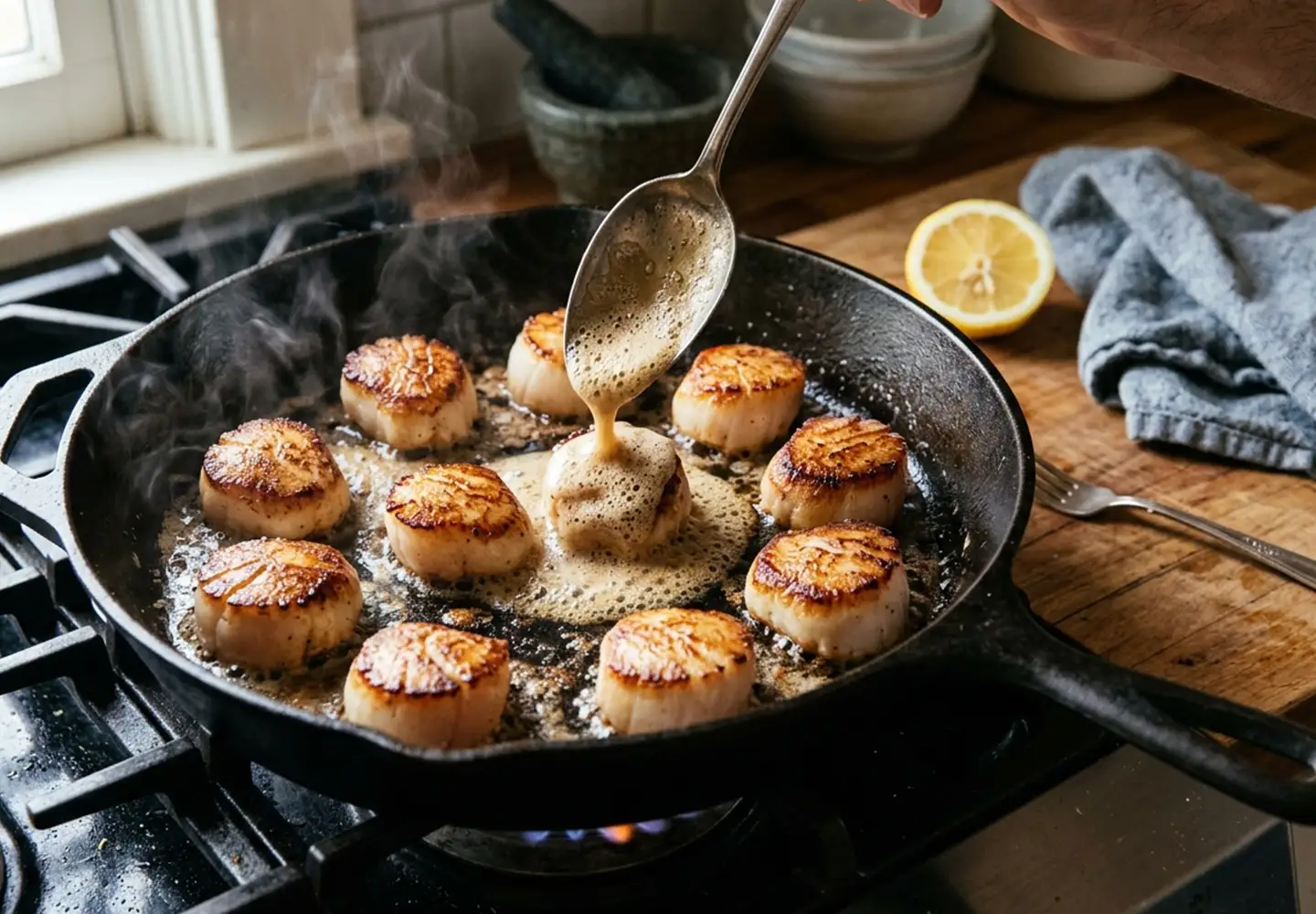
- Finish with butter. In the last minute, add a knob of butter and, if you like, a smashed garlic clove and a sprig of thyme. Tilt the pan and spoon the foaming butter over the scallops a few times.
- Pull them early and rest. Take them off the heat while the centre is still barely translucent; they keep cooking on the plate. Finish with a squeeze of lemon and a pinch of flaky salt, and serve right away.
A finished scallop should be firm at the edges, tender in the middle, and just opaque. If it is bouncy and squeaky, it went too far. Scallops forgive almost everything except time, so when in doubt, pull them a beat sooner.
What to serve with seared scallops
Seared scallops do not need much. They are rich and sweet, so they want either something bright to cut them or something plain to sit against.
- Over a purée. Cauliflower, pea, or celeriac purée turns four scallops into a plate that looks like more than it is.
- With pasta or risotto. A lemon-butter pasta or a simple risotto stretches a small amount of scallop into a full meal.
- Wrapped in bacon for a crowd. Our Bacon-Wrapped Scallops are built for exactly this, sweet scallop against smoky bacon, with almost no work beyond the oven.
- In a chowder or one-pot. When scallops share the plate with other seafood, a mix like our Seafood Medley holds up in soups and chowders where everything cooks together.
Serve them simply and let the sear do the talking. Season at the end, add lemon, and keep the plate uncrowded.
How to cook scallops, the short version
Buy dry scallops. Dry them again at home. Get the pan hot, give them room, and leave them alone until the crust forms. That is the entire method. Once the moisture problem is solved, learning how to cook scallops stops feeling like a restaurant secret and starts feeling like a weeknight habit.
If you want scallops that were frozen dry with nothing added, our Sea Scallops are packed the way a scallop should be, and the rest of the market is stocked the same way. For more ways to cook what you buy, our recipe collection is built around real weeknight cooking.