In the spring of 2021, Oceana Canada took seafood samples from restaurants and grocery stores in four Canadian cities and ran DNA tests on them. Forty-six per cent came back as something other than what the label said. That is the measured scale of seafood mislabelling in this country, and it is not new.
That round was not a fluke. An earlier round of the same investigation tested 472 samples across six cities between 2017 and 2019 and found 47 per cent mislabelled. Different cities, different years, the same answer within a percentage point.
Seafood mislabelling in Canada is not an occasional scandal. It is the background condition.
The number that actually helps you
The headline figure is alarming and not very useful, because it averages two completely different situations.
In that 2021 round, the mislabelling rate at retailers was 6.5 per cent. In restaurants it was 65 per cent. Ten times higher. Those two figures come from trade coverage of the study rather than from the report summary, which is worth knowing given how much weight they carry here.
That gap is the single most actionable fact in this subject. It also moved in opposite directions: retail had come down from a combined 25 per cent average in the earlier studies, while restaurants had gone up from 56 per cent.
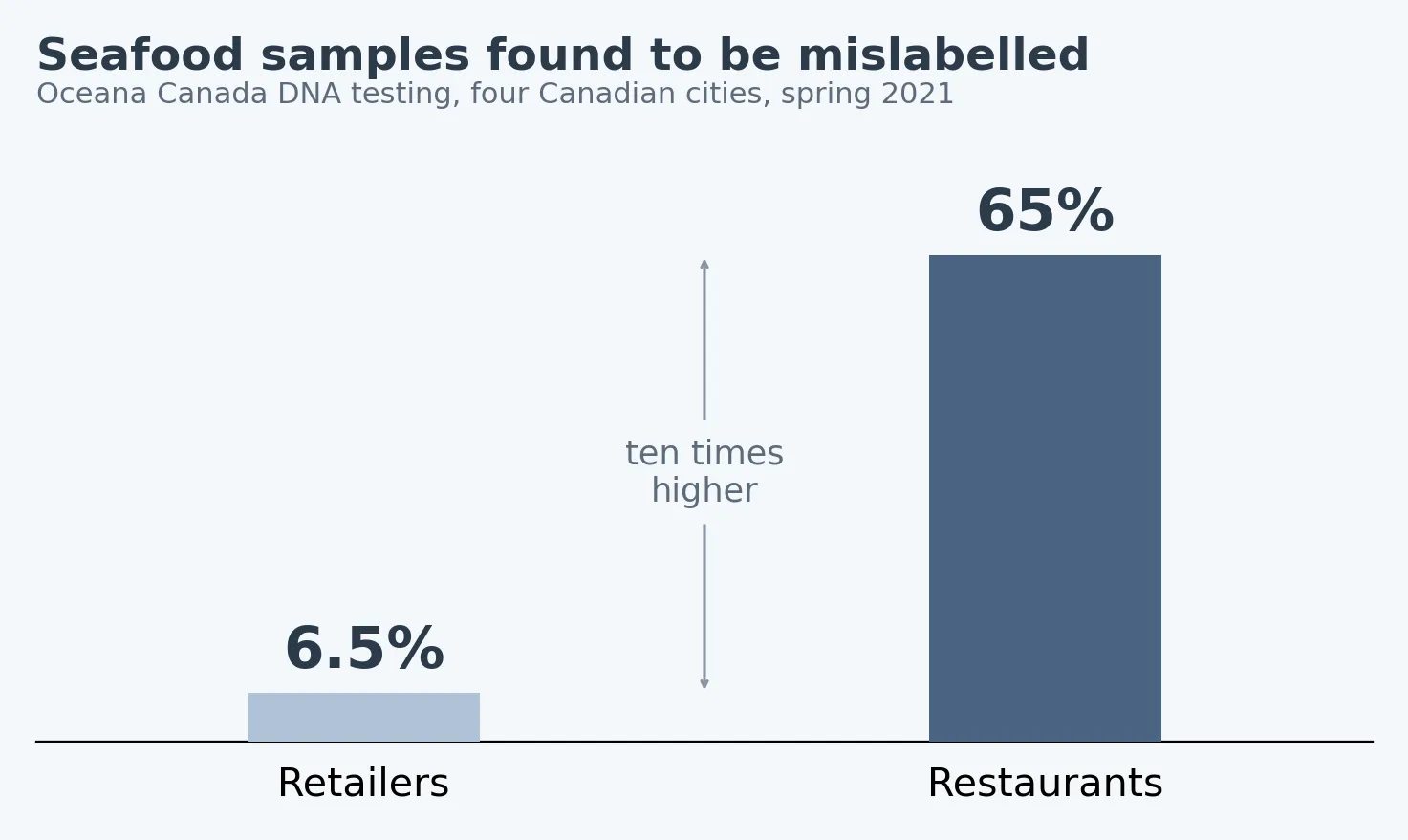
The reason is supply chain length and control. A grocery chain buys directly, in volume, under contract, with documentation it can be held to. A restaurant buys through distributors, often several, sometimes substituting when something is unavailable, and the person writing the menu is rarely the person who took the delivery.
None of which means restaurants are dishonest. Oceana’s own framing is that retailers and restaurants can themselves be victims of fraud, because the substitution can happen anywhere between the boat and the plate. If the chain is long enough and opaque enough, the last person in it genuinely does not know.
Where you are matters, and Halifax does better
The city-level numbers are worth reading if you live here. Halifax is the only Atlantic Canadian city Oceana tested, so this is a Halifax finding rather than a regional one.
In the 2017 to 2019 study, Halifax had the second-lowest rate of the six cities at 38 per cent, behind Vancouver at 26. Victoria came in at 67 per cent, Montreal 61, Toronto 59, Ottawa 46. In the 2021 round, Halifax was the lowest of the four tested, at 32 per cent, against Montreal at 52 and Toronto and Ottawa at 50 each.
Speaking to Global News, an Oceana Canada campaigner put the pattern plainly: in coastal communities, mislabelling tends to be lower.
That makes sense. Shorter chains, more people who know what the species actually looks like, and a local market where being caught selling the wrong fish is a real problem.
It is still 32 per cent. Roughly one sample in three, in the best-performing city in the country, in a port town. Proximity to the water helps. It does not fix it.
What gets substituted, and why it is not random
The substitutions are not accidents of similar-looking fillets.
In the earlier testing, cheaper species were sold as more expensive ones in about three quarters of the mislabelled cases. That is the whole economic logic: the substitution only makes money in one direction.
And some of it is not just a pricing problem. The 2021 round found ten instances where products labelled as butterfish or tuna turned out to be escolar, a species restricted or banned outright in several countries because of the digestive effects of the oil in its flesh. Somebody ordering tuna is not expecting that, and cannot detect it by looking.
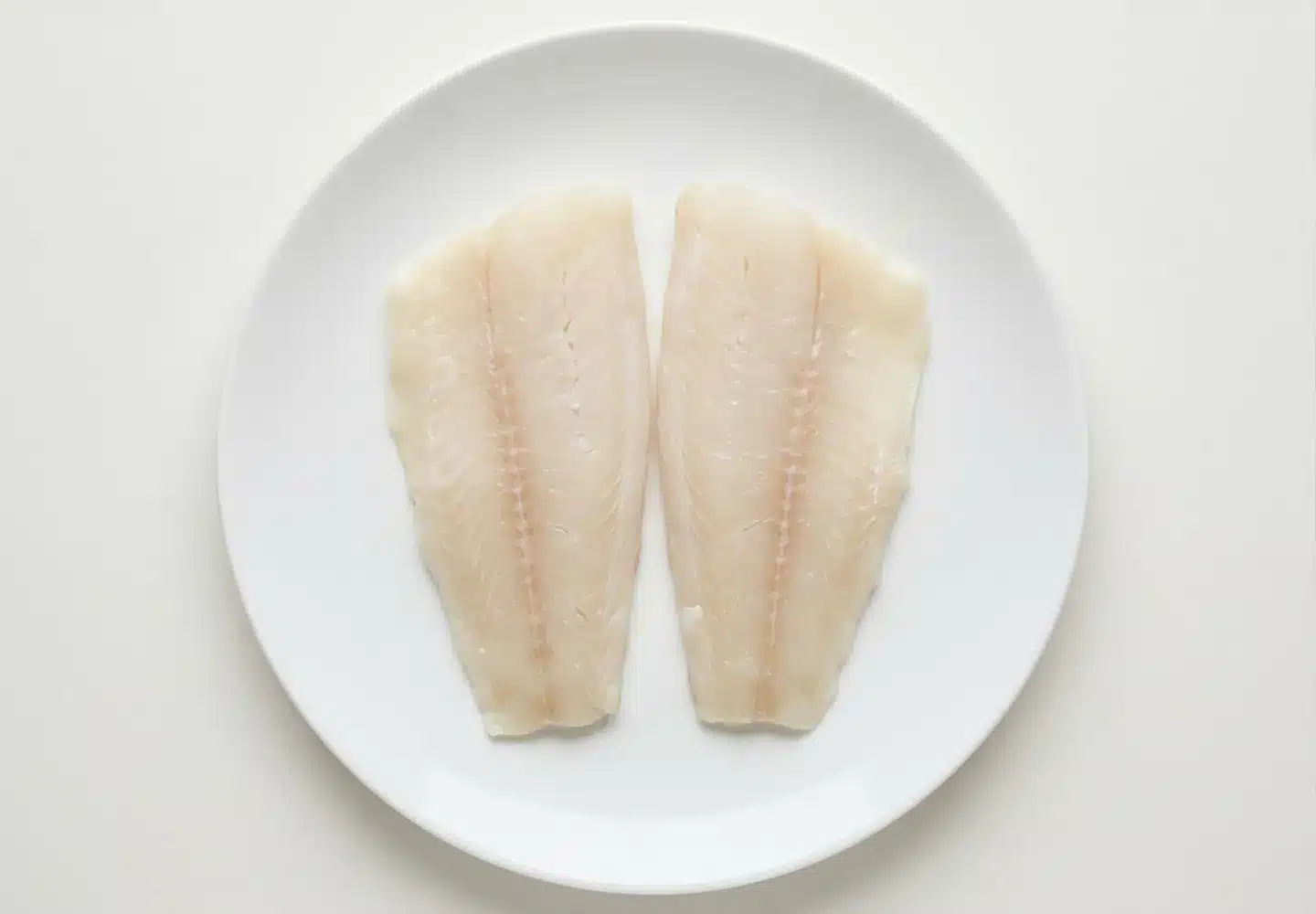
This is the part that makes mislabelling different from ordinary consumer annoyance. You cannot inspect your way out of it. A fillet has no tell. The species claim is the only information you have and it is the thing being falsified.
Why the fix is boring and structural
Canada committed in 2019 to building a boat-to-plate seafood traceability system. By the time of the 2021 testing, two years later, no plan or timeline had been published.
That is the actual problem. Not that individual sellers are crooked, but that the system does not require anyone to be able to prove what they are selling. A claim nobody has to document is a claim nobody has to substantiate, and substitution survives in exactly that gap.
Public appetite is not the obstacle. Polling by Abacus Data, commissioned by Oceana Canada alongside the 2021 results, found 87 per cent of Canadians concerned about buying mislabelled seafood, up from 76 per cent the year before.
What this means for buying
Four things follow, and they are more useful than checking labels harder.
Buy where the chain is short. The ten-to-one gap between retail and restaurant is really a gap between fewer hands and more hands.
Ask which species, using the scientific name if you want to be certain. “Snapper”, “sole”, “sea bass” and “butterfish” are market names covering many species. Atlantic haddock is Melanogrammus aeglefinus and there is no ambiguity in that.
Ask where it was landed and who processed it. Not the country. The fishery. A seller who can answer has a chain short enough to know.
Treat certification as a floor rather than proof of species. MSC chain of custody does track a product through the supply chain, which is exactly the mechanism that makes substitution hard, and we cover what the labels do and do not promise in MSC, ASC and Ocean Wise seafood certifications and why we treat the floor as a starting point in Ocean Wise certification: our floor, not our ceiling.
Seafood mislabelling, and where we sit in it
Seafood mislabelling is a chain-length problem, and we are not going to claim immunity from it. Every seller in a long chain is exposed, and a company saying otherwise is telling you it has not thought about it.
What we can do is keep the chain short and answer the question. We carry thirteen products, not three hundred, and the reason is that a small range is one we can actually account for. Where our haddock comes from names two fisheries and explains the choice between them. Why we only carry one kind of salmon explains a refusal rather than a range.
If you want to know the species and the source of anything in the market, ask us. Where we know, we will tell you. Where we do not, we will say that instead, which is the more useful answer of the two.