A developing story. First published 16 September 2026. Updated 2 October 2026.
Most people assume Canada is a salmon country that sells salmon to the world. That is still true. It is also a country that buys more salmon from the world than it used to.
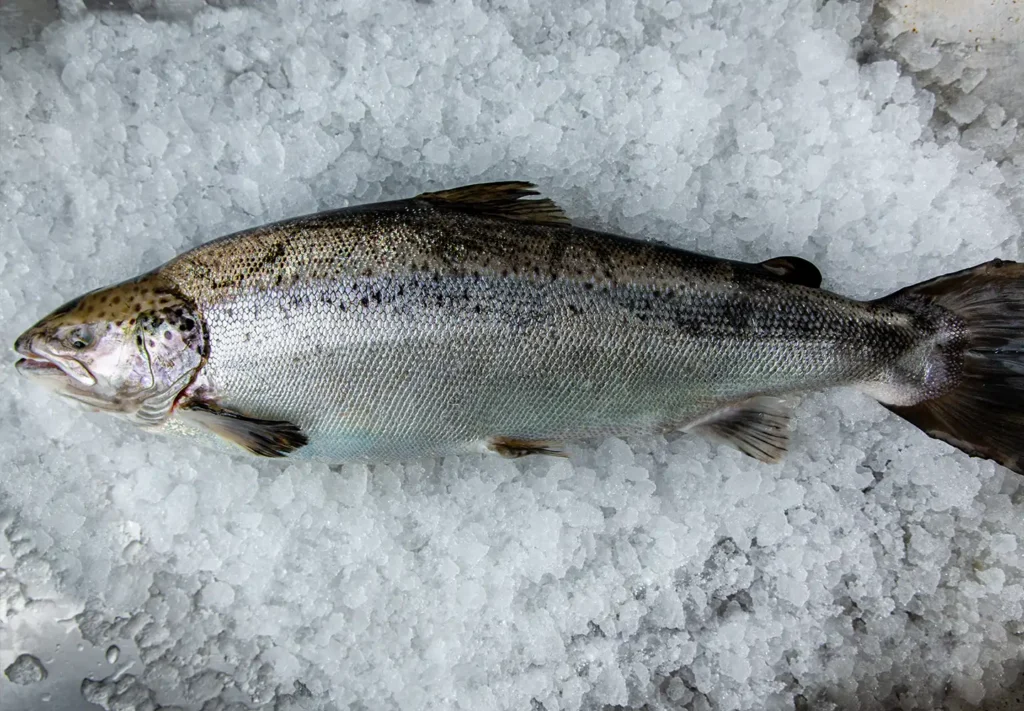
On 10 September the Atlantic Canada Fish Farmers Association published Farming our Future, a policy report it commissioned from Enterprise Canada, and written by that firm’s vice president of policy. It is an advocacy document with a list of asks. It also contains a trade figure worth sitting with. Canada imported more than $765 million of Atlantic salmon in 2025, roughly double the 2016 value, and the value of Canadian salmon exports fell 8 per cent over the same period.
Start with what the number does not say
Canada has not become a net importer of salmon. By the report’s own figures, Canadian salmon exports in 2025 were $928 million against $765 million of imports. We still sell more than we buy.
That comparison needs a caveat the report does not flag. The $765 million is Atlantic salmon. The $928 million is salmon, all species, including the Pacific salmon British Columbia exports. Not the same category, so the two figures are indicative rather than exact. The direction holds on every series we could find: Canada is still a net exporter by value. What changed is the size of the gap.
There is a second thing worth flagging, because we could not resolve it. The report’s endnote points to Innovation, Science and Economic Development Canada’s Trade Data Online, but does not say which customs codes were counted. A separate series derived from Statistics Canada and Fisheries and Oceans Canada puts Atlantic salmon imports at about $144 million in 2024. That is a fivefold difference, and the likeliest explanation is scope: one series probably covers a narrow customs line, the other aggregates several.
Both may be correct. They are not measuring the same thing, and the report does not show its working.
What actually happened to Canadian production
This is where the story turns, and it is the part most coverage will flatten.
Canadian farmed salmon production peaked at just over 148,000 tonnes in 2016. By 2024 it was just over 109,000 tonnes. That is a real decline, and the report is right to name it.
But the decline is a British Columbia story. In June 2024 the federal government announced a ban on open net-pen salmon farming in BC coastal waters, in full effect from 30 June 2029. Production there has since fallen by more than 40 per cent. The report attributes that to a loss of more than $700 million in GDP and about 3,000 jobs.
Atlantic Canada went the other way. Figures from the Canadian Aquaculture Industry Alliance put production here up 17.7 per cent in 2024, at 55,232 tonnes, slightly ahead of British Columbia’s 53,816. Those two add to just over 109,000, which is where the national number comes from.
The report is not consistent about this. Its opening pages say Atlantic Canada produces less farmed salmon today than a decade ago. A few pages later it says Atlantic Canada’s production is growing. Both sentences are in the same document. The second matches the figures.
There is a jurisdictional reason for the split. In British Columbia, Ottawa regulates salmon farming directly. In Atlantic Canada the provinces do. That is why a federal decision about BC waters does not bind New Brunswick, Nova Scotia or Newfoundland and Labrador.
The disagreement
The industry position is that Canada has the coastline, the expertise and the workforce, and that regulatory delay is holding it back. The report says approvals here can take up to seven years against a Norwegian target of 26 weeks, and cites a Nova Scotia expansion that spent seven years under review.
The conservation position is that open net pens are porous, and that pathogens, sea lice and parasites move between farmed and wild fish. That argument, alongside overfishing, ocean warming and habitat loss, is part of the case made for the British Columbia decision.
Both are real arguments made by serious people. The report also asks government to pause Marine Protected Area expansion in Atlantic Canada, and to revisit the rule that keeps fish farms out of them. That is a significant ask, and it deserves more scrutiny than a trade statistic will get.
One disclosure, because we are not a neutral party here. Afishionado is a member of Off the Table Canada, a campaign working to take open net-pen farmed salmon off Canadian menus, run with Living Oceans, the Atlantic Salmon Federation and WildFish. We carry one Atlantic salmon and it is raised on land. We have tried to set out both positions above fairly, and you should read them knowing that.
As of 16 September, no conservation group, provincial minister or federal department has responded publicly.
Update, 2 October 2026: Since publication, the Atlantic Salmon Federation and the Conservation Council of New Brunswick have responded publicly. As CBC reported, the Federation opposes new farm approvals and says growth should come from existing sites, and the Conservation Council says Marine Protected Areas should stay closed to aquaculture.
What this means here
Whatever happens to the national production number, the people who feel it first are not in Ottawa.
The report counts more than 9,400 jobs in the sector, most of them rural, with more than 4,400 in production and nearly 4,800 in processing. In Charlotte County, New Brunswick, population about 26,000, it says aquaculture accounts for one job in five. Those are the association’s own numbers, and the shape of them is not in dispute. This is wharf work, plant work and hatchery work in small places.
A policy argument had at national level gets settled a long way from where the consequences land.
The Fishmonger’s Take
We are not going to tell you imported salmon is bad. Some is farmed well and some is not, and the same is true of Canadian salmon. Nationality is not a standard.
What these numbers describe is a supply chain getting longer. More countries in it, more handlers, more distance between the pen and the counter. Every extra step is a place where the answer to “where did this come from” gets vaguer. That is as true of Canadian fish in a long chain as of imported fish.
We have written before about the standard we apply. Why we only carry one type is that argument, and land-based salmon farming covers how ours is raised.
What is new is the trade data underneath it. The question got harder to answer over ten years not because sellers got less honest, but because the chain got longer.