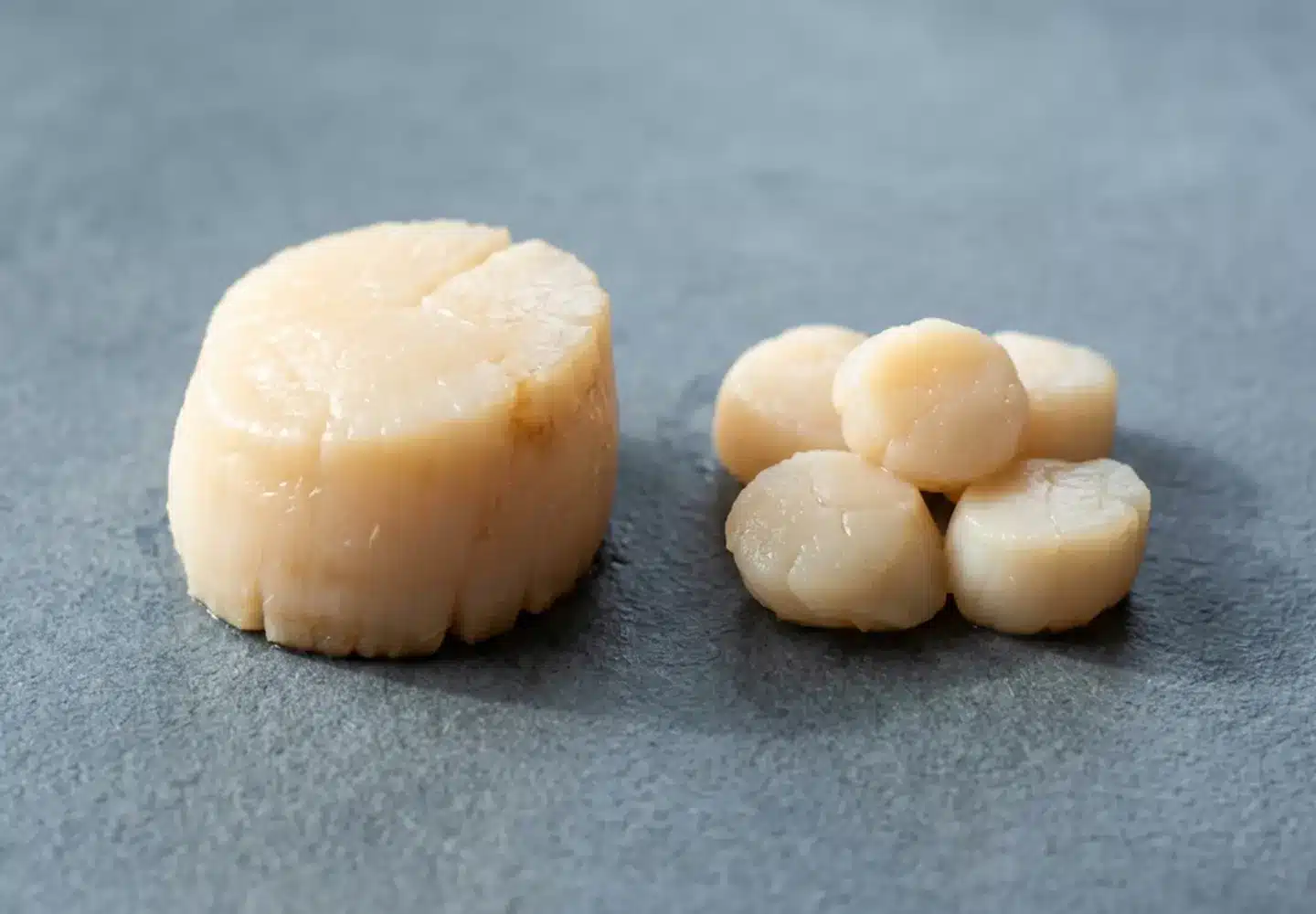
Sea scallops vs bay scallops sounds like a question about size. It is not. They are two separate species, living two separate lives in two separate kinds of water. The size gap is a consequence of that rather than the point of it. One is a deep-water animal that can live twenty years. The other rarely sees a second birthday.
That matters at the counter because the two are not interchangeable. Buy the small ones expecting the big ones and you get something that shrinks, toughens and refuses to brown. The failure will feel like your cooking’s fault. It is not. You bought a different animal.
The species, not the grade
The big ones are Atlantic sea scallops, Placopecten magellanicus. According to NOAA Fisheries, they range from Newfoundland down to Cape Hatteras. They sit on sandy and gravelly bottom at roughly 100 to 300 feet, and they can live up to twenty years. The largest one ever recorded was about nine inches across the shell. Most stop somewhere under six.
The small ones are bay scallops, Argopecten irradians. They live in shallow bays, estuaries and eelgrass beds. The New York State Department of Environmental Conservation describes them as short-lived, with numbers that swing hard year to year depending on how the previous year’s spawning went. Roughly eighteen months to two years is a full life. There are only ever a couple of generations alive at once.
Both are bivalves, and in both cases the white disc you buy is the adductor muscle, the one that snaps the shells shut. Scallops use it to swim, which most bivalves cannot do. A sea scallop’s shell is unusually smooth for the family, thought to be an adaptation for moving faster through water.
Twenty years of growing against eighteen months of growing produces exactly the gap you would expect. Sea scallops are sold by count, and NOAA lists the standard grades as U10, 10/20 and 20/30, meaning that many meats make a pound. Bay scallop counts run many times higher. Grading on them is looser and less standardized, so a bag can hold more variation than the label suggests.
Where sea scallops and bay scallops actually come from
This is the part most comparisons leave out.
The sea scallop fishery is on our doorstep
Fisheries and Oceans Canada splits the Canadian fishery in two. An inshore fleet works the Bay of Fundy. An offshore fleet works Georges Bank and the banks off Nova Scotia and Newfoundland. Georges Bank alone accounts for roughly 70 to 80 percent of offshore landings. The same management plan records that Nova Scotia was responsible for 84 percent of Canadian scallop export value in 2015, which tells you where this industry sits.
It is also managed on size, not just volume. DFO sets an average meat count, expressed as meats per five hundred grams, specifically to discourage the harvest of small scallops. The strategy is to target animals that have already spawned, believed to be age four and up. A scallop’s size is a fisheries management lever, not just a marketing grade.
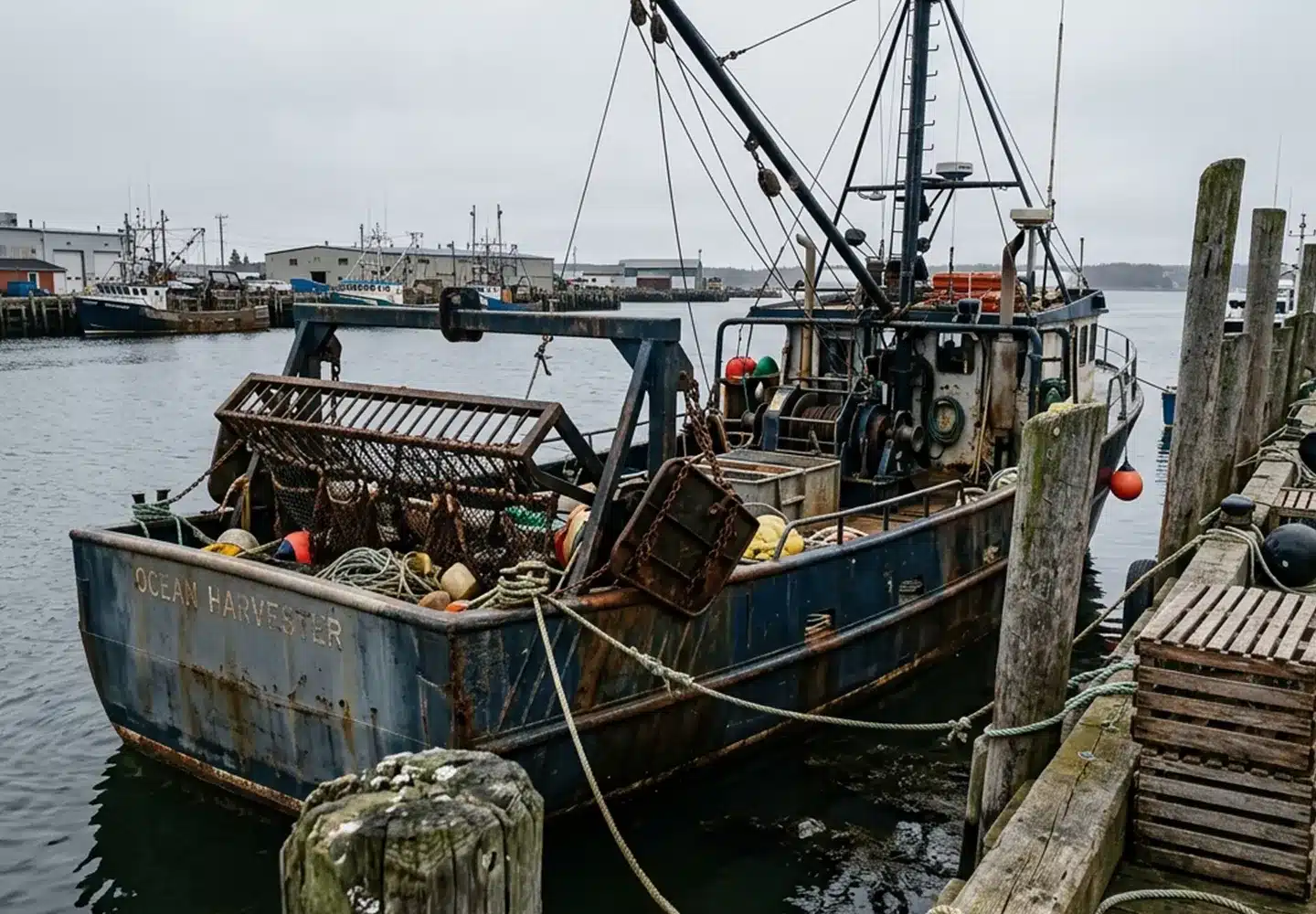
DFO’s plan also records a first. The Eastern Canada offshore fishery was the earliest scallop fishery in North America to earn Marine Stewardship Council certification, in 2010, and MSC recertified it in 2015. Certifications lapse and get renewed. That plan is now several years old, so treat those dates as history rather than a current claim. If you want to know what a fishery holds today, look it up today. We cover what the various labels actually promise in our guide to MSC, ASC and Ocean Wise.
Bay scallops are mostly farmed, and mostly not nearby
Their whole existence depends on eelgrass, and eelgrass has not had a good century. NOAA’s National Centers for Coastal Ocean Science records that Chesapeake Bay held bay scallops until 1933, when seagrass loss wiped them out. Nobody has documented a population there since. Similar collapses ran up and down the coast.
So where do the bay scallops in the freezer come from? Mostly a farm. The Monterey Bay Aquarium Seafood Watch global report on farmed scallops puts the bay scallop at 58 percent of Chinese scallop production, the largest share of any species there. This is an animal native to the eastern seaboard of North America. It went to China in the 1980s and the farming there took hold.
Worth saying plainly: farmed is not an insult here. Scallops are filter feeders, so nobody feeds them anything. Suspended net culture is one of the gentler forms of aquaculture there is. The point is not that bay scallops are bad. The point is that “bay scallop” sounds local and usually is not, and if provenance matters to you, that word will mislead you.
Canada’s own commercial scallop fisheries, as DFO lists them, are sea scallops and Iceland scallops. Bay scallops are not on the list.
Why one sears and the other cannot
Size is not a quality ranking. It is a margin for error.
Browning needs the surface of the scallop to get well above the boiling point of water while the middle stays under. A big scallop gives you a real window to do that in. A small one gives you almost none. By the time the outside has taken enough heat to colour, the inside has gone past done and into rubber. That is a geometry problem, not a technique problem, and no amount of pan skill solves it.
Which is why the whole method in our guide to searing scallops assumes a large one. It also assumes an untreated one, because a scallop soaked in phosphate carries water that no amount of patting dry will remove. That is a separate axis from species entirely, and it is the more common cause of a ruined scallop. We laid out how to read for it in dry vs wet scallops. Our reasons for refusing to sell the treated version are in why we only sell dry-packed scallops.
Two axes, then. Species tells you how big and how much cooking margin you have. Treatment tells you whether the thing will brown at all. A treated sea scallop and an untreated bay scallop will both let you down, for entirely different reasons.
What each one is for
The decision is simpler than the biology.
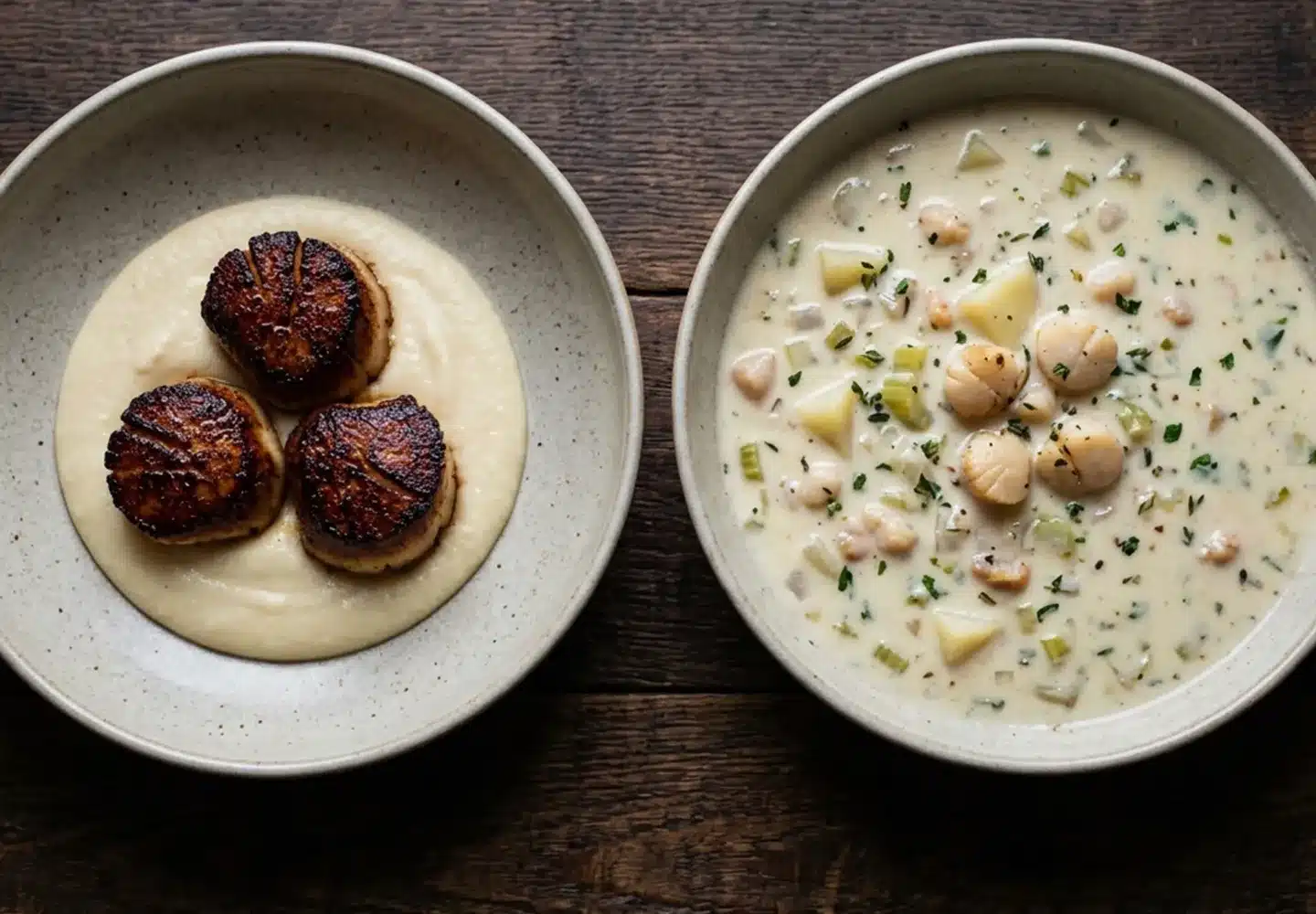
Buy sea scallops when the scallop is the dish. Anything where it arrives on the plate as a recognizable object with a crust on it. Seared over a purée, on a risotto, on a skewer, wrapped in bacon for a room full of people. You are paying for size because size is what makes the presentation possible.
Buy bay scallops when the scallop is an ingredient. Chowder, a baked gratin, a cream pasta, anything where it goes in near the end and contributes sweetness and texture rather than standing alone. Our building-block guide to seafood chowder is the obvious home for them. A mixed pack like our Seafood Medley does the same job with a different cast.
The mistake almost everyone makes is buying small because it is cheaper and then cooking it like it is big. Cook a small scallop fast, in company, and it is lovely. Ask it to hold a sear on its own and it cannot.
The label is looser than you think
“Bay scallop” does as much work as a size description as it does as a species name. Sellers use it for small scallops from several species and several oceans. The Seafood Watch report cited above treats farmed scallops as a group spanning Argopecten, Chlamys and Patinopecten rather than one animal. A bag labelled bay scallops may be the Atlantic species farmed in Asia, or a relative from South America, or a warm-water cousin from the Gulf of Mexico.
The practical move is the same one that works for treatment. Look for what is actually stated: species, origin, count. An ingredient list tells you about additives, not about which animal you are holding. If the species matters for what you are cooking, ask the seller, and treat a vague answer as an answer.
One more thing, because it comes up every time. There is a durable story that small scallops are sometimes rounds punched out of skate or shark wing. We went looking for a documented, recent case and did not find one, so we are not going to repeat it as though we had. File it as folklore until somebody produces evidence. The dull version of the risk, a small scallop of unclear species and unclear origin, is real and boring and worth more of your attention.
Sea scallops vs bay scallops, in one line
Sea scallops vs bay scallops comes down to what you want the scallop to do. If it is the centre of the plate, buy the big ones and give them room. If it is one voice in a chorus, the small ones are better and cheaper and were always meant for that job.
Ours are Sea Scallops, graded 20/30, packed with nothing added. That is a large scallop with a wide margin for error, which is a polite way of saying it is hard to ruin. The rest of the market is stocked on the same principle.