
Ask most people what local seafood actually means on a label and they will tell you it means nothing. A marketing word, unregulated, free for anyone to use.
That is the common assumption and it is wrong. The CFIA sets out what it will accept as local, and has done since 2013.
The problem with local seafood is not that the word is empty. It is that the official definition is so wide you could drive most of a day and never leave it.
What the rule actually says
The Canadian Food Inspection Agency’s interim policy on local food claims recognizes “local” as food produced in the province or territory where it is sold, or food sold across a border within 50 kilometres of the originating province or territory.
So a fish landed at Yarmouth and sold in Sydney is local. That is the length of Nova Scotia, end to end, and entirely inside one province. A fish landed in Ontario and sold in Ontario is local across a province larger than France.
The previous rule was much tighter. Before 2013 the CFIA interpreted “local” as food originating within 50 kilometres of where it was sold, or within the same local government unit. That is much closer to what the word means in plain English.
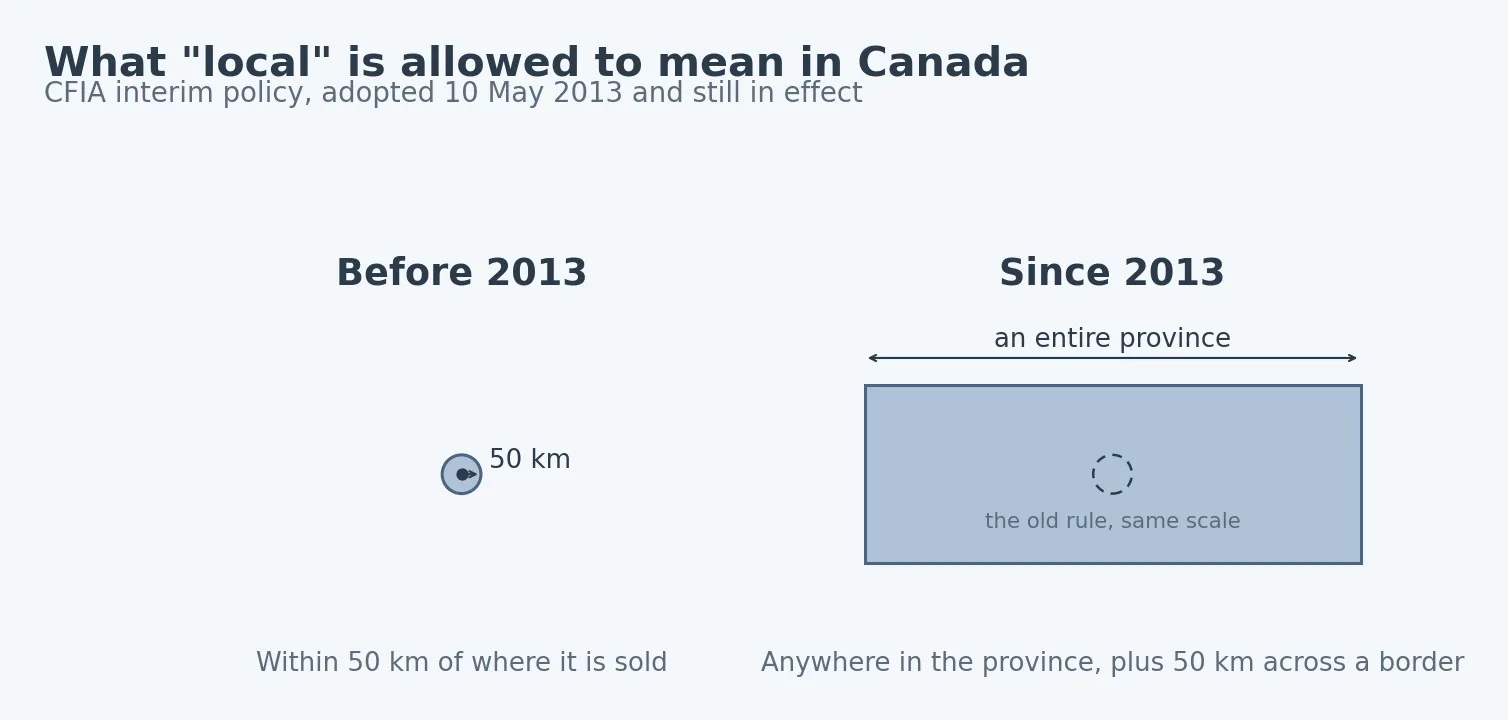
The agency replaced it because it was judged outdated and out of step with how food is actually produced. It also said at the time that it recognized this was a broad interpretation and that views differed on how the word should be defined.
They were not wrong about the views differing. Javier Alarco, then executive chef at the Delta Prince Edward, made the obvious point when the change landed. The definition works on an island you can cross in two hours. It makes much less sense in Ontario or Quebec, where local becomes “almost one third of the country away.”
The part nobody expects
That policy was adopted on 10 May 2013. It was explicitly temporary, pending a review of food labelling regulations.
As of writing it is still the policy, and current industry labelling guidance still states it as the operative rule. Thirteen years of interim.
We are not pointing that out as a gotcha. Labelling reviews are genuinely slow and the agency has a great deal else to do. But if you assumed the word on the label was governed by something settled, it is governed by a placeholder that has outlasted most of the businesses using it.
What this means for fish specifically
Seafood makes the gap wider than it is for most foods, for two reasons.
First, fish moves before it is sold. A fillet can be landed in one port, trucked to a plant in another and sold in a third, never leaving the province and qualifying as local throughout. The claim describes two points, where it was produced and where it was sold. It says nothing about the line between them.
Second, processing can happen very far away indeed. Fish caught in North American waters being shipped overseas for filleting and shipped back is an established feature of the industry, driven by labour costs. Where that leaves a “local” claim depends on what counts as produced, and the interim policy does not spell that out for a fish caught in one country and cut in another.
Neither of these is fraud. They are what happens when a definition built around where something is grown and sold meets a supply chain with several stops in between.
Labels diverge from package contents for other reasons too, and seafood mislabelling covers the DNA testing on that.
The useful question is not whether it is local
Here is what we would ask instead, and none of these is answerable with one word.
Which fishery or farm? Not the province, the actual place. Someone who knows will tell you. Someone who does not will tell you the province.
Who processed it, and where? This is the question “local” hides most effectively, and it is usually the longest leg of the journey.
Wild or farmed, and which system? They are different products with different arguments attached, covered in wild vs farmed salmon.
When was it frozen, and how? Handling shapes what arrives on your plate more than distance does.
A seller who can answer those four is telling you more than any origin claim could. They are describing a chain rather than asserting a category.
Where we sit in this
We could put “local” on some of what we sell and be entirely within the rules. We would rather name the fishery.
Where our haddock comes from sets out two fisheries and the choice between them, including the one that is not Canadian and why. Our salmon is raised in Centre Burlington, which is a town rather than a province, and the reasoning is in land-based salmon farming.
That is not a claim to be the only honest seller. Plenty of operators name their sources. The point is narrower. A word covering a whole province cannot do the work people think it is doing, and the alternative is not a better word. It is an actual answer.
Local seafood, in short
Local seafood is a defined term in Canada. The definition is your entire province plus 50 kilometres, and it has been provisional since 2013. It tells you a fish was produced and sold inside the same large area. It tells you nothing about the distance travelled, the processing, the handling, or the species.
Ask which fishery instead. It is a harder question and it has a real answer.
Everything in the market has one, and we will tell you what it is.