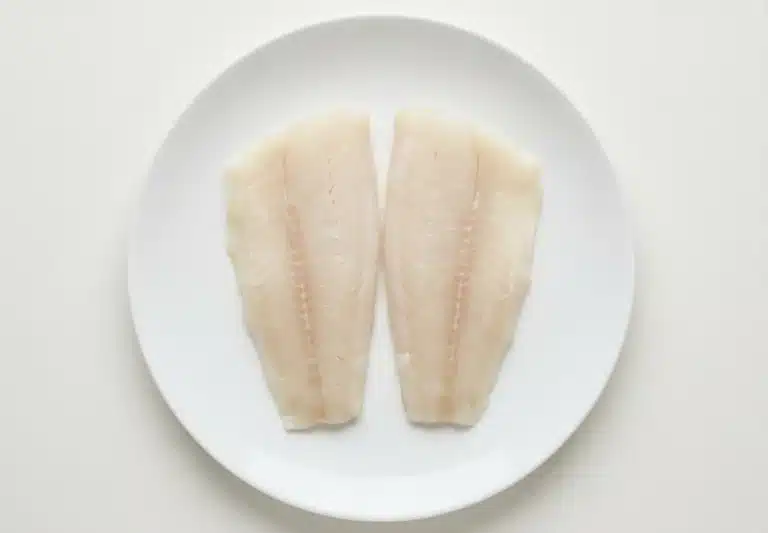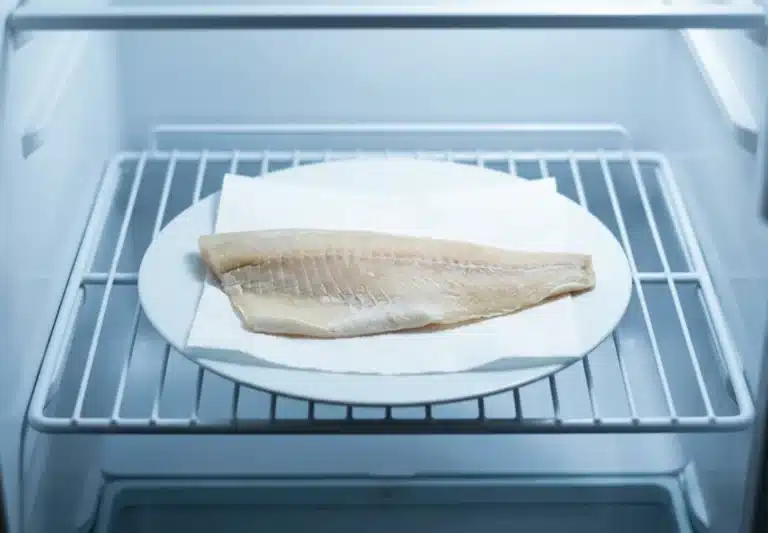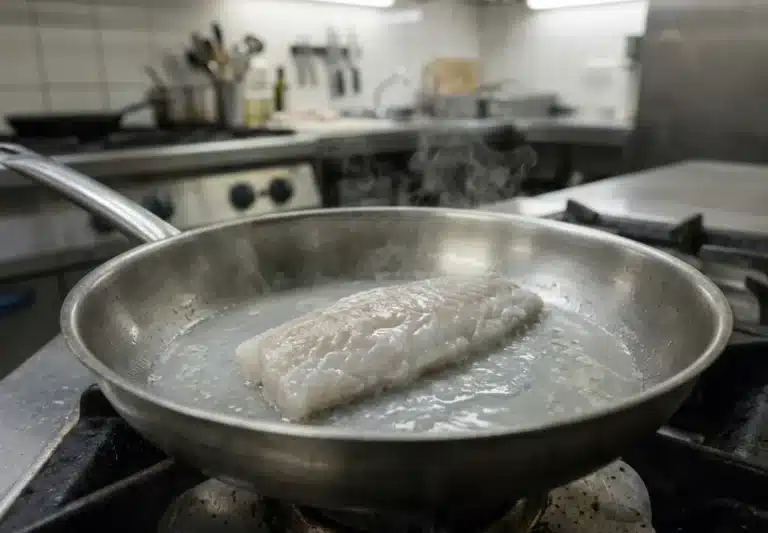

Smoked haddock has more history packed into it than most foods manage across an entire cuisine. The story starts in a village south of Aberdeen, where fishwives smoked haddock over peat fires. From there, it travelled to London by stagecoach and later by railway, crossed the Atlantic with Scottish immigrants, appeared on Victorian breakfast tables for the upper class, detoured through colonial India, and eventually landed on the Savoy menu under the name of a novelist who died just two years after chefs created the dish for him.
That’s before Cullen Skink, before the Arbroath smokie, before any of the dishes that made smoked haddock what it is in North Atlantic cooking.
This is the full story, and a guide to the fish itself.
What smoked haddock actually is
Producers make smoked haddock by curing haddock with salt and then exposing it to either cold or hot smoke to preserve the fish and add flavour. That’s the simple version. The details matter.
Cold smoking keeps temperatures below 30°C (86°F). The smoke flavours and preserves the fish without cooking it. The texture stays firm and dense. You need to cook the fish before eating it. Producers cold-smoke Finnan haddie, and most smoked haddock sold in Canadian and British supermarkets uses the same method.
Hot smoking cooks the fish in the same process. Temperatures run from around 80°C upward. The flesh flakes and becomes moist, with a stronger cooked-through smokiness. Arbroath smokies are hot-smoked. They come out of the barrel ready to eat.
The difference matters in the kitchen. Cold-smoked haddock poaches beautifully in milk. It holds together for chowder and kedgeree. Hot-smoked haddock can be eaten as-is or folded into dishes that want a more robust cooked flavour.
The yellow dye question comes up constantly. Naturally smoked haddock is pale cream or golden. Many supermarkets create that bright yellow colour with annatto or tartrazine instead of achieving it through longer smoking in the smokehouse. It tastes different. For cooking, undyed is almost always the better choice.
Finnan haddie: where it started
The origin debate has been going on since the 18th century and shows no signs of resolving. One tradition traces the name to Findon, a fishing village about 13 kilometres south of Aberdeen in Aberdeenshire. The other traces it to Findhorn, a village on the Moray coast about 60 kilometres west. Both communities claim precedence, and the Oxford English Dictionary acknowledges both possibilities without settling the question.
Historians agree that the technique dates back at least to the early 18th century, and possibly earlier, in the fishing communities of northeastern Scotland. Fishwives salted fresh haddock and smoked it over green wood and peat, creating a lightly flavoured fish with a pale golden colour that spoiled within two to three days.
That short shelf life was the problem. Finnan haddie was famous in Aberdeen long before it reached London. Fish reached the capital within twelve hours of being caught, but the trip south by road took too long for a product that lasted only two days. Smoked haddock appeared sporadically in London by the early 19th century, but railway connections between Aberdeen and London in the 1840s finally made it widely available.
The Industrial Revolution solved a logistics problem that geography had imposed on a great smoked fish for over a century.
Traditional Finnan haddie is a whole haddock, split through the backbone, lightly brined, and cold-smoked over peat and green wood for several hours according to Slow Food UK’s Ark of Taste entry, which documents the traditional process. What’s sold today as smoked haddock is usually fillets, cold-smoked industrially, with the split whole fish being the rarer find. Slow Food UK has placed traditional Finnan haddie on its Ark of Taste, a catalogue of endangered food products at risk of disappearing.
Arbroath smokies: the other tradition
While Finnan haddie was spreading south from Aberdeenshire, a different smoking tradition was developing 80 kilometres down the coast. Local tradition holds that the technique originated not in Arbroath itself but in the village of Auchmithie, about five kilometres to the north. The fishwives there hot-smoked whole haddock in half-barrels sunk into the ground, using hardwood fires covered with wet hessian sacks to trap the heat. The UK Government’s protected food name specification, the document the smokie’s protected status rests on, sets out the contrast directly: Arbroath smokies are hot smoked in a short blast of fairly intense heat, while kippers and Finnan haddock are cold smoked and need cooking afterwards.
Towards the end of the 19th century, Arbroath’s fishing industry was declining and the town council offered Auchmithie’s fishing families land in an area called the Fit o’ the Toon, the lower end of town where the Brothock Burn meets the sea. The families moved with their methods intact. Arbroath took the name, the harbour, and the smokies.
In 2004, the Arbroath smokie became the first Scottish food to receive Protected Geographical Indication status under EU law. The protection mirrors what Champagne, Parma Ham, and Stilton Cheese receive.
Producers can only call a fish an Arbroath smokie if they make it within eight kilometres of Arbroath Town Hall using traditional methods. They head and gut the haddock by hand, salt it overnight, tie the fish in pairs at the tail with locally made jute string, and hot-smoke it over hardwood in a barrel covered with wet hessian.
The result is a fish with coppery-brown skin and pale, moist flesh that pulls apart in large sweet flakes. It’s best eaten warm, directly from the smokehouse, with nothing added. The flavour is deeply savoury, mildly smoky, and entirely its own.
The two traditions represent different answers to the same question of what to do with North Atlantic haddock before refrigeration existed: cold-smoked Finnan haddie and hot-smoked Arbroath smokie. Both answers are genuinely excellent.

Cullen Skink
Cullen is a small fishing town on the Moray Firth, about 80 kilometres west of Aberdeen. It gave its name to Scotland’s most beloved smoked fish soup, and the etymology of that name is itself worth a paragraph.
Skink is an old Scots word for a shin of beef, and by extension for the soup you boil out of one. The Dictionary of the Older Scottish Tongue traces it to Middle Dutch and Middle Low German words for the shin or hough, attested in Scots from 1602, and the Scottish National Dictionary records both senses: the cut of beef, and the potage made from it. The beef-based skink was a staple. By the early twentieth century, smoked haddock was more plentiful in Cullen than beef, particularly after the town developed a specialisation in smoked fish production. The haddock replaced the beef. The name stayed.
The result is what might be called Scotland’s answer to New England clam chowder, except older and with better flavour. Smoked haddock, potatoes, onion, and milk or cream. Cooked gently, not aggressively. The smokiness of the haddock and the sweetness of the potato work against each other in exactly the right way. In its simplest form, it requires no technique beyond patience and quality fish.
Cullen Skink appears on menus across Scotland, from harbour cafes to the Gleneagles hotel.
People serve it on Burns Night (January 25) and St. Andrew’s Day (November 30) because it represents Scottish cooking in its most direct form. The town also hosts the annual Cullen Skink World Championship, which shows how seriously locals take the soup in its birthplace.
If there’s a single recipe that shows what smoked haddock can do when you don’t overthink it, Cullen Skink is the one.
Kedgeree: India to Victorian Britain to your breakfast table
Kedgeree’s story is one of the more interesting collisions in food history. The dish begins in India, centuries before Britain developed an interest in it.
The dish derives from khichdi, an Indian preparation of rice and lentils documented in medieval Indian sources long before any European contact. Khichdi was comfort food, the Indian equivalent of a simple restorative: mild spices, soft grains, easy to digest. The Mughal emperor Aurangzeb reportedly enjoyed a version that included fish and eggs, which may have evolved into the earliest form of kedgeree.
As British colonists in India adapted local food to their own tastes and then carried it home, khichdi underwent a transformation. The lentils disappeared. Smoked fish replaced the fresh fish or was added in. Specifically smoked haddock, which survived the stagecoach and later railway journey from Aberdeen to London. Eggs were added. The spices were adjusted. The 1790 cookbook by Stephana Malcolm included an early version using haddock and cayenne pepper. Isabella Beeton’s Mrs Beeton’s Book of Household Management, published in 1861, formalized it: cold dried haddock, boiled rice, hard-boiled eggs, butter, salt and cayenne.
The reason haddock specifically became the fish of kedgeree is practical. A former Savoy Hotel chef explained it plainly: salmon was too delicate to survive the journey south from Scotland in the 1800s. Smoked haddock arrived intact. The fish wasn’t chosen for culinary reasons so much as logistical ones. It just happened to work brilliantly.
By the Victorian era, kedgeree was fashionable breakfast food in upper-class households. By the 1930s and 1940s, it had become a working-class staple because leftover rice and tinned or smoked fish made it cheap and filling. It occupies that rare category of dish that managed to be both aristocratic and economical, simultaneously.
Today kedgeree sits comfortably on brunch menus across Britain and is quietly overdue for wider attention in North America, where the flavour combination of smoked fish, spiced rice, and egg is unusual enough to seem inventive and familiar enough to become a habit.
The Arnold Bennett omelette
In 1929, a chef named Jean Baptiste Virlogeux at the Savoy Hotel in London created an omelette for Arnold Bennett, an English novelist who was staying at the hotel while writing his book Imperial Palace, according to research by food journalist Neil Sowerby. Bennett loved it so much he demanded it wherever he travelled. It has been on the Savoy Grill menu ever since. Bennett died two years later from typhoid contracted while drinking tap water in France.
The dish is an open omelette, topped with poached smoked haddock flaked into a béchamel sauce enriched with hollandaise, and finished with Parmesan cheese under the grill. The Savoy version uses eight egg yolks and a full 250g of butter per serving. It is not the kind of thing you can eat every day and expect a long life. But it exists, and it has survived nearly a century on the menu of one of London’s great hotels on the strength of smoked haddock alone.
What connects the Arnold Bennett omelette to Finnan haddie is the same thing that connects Cullen Skink to kedgeree: the specific quality of smoked haddock as an ingredient. It takes heat gently. It absorbs dairy beautifully. When producers properly cure smoked fish instead of dyeing it, the smoke flavour integrates into sauces and broths without overpowering them.
The fish disappears into the dish while making the dish taste unmistakably of itself. That’s a rare quality, and it explains why smoked haddock has accumulated so many classics around it across so many cultures and centuries.
Smoked haddock in Atlantic Canada
Scottish immigrants brought smoked haddock across the Atlantic, and it took root in the Maritime provinces the same way it did in the towns it came from. Nova Scotian fish and chips were already haddock before they were anything else. The chowder tradition in Atlantic Canada overlaps with Cullen Skink in ways that reflect shared ancestry rather than coincidence. Smoked haddock chowder, while less formally named than its Scottish cousin, is a Maritime staple.
The connection between the Scottish and Atlantic Canadian haddock traditions is one of the less documented but more interesting threads in the region’s food history. The same fish, the same smoking techniques, carried across the Atlantic and adapted to a different coast.
How to use smoked haddock
If you’re cooking with smoked haddock for the first time, start with milk.
Poaching cold-smoked haddock in milk is the foundation of most of the classics. Bring the milk to a bare simmer with an onion, a bay leaf, and a few peppercorns. Add the fillet, skin side up. Six to eight minutes. The flesh will turn fully opaque and flake cleanly. The milk becomes the base of whatever you’re making: Cullen Skink, kedgeree, the sauce for an Arnold Bennett omelette, a chowder.
The milk does two things. It tempers the salt from the cure and it carries the smoke flavour into the liquid, making it available for the whole dish rather than concentrating it in the fish alone.
Beyond milk-poaching:
Smoked haddock scrambled eggs require no instruction beyond using good eggs and not overcooking either element. Flake cold-smoked haddock into softly scrambled eggs at the last moment off the heat.
Smoked haddock fishcakes start with mashed potato, flaked poached haddock, and a binding of egg. Pan-fried in butter, finished in the oven to heat through. Atlantic Canadian kitchens have been making some version of this for as long as anyone can remember. Our Haddock 101 guide covers the broader picture on haddock as a species if you’re starting from the beginning.
For plain haddock cooking methods, our guide on how to cook haddock covers pan-searing, baking, and poaching in detail.
What we carry
We don’t currently carry smoked haddock. If that changes, it will appear in the Afishionado market.
What we do carry is the fish itself: Haddock Fillets from the Atlantic Canadian Scotian Shelf and Bay of Fundy, and Breaded Haddock using Icelandic cold-water haddock. The sourcing decisions behind both are explained in our piece on where our haddock comes from, and the recovery story behind the Atlantic Canadian fishery is in Atlantic Canada’s haddock comeback.
If smoked haddock has made you curious about the fish in general, the 10 fun facts about haddock is the lighter read and the is haddock good for you piece covers the nutrition.