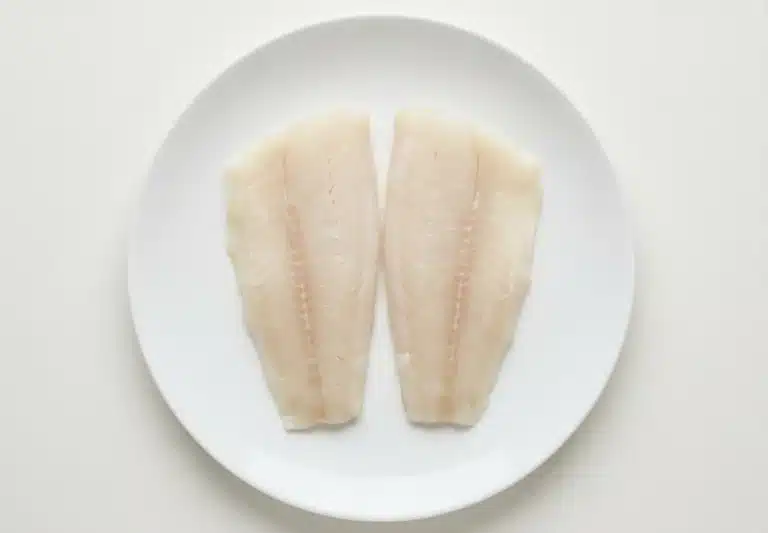
Here is the thing nobody tells you about why fish sticks to the pan. It is supposed to. Every piece of fish you have ever cooked well stuck to the pan first, and then stopped. The sticking is not the failure. The failure is reaching for the fish during the part where it is still stuck.
That changes the problem. You are not trying to prevent an event. You are trying to wait out a phase, and the whole skill is knowing how long the phase lasts and what tells you it has ended.
Sticking is a chemical bond, not friction
The intuitive picture is a rough surface catching hold of something soft. That is not what is happening.
According to the Royal Society of Chemistry, sticking is caused by chemical bonds forming between the food and the metal of the pan. Some are weak van der Waals forces. Some are proper covalent bonds. And protein-rich foods are the worst offenders, because proteins can form complexes with metal atoms in the pan, iron in particular.
So the fish is not caught. It is bonded. Chemically, to your skillet.
The surface roughness does matter, but not the way you would think. Under a microscope even a polished pan looks like landscape, all hills and valleys and caves. That texture is not a hook. It is surface area, and more surface area means more metal atoms available to bond with.
This reframes every piece of advice you have heard. Nothing you do makes a pan smooth enough to stop this. What works is occupying those metal atoms before the fish gets to them, or waiting for the fish to stop wanting them.
Why fish sticks to the pan harder than a steak does
Fish is more prone to this than beef or chicken. The reason is not that it is delicate in some vague way. It is measurable.
Fish proteins give way sooner
Seafood muscle proteins are less thermally stable than the proteins in land animals. They start unfolding at lower temperatures, which means they become reactive sooner and bond to metal sooner, at a point when the fish is still soft and has no crust to protect it.
Cold water makes it worse
Then it gets more specific, and more interesting if you live where we live. The thermal stability of fish myosin tracks the temperature of the water the fish came from. Work by Davies, Ledward, Bardsley and Poulter in the International Journal of Food Science and Technology found a clear relationship. Habitat temperature tracks the thermal denaturation of myosin across a range of species. Warm-water fish hold their structure longer under heat. Cold-water fish give way sooner. An earlier study by the same group put cod myosin about ten kelvin below snapper.
Read that again with a North Atlantic map in your head. The haddock and cod and pollock pulled out of some of the coldest working water in the world have among the least heat-stable proteins you will ever put in a pan. They unfold first. They bond first. They are the hardest fish to release and the easiest to tear.
That is not a defect. It is the same adaptation that makes them cook in four minutes and flake the way they do. The protein structure that gives way early in a hot pan is the protein structure that works at two degrees in December. You are not fighting bad fish. You are cooking a cold-water animal on a surface it was never designed to meet. The fish that is hardest to sear is hardest for a reason worth knowing, and which fish behaves how is worth knowing too. We go through that in haddock vs cod.
What that looks like across the fish you actually cook
Fat is the variable you can look up, and it maps onto the argument directly. More fat at the surface means fewer chances for protein to meet bare metal. All five figures below come from NOAA Fisheries species pages, raw, per 100 grams, so they are measured the same way and can be compared to each other.
| What you are cooking | Fat, g | Protein, g | What to expect when you put it down |
|---|---|---|---|
| Atlantic cod | 0.67 | 17.81 | The leanest here, so the most direct protein to metal contact. Longest wait, most likely to tear if you rush it. |
| Haddock | 0.72 | 18.91 | As lean as cod with a finer flake. Same wait, less handling. |
| Sea scallops | 0.76 | 16.70 | Lean, but small and thick. The wait is short and the window between crust and rubber is narrow. |
| Atlantic pollock | 0.98 | 19.44 | Marginally fattier than haddock and behaves much the same. |
| Atlantic salmon, farmed | 6.34 | 19.84 | Roughly nine times the fat of cod. Releases soonest, and skin-side down puts another barrier in the way. |
The last column is our judgment from cooking these, not a measurement. The first two are measured.
One honest caveat on the salmon figure. NOAA lists farmed Atlantic salmon at 6.34 grams, while other credible sources put it above 12, because fat in farmed fish varies with feed, season and which part of the fillet you take. Treat it as an order of magnitude against cod rather than a precise number. The comparison holds either way, and it holds harder at 12.
The bond breaks itself
Now the part that makes all of this useful.
Those bonds are not permanent, and you do not break them. The Royal Society of Chemistry puts it plainly. Eventually the proteins at the surface get hot enough to react with something other than the pan, and after that, sticking stops being a problem. What they react with is each other and the sugars around them. What you see when that happens is browning.
So the crust is not a non-stick layer you build on top of the problem. The crust is the same proteins, now busy elsewhere. The bond ends because the chemistry moved on.
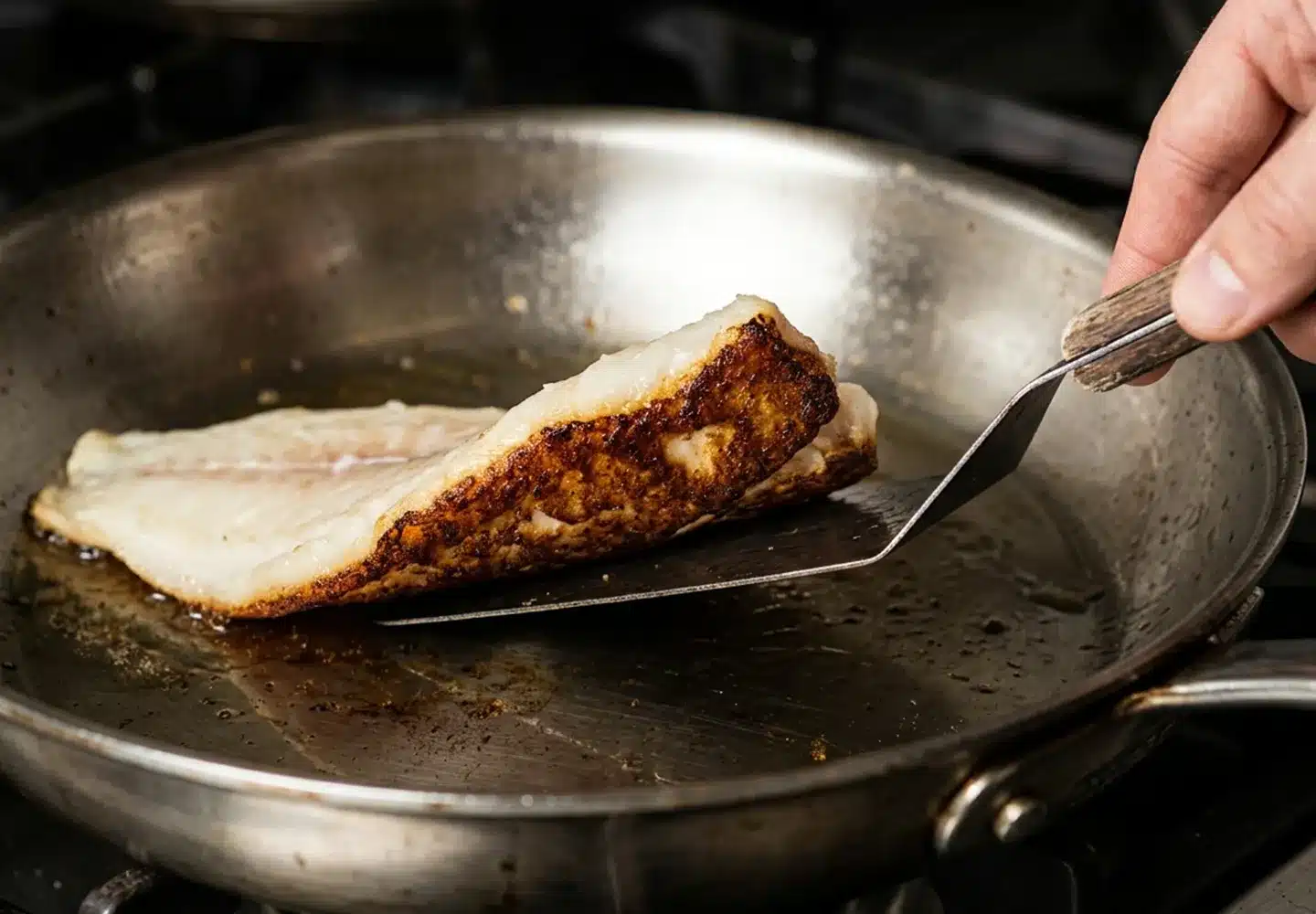
This is why every good instruction about fish is really an instruction about patience. Put it down. Do not touch it. When it is ready it will tell you, because it will lift without argument.
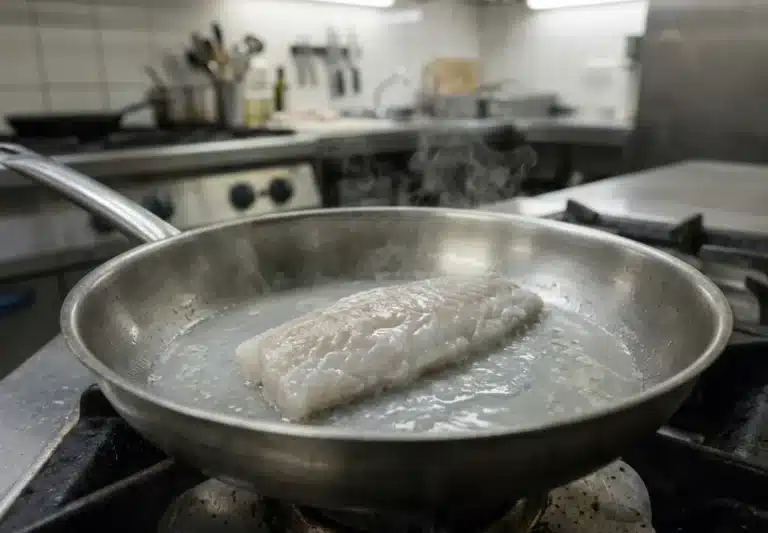
The test is a small one. Slide a thin fish spatula under one edge and lift gently. If it comes, the whole fillet will come. If it resists at all, you are still inside the phase, so put it back down and give it another thirty seconds. Prying is how people tear fish and then conclude they cannot cook fish.
The other half of this is moisture, and it is genuinely the more common cause of a bad sear. A wet surface cannot get past the boiling point of water no matter how hot your pan is. So it steams instead of browning, and the phase never ends. We laid that out properly in pat fish dry before cooking. That is the piece to read next if your fish is not browning at all. Heat is the other variable, and cooking fish temperature covers where to set it.
What the oil is actually doing
Most people think oil is lubrication, a slippery layer keeping two things apart. That is not the mechanism either.
Heat oil in a pan and it runs into all those microscopic valleys. There it reacts with the metal atoms themselves and forms a coating the Royal Society of Chemistry calls a patina. The point is not slipperiness. The point is that there are now very few free metal atoms left for your fish to bond with. The oil got there first and took the seats.
Two things follow. Both are practical.
Heat the pan before the oil, not with it. Cold oil in a cold pan sits on the surface. Hot oil in a hot pan does the reaction that occupies the metal.
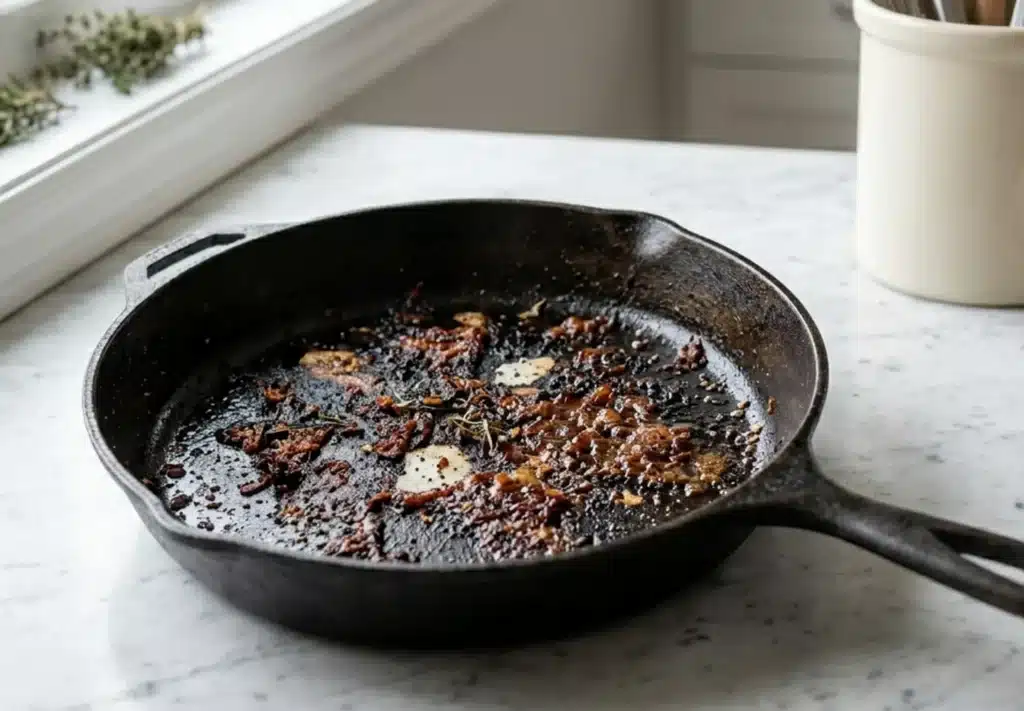
Detergent strips the patina, which is why it has to be rebuilt. This is what people mean by seasoning a pan. It is why cast iron gets better with age while a scrubbed stainless pan starts every session from zero. Nothing mystical about it. You are rebuilding a chemical coating that soap dissolved.
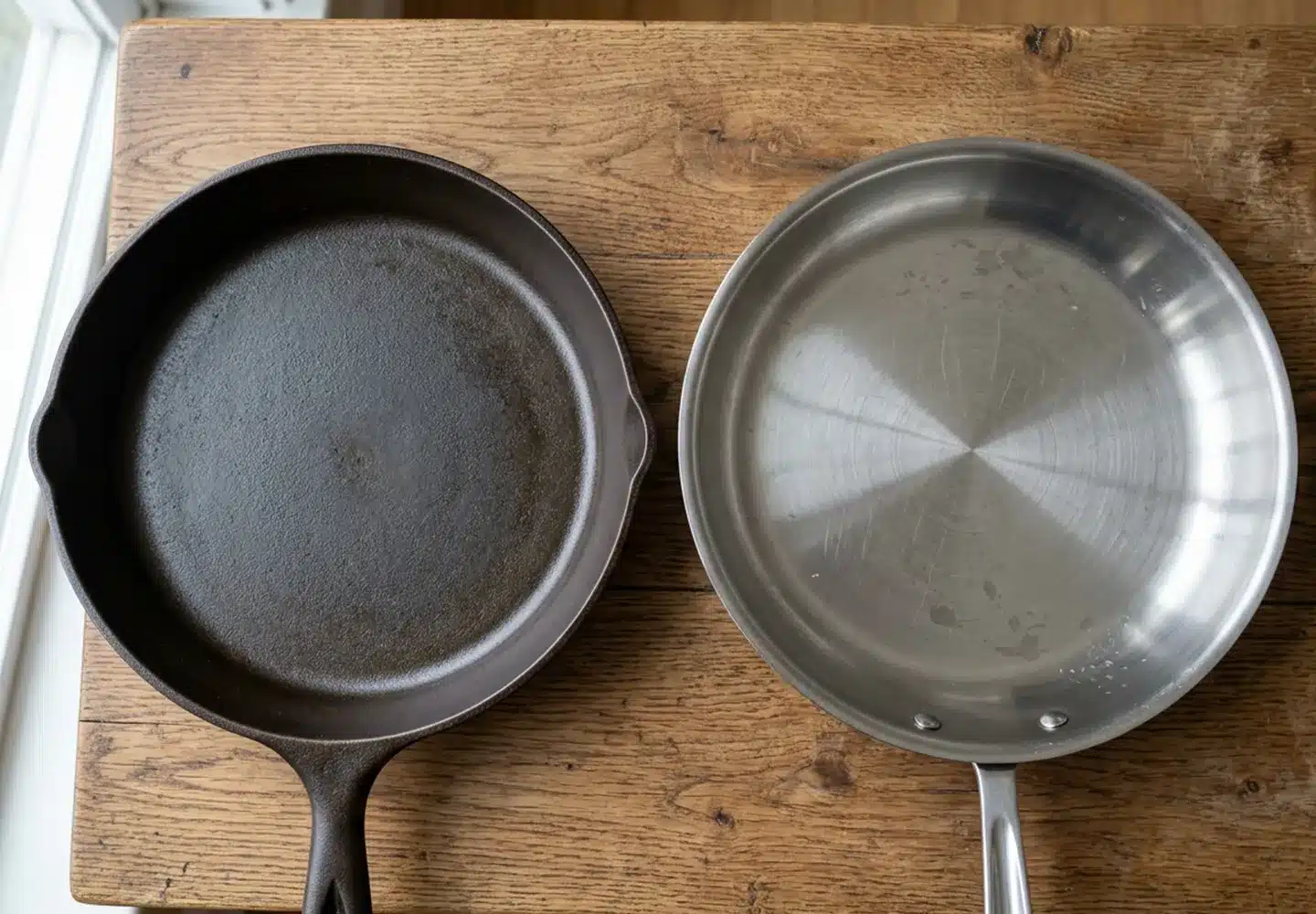
Non-stick works on the same principle by a different route. PTFE holds only strong carbon to carbon and carbon to fluorine bonds. Those would have to break before anything in your food could bond to it. Which raises the obvious question of how the coating stays on the pan. The answer is that it is not chemical at all. Manufacturers roughen the metal deliberately, the liquid coating seeps into the valleys, and when it sets it is locked in place. The roughness that causes your sticking problem is the roughness that solves it.
Three approaches, one idea. Occupy the metal, or give it nothing to hold.
When it is the fish and not the pan
Sometimes you do everything right and still get a wet, pale, gripping fillet. At that point look upstream.
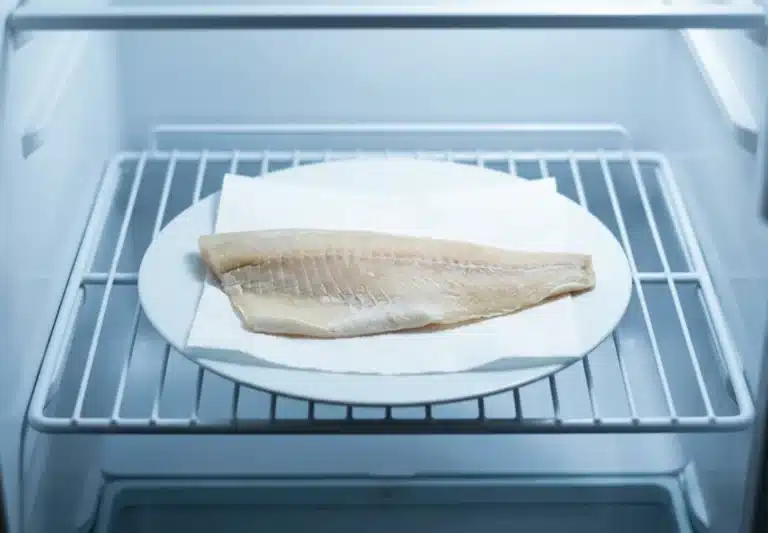
Fish muscle holds a lot of water, and it holds it inside a protein structure rather than loosely. Damage that structure and the water comes out. Slow freezing, thawing badly, or simple age all reduce how much water the flesh can keep hold of. What it cannot keep ends up on the surface, exactly where you do not want it.
This is a freezing and handling question rather than a cooking one, and it has its own answers. Frozen fish quality covers what freezing does to the flesh. How to thaw frozen fish covers the part most people get wrong.
Two smaller things worth knowing. Skin changes the calculation. Skin-side down gives you a layer between protein and metal that is meant to take the abuse, which is the subject of skin-on vs skinless fish. And a crowded pan fails for a different reason than a cold one. Every fillet gives off steam, and enough steam in one place keeps the whole pan below the temperature where the phase can end.
Why fish sticks to the pan, in one line
So the answer to why fish sticks to the pan is that its proteins bond to metal, and it releases because those same proteins find something better to bond with. Your job is to keep the surface dry, get the metal occupied, and then leave the fish alone long enough for the chemistry to finish. Everything else is detail.
If you want to put this to work tonight, how to cook haddock three ways walks through it on the fish most likely to test you, and our Nova Scotia Haddock is cold-water fish with all the delicacy that implies. The rest of the market is stocked the same way.