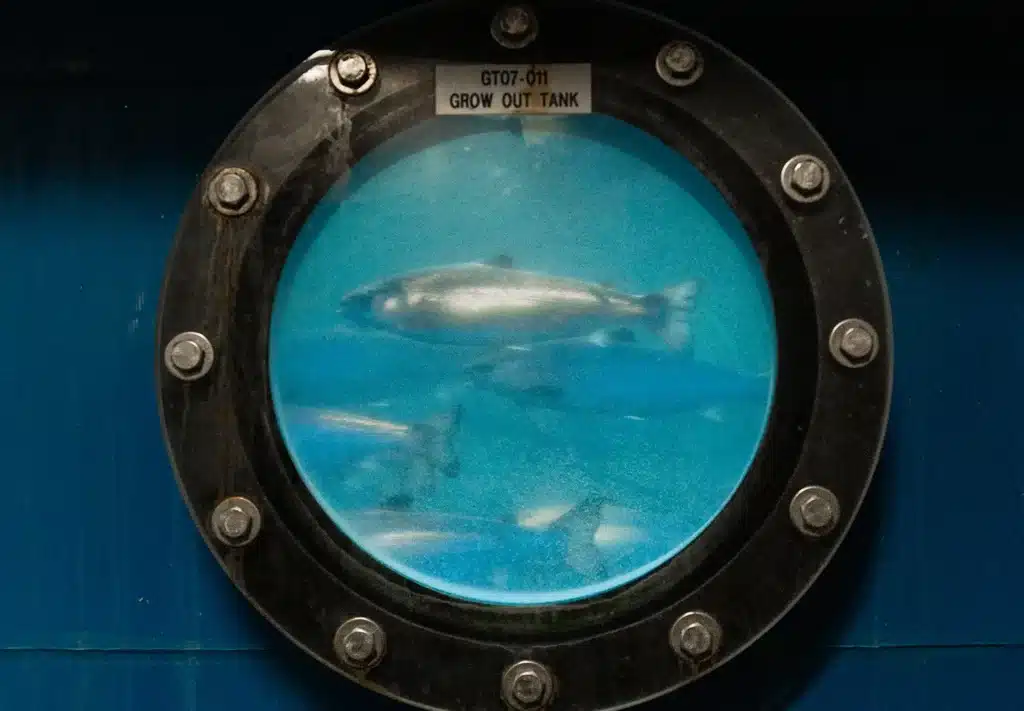
In a building set back from the Bay of Fundy in Centre Burlington, Nova Scotia, Atlantic salmon are swimming in saltwater tanks. They’ve never seen the ocean. They never will.
This is land-based aquaculture, a quietly radical approach to salmon farming that’s trying to solve problems the conventional industry has spent decades avoiding. The facility is operated by Sustainable Blue, a company that has spent close to twenty years engineering a way to raise Atlantic salmon without putting them in the ocean, without discharging waste into the surrounding environment, and without using antibiotics or hormones. The salmon are fed sustainably sourced marine protein, grown to harvest weight in about two years, and processed on site.
It sounds simple. It isn’t. Almost no one else in the world has built a fully closed-loop system at commercial scale. The reason has less to do with technology and more to do with what land-based aquaculture asks of the people who try it.
The problem with conventional salmon farming
For decades, salmon farming has meant open-net pen aquaculture. Atlantic salmon raised in mesh enclosures suspended in coastal waters, fed through automated systems, harvested at scale, sold to the global market. It’s efficient. It’s cheap. But it’s also the source of nearly every serious environmental concern about farmed salmon.
The environmental costs
These costs are well-documented. Sea lice infestations transfer to wild salmon populations passing nearby. Antibiotic and pesticide use leaches into surrounding waters. Fish escape during storms and equipment failures, interbreeding with wild stocks and diluting their genetic resilience. Effluent flows directly into the ocean, creating anoxic dead zones beneath cages. Mass die-offs from disease and rising water temperatures have killed hundreds of millions of farmed salmon worldwide in the past decade.
Industry response has been slow and incremental. Better feed conversion ratios. Slightly cleaner sites. New treatments for sea lice. None of it addresses the underlying issue: open-net pen aquaculture concentrates intensive animal agriculture in marine environments that weren’t designed to absorb it.
Off the Table Canada, a campaign of chefs, restaurants, and food businesses that includes Afishionado, has been making this case publicly. Their argument is straightforward: open-net pen salmon farming is fundamentally incompatible with healthy oceans, and the way out isn’t reform. It’s a different model entirely.
What land-based aquaculture actually is
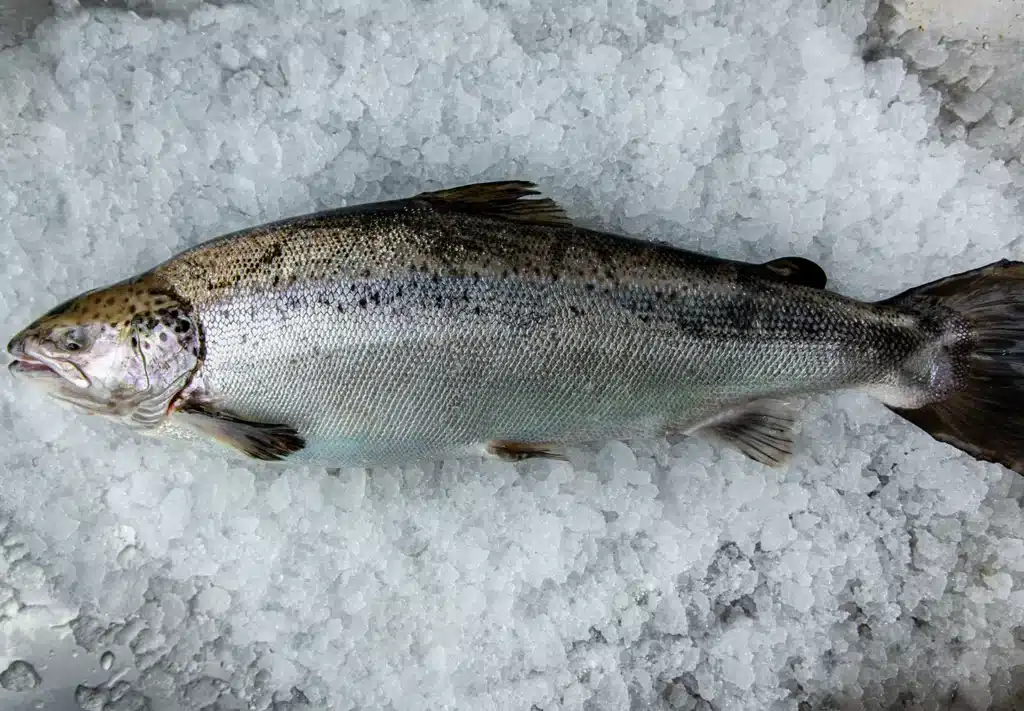
Land-based aquaculture refers to closed-loop or recirculating aquaculture systems (RAS) that raise fish entirely on land, in tanks, with no ocean contact.
The technical requirements are demanding. Operators must maintain stable water temperature, oxygen levels, and salinity. Waste needs to be filtered continuously. Diseases and parasites must be kept out, which is harder than it sounds when you’re moving thousands of fish through a closed environment. Salmon’s biological transition from freshwater to saltwater has to be managed to mirror their wild life cycle. And all of this has to happen at a scale that makes the economics work.
Most land-based salmon operations recycle some water but still discharge a portion. A truly closed-loop facility recirculates 100 percent and converts the solid waste into something useful, typically energy through a biodigester. Sustainable Blue’s facility runs on that model.
The benefits are direct and measurable. No fish escapes, because there’s nowhere to escape to. No interbreeding with wild populations. No disease transmission to wild fish, and minimal disease pressure on the farmed fish themselves because they’re never exposed to wild pathogens. No antibiotics needed. No discharge of waste, chemicals, or excess nutrients into the ocean. No coastal habitat disruption.
The honest trade-off: energy
Recirculating systems require continuous filtration and water treatment, which requires electricity. Critics of land-based aquaculture, including the Northwest Aquaculture Alliance, point out that current RAS facilities can produce roughly double the greenhouse gas emissions of ocean-based farming, particularly in regions where electricity is still partly coal-fired. It’s a real concern and worth acknowledging directly.
What Sustainable Blue and similar operations argue is that the comparison isn’t apples to apples. Open-net pen farming’s environmental impacts are externalized to the ocean. Land-based aquaculture’s environmental impacts are internal to the facility, measurable, and improvable as energy grids get cleaner. One model spreads its costs across a public resource. The other absorbs them and pays for them directly.
That’s the philosophical case. Whether it justifies the price premium is the question every land-based producer has to answer.
The Sustainable Blue case study
Sustainable Blue’s story starts in the UK in the 1990s. Dr. Jeremy Lee, an engineer, had been developing water treatment systems for public aquariums while watching the open-net pen industry expand rapidly in British and Norwegian waters. He understood the environmental impacts these farms were generating, and he had been working on a closed-loop alternative for years.
CEO Kirk Havercroft joined the project as a young accountant in 1994, just out of university and looking for work to pay off his student loans. He’s been with the company for over three decades since, eventually relocating from the UK to Nova Scotia to lead operations. In a 2025 conversation published in Afishionado’s community section, Havercroft described being immediately captivated by what Lee was trying to build. “I was just applying for an ordinary job,” he said, “and I was just, you know, instantly captivated by such a compelling story.”
The project moved to Nova Scotia in 2007. The first pilot plant opened in Centre Burlington in 2010, focused initially on niche European species. By 2013, they had switched focus to Atlantic salmon. The freshwater hatchery came next, then a second-generation saltwater grow-out pilot, then an expanded production facility. In 2021, they completed an additional saltwater facility that brought their capacity to 1,000 metric tonnes per year.
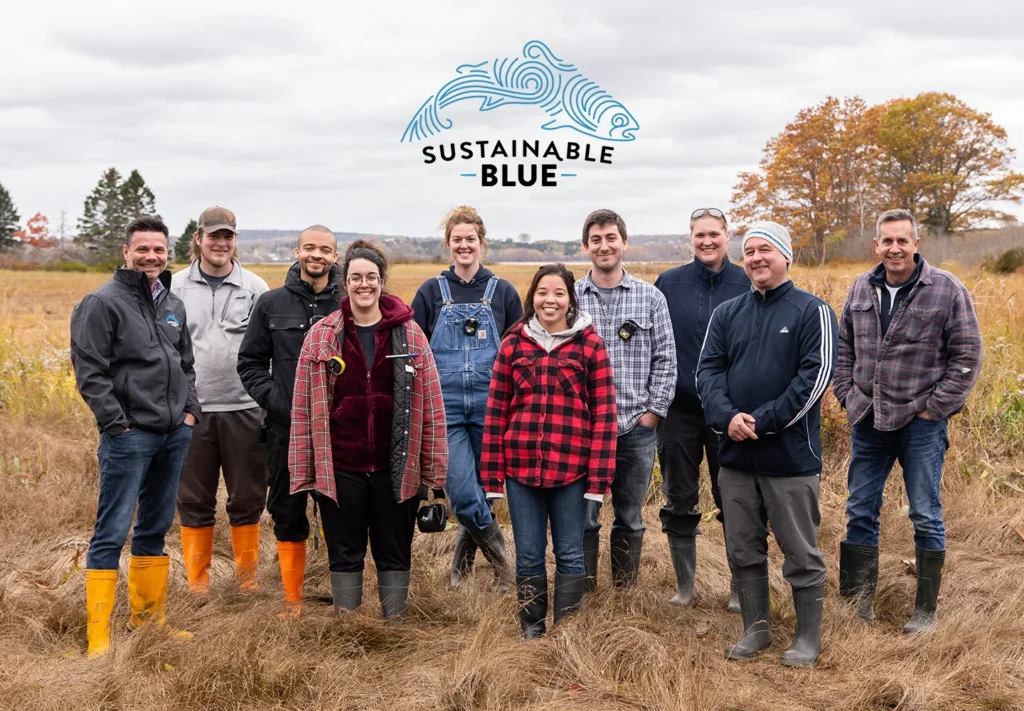
The development has not been linear or easy. Land-based aquaculture at this scale is genuinely difficult, and Sustainable Blue has faced significant operational and financial challenges, including a major equipment failure in late 2023 that resulted in the loss of a substantial portion of their harvest. They’re currently working through a restructuring process aimed at scaling production and reaching profitability.
This is worth saying out loud, because honesty about how hard this is matters. Land-based aquaculture isn’t a finished solution. It’s a category of innovation that requires capital, time, and patience to mature. The producers doing it well are figuring out a model that doesn’t have many precedents. Some will succeed. Some won’t. The technology will keep improving.
What Sustainable Blue has proven, even through their challenges, is that the closed-loop model works. Atlantic salmon can be raised at commercial scale, on land, with no discharge to the ocean, no antibiotics, and no risk to wild populations. The salmon they produce is high quality and tested against the standards of buyers, certifiers, and chefs across North America.
For a closer look at the technical specifics of what Sustainable Blue produces, including their published operating standards and current facility capabilities, their public technical breakdown is the primary source.
Land-based aquaculture: What this means for the future of seafood
Land-based aquaculture is not going to replace ocean farming overnight. The economics are still finding their level. The technology is still maturing. Some regions are politically committed to ocean farming and will defend the existing model for as long as possible. The transition will be slow.
But the direction is clear. As consumer awareness grows, as environmental costs of ocean farming become more visible, and as land-based technology continues to improve, the model is going to keep gaining ground. Producers like Sustainable Blue are doing the early work of figuring out what good looks like.
Why this matters across the supply chain
The seafood industry has a path forward that doesn’t depend on the ocean absorbing more intensive farming. Consumers get an option that aligns with values most people already hold: clean food, responsible production, no hidden externalities. Restaurants and retailers can stock Atlantic salmon they can defend at the menu level.
Afishionado came to this category because it gave us a way to sell Atlantic salmon without compromising on what we stand for. Our full case for why Sustainable Blue is the only Atlantic salmon we carry lays out the specific reasoning. The short version: when you look at what’s actually happening in ocean farming, and you compare it to what closed-loop systems are now demonstrably capable of, the choice gets simpler.
For more context on the broader conversation, our pillar guide on wild vs farmed salmon covers what’s actually available in the Canadian market, and our guide to aquaculture in Canada takes a deeper look at the industry as a whole.
Land-based aquaculture isn’t a perfect answer. Nothing in food production is. But it’s the best answer we’ve seen so far for raising Atlantic salmon at scale without paying the costs to the ocean. Until something better comes along, it’s the answer we’re going with.
If you want to see what good salmon raised this way actually looks like, our shop is where to find it.