Wild vs farmed salmon is one of the most common questions at the fish counter, and one of the most badly answered. The shorthand most people use is that wild is better, farmed is worse. The reality is more complicated.
Wild salmon can be excellent or destructive depending on how it’s harvested, where it comes from, and what populations are doing. Farmed salmon can be destructive or excellent depending on how it’s raised, what method is used, and what the producer’s standards actually are. Both categories contain great seafood. Both contain bad seafood. The label tells you almost nothing on its own.
This article explains what wild and farmed actually mean in the Canadian context, what each can and can’t promise, and how to read the labels you’ll see when you shop.
Why the wild vs farmed salmon conversation is confusing
Three things have muddied this conversation over the last twenty years.
First, the labels themselves are inconsistent. “Wild Pacific salmon” tells you one thing. “Atlantic salmon” tells you something else (it’s almost always farmed). “Sustainably sourced” tells you nothing, because no one polices the word. “Ocean Wise recommended” is meaningful but rare on store shelves.
Second, farming methods vary dramatically. Open-net pen aquaculture is the dominant global model and the source of most environmental concerns about farmed salmon. Land-based closed-loop aquaculture is a very different system with very different environmental impacts. Calling both “farmed” obscures more than it reveals. Our piece on the case for land-based aquaculture covers the distinction in depth.
Third, the assumption that wild is automatically better doesn’t hold up. Many wild salmon fisheries are sustainably managed and produce excellent fish. Others operate in stressed ecosystems with declining populations. Wild Atlantic salmon in Canada, for example, has been so depleted that commercial fishing has been banned for over thirty years.
The honest version of the wild vs farmed salmon conversation isn’t a hierarchy. It’s a set of questions about specific producers, methods, and standards.
What “wild salmon” actually means in Canada
Wild salmon are fish that grow in their natural habitats, in rivers and oceans, without being raised in aquaculture systems. In the Canadian market, “wild salmon” almost always means Pacific salmon: sockeye, chinook, coho, pink, or chum.
Wild Atlantic salmon is a different story. Canada’s commercial wild Atlantic salmon fishery has been closed since the 1990s due to severe population decline. What remains is recreational and Indigenous food fishery, with strict limits to protect the few populations still surviving.
In 2024, the federal government published its National Strategy to Ensure the Future of Atlantic Salmon, a twelve-year plan focused on restoration. Recovery is slow. For now, every “Atlantic salmon” you see at a Canadian fish counter is farmed.
What wild salmon offers:
A natural diet that produces leaner flesh and firmer texture. Distinct flavour profiles that vary by species and run. Cultural and ecological significance, particularly for Indigenous and coastal communities. Generally fewer human inputs (no feed manufacturing, no antibiotics, no aquaculture infrastructure).
Where wild salmon falls short:
Population pressure varies wildly by species and region. Climate change is shifting migration patterns and reducing survival rates. Habitat loss continues to compound historic overfishing. Wild salmon is seasonal, which means availability and price fluctuate. Some “wild” labels obscure the actual fishery and its management quality.
What “farmed salmon” actually means in Canada
Farmed salmon (aquaculture) refers to fish raised in controlled systems rather than caught from wild populations. In Canada, the two dominant methods are open-net pen aquaculture and land-based closed-loop aquaculture. They’re both farming. They’re not the same.
Open-net pen aquaculture raises salmon in mesh enclosures suspended in coastal waters. It’s the most common method globally and the source of nearly every well-documented environmental concern about farmed salmon: disease transfer to wild populations, sea lice infestations, fish escapes, effluent discharge, antibiotic and pesticide use. In June 2024, the Government of Canada announced that this method will be banned in British Columbia coastal waters by June 30, 2029. The ban applies only to BC. Atlantic Canada continues to permit open-net pen farming for now.
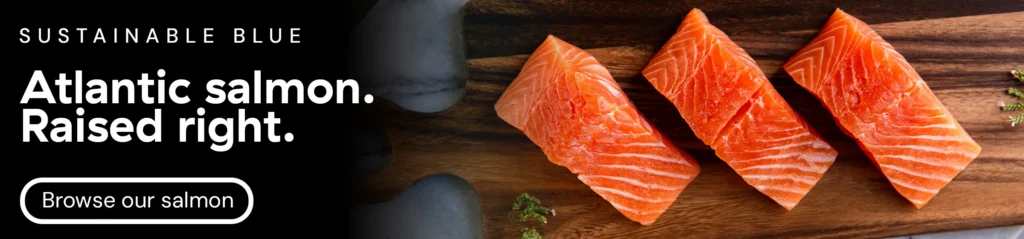
Land-based closed-loop aquaculture raises salmon entirely on land, in recirculating tanks, with no ocean contact. No fish escapes. No effluent discharge. No need for routine antibiotics. The trade-off is higher energy use. This is the model used by Sustainable Blue, the producer Afishionado partners with for all of our Atlantic salmon. For the full case for why we chose this category, see our piece on land-based salmon farming: why we only carry Sustainable Blue.
What farmed salmon offers:
Year-round availability at consistent quality and predictable pricing. High production efficiency without drawing from wild populations. In the case of land-based systems, dramatically reduced environmental impact and no antibiotic use.
Where farmed salmon falls short:
Open-net pen farming carries real environmental costs that fall on coastal ecosystems and wild populations. Even responsible aquaculture requires feed inputs, and feed sustainability varies. Land-based systems use significant energy. Quality and standards vary considerably between producers, which is why sourcing transparency matters more than the category label.
Wild vs farmed salmon: nutrition and flavour
The nutritional and culinary differences are real, but smaller than most people assume.
Nutrition. Farmed salmon typically has higher fat content and therefore higher omega-3 fatty acids (EPA and DHA) per 100 grams than most wild Pacific species. This is because farmed salmon eats a more energy-dense diet by design. Higher fat also means slightly more calories. Wild salmon is leaner with fewer calories and less omega-3 per serving, but excellent nutritional density overall. Both meet Canadian food safety standards. Both are excellent sources of protein, vitamin D, and key minerals. For the full nutritional comparison, see our piece on salmon health benefits.
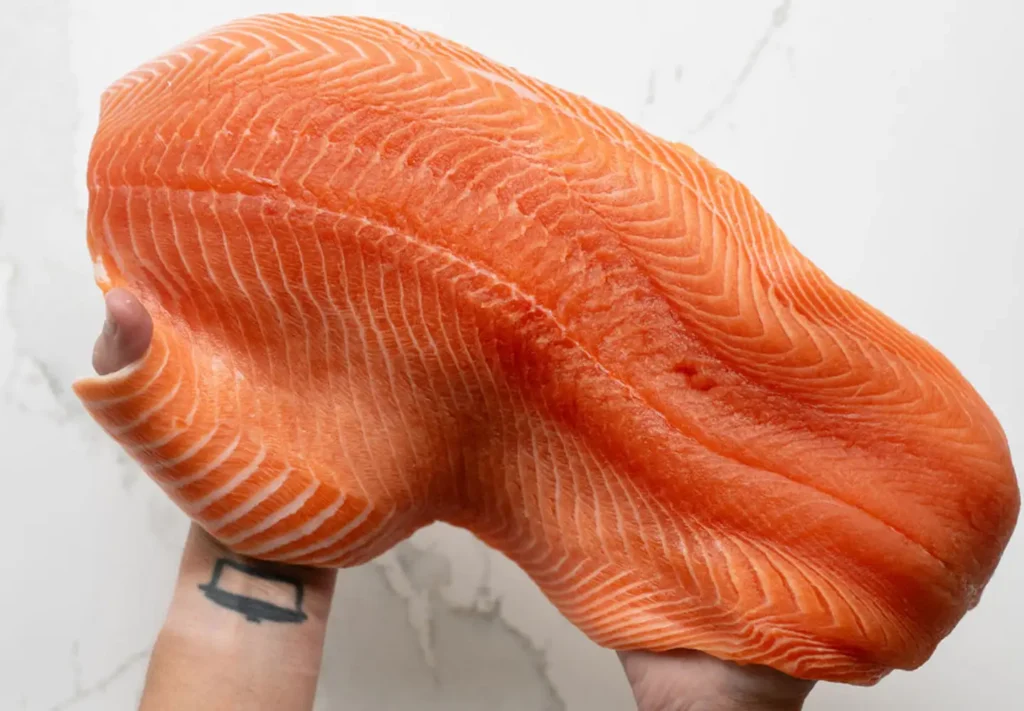
Flavour and texture. Wild salmon has firmer, leaner flesh and a more pronounced flavour, often described as stronger or “fishier” in the best sense. The colour is typically deep red to orange because wild salmon eats crustaceans rich in astaxanthin, a natural pigment.
Farmed salmon has softer, fattier flesh and a milder flavour. Many people prefer this profile for everyday cooking because it’s more forgiving and pairs well with a wide range of preparations. Farmed salmon gets its colour from carotenoids added to feed, which mimic the natural pigments wild salmon would consume.
Neither flavour profile is universally better. They’re different products with different best uses.
How to read salmon labels in Canada
A well-labelled salmon product tells you several things. Many products don’t tell you enough.
What should appear on the label:
The common name of the fish. Wild Pacific salmon should specify the species (sockeye, coho, chinook, pink, chum). Farmed Atlantic salmon should say “Atlantic salmon” or “farmed Atlantic salmon.”
Country or region of origin. Imported salmon must be labelled with country of origin. Domestic salmon may include province or region.
“Previously frozen” if the fish has been thawed for sale. This is required when applicable.
Method of harvest or farming when listed. Some producers voluntarily include detail (e.g., “land-based aquaculture” or “MSC certified wild fishery”).
Certifications to look for:
Marine Stewardship Council (MSC) certification for wild capture fisheries that meet sustainability standards.
ASC (Aquaculture Stewardship Council) certification for farmed products that meet environmental and social standards.
Ocean Wise Recommended designation for products that meet Ocean Wise’s sustainability assessment criteria.
For the full breakdown of what each certification actually means, see our guide on MSC, ASC, and Ocean Wise seafood certifications.
Questions to ask at the fish counter:
Is this wild or farmed? What species? Where was it harvested or raised? What farming method, if farmed? Is it fresh or previously frozen? Does it carry any certifications?
A good fishmonger will know the answers. If they don’t, that tells you something.
Where Afishionado lands on wild vs farmed salmon
We don’t carry wild salmon. We carry one type of farmed Atlantic salmon, from one producer, raised in a closed-loop land-based system. That’s a deliberate choice, and it’s worth explaining.
We carry Sustainable Blue Atlantic salmon because it meets a standard we apply to every product we sell: no ocean discharge, no antibiotics, no fish escapes, no risk to wild populations, full traceability. Most farmed salmon doesn’t meet that standard. Most wild salmon we could carry would have to be shipped from the West Coast, which complicates the supply chain story we built the business around. For our full reasoning, see our piece on sustainable salmon in Canada and why we only carry one type.
This doesn’t mean wild salmon is wrong. It means we made a sourcing decision that emphasized a specific set of values, and we’d rather stand by that decision than carry options we couldn’t defend.
When you buy salmon from us, you’re buying one product, with one origin story, with full traceability. If that’s not what you want, there are excellent wild salmon producers operating elsewhere, and we’d encourage you to seek them out. If it is what you want, our Sustainable Blue salmon is ready to ship in 12 portion packs or 24 portion packs, depending on how much salmon your household goes through.
So what should you actually buy?
The choice depends on what you value most. The framework looks like this:
If flavour and tradition matter most to you, wild Pacific salmon during peak season is a remarkable product. Sockeye for grilling and smoking. Chinook for richness. Look for MSC certification and a specific fishery name on the label.
If consistency, availability, and minimized environmental impact matter most, properly raised farmed Atlantic salmon from a closed-loop land-based system delivers reliable quality year-round. Our Sustainable Blue product line is what we recommend.
If price is the dominant factor, conventional farmed Atlantic from open-net pens is the cheapest option, but it comes with environmental costs we don’t believe in. We don’t carry it, and we’d encourage you to consider alternatives.
For the comprehensive view across the full salmon landscape, see our ultimate guide to salmon for everything from species comparison to cooking technique.
Final thoughts on wild vs farmed salmon
The wild vs farmed salmon conversation is less about the categories themselves and more about the specific producers behind them. A well-managed wild fishery and a responsibly operated land-based farm both produce excellent salmon. A poorly managed wild fishery and an industrial open-net pen operation both produce salmon that comes with real costs.
What matters is asking the right questions and choosing producers whose practices you can defend. The label is a starting point, not an answer.
Browse our shop to see the salmon we’ve decided we can stand behind, along with the rest of our seafood selection. Or explore our recipe collection for tested ways to cook whatever salmon you bring home.